LNMO

Low Noise Master Oscillator Qualification

STATUS | Completed
STATUS DATE | 19/12/2023
ACTIVITY CODE | 5C.281
LNMO

Objectives

The objective of these projected 24 months activities is to industrialize, manufacture and qualify the compact, lightweight, low-cost and Low Noise Master Oscillators (LNMO), which has been developed in the frame of an ARTES 5.1 project, contract N°4200023116, by testing 16 Engineering Qualification Models (EQM) at 5MHz, 10MHz, 20MHz and 40MHz. To cover the whole frequency range only one crystal holder has been used (HC37), instead of 3 initially planned (HC40, HC37 and HC35). 
These equipments shall be free of ITAR license control for use in worldwide space programs.

Challenges

The key issues addressed in LNMO project are:

  • Reach phase noise requirements from 1Hz to 100kHz over the whole frequency range (5MHz to 40MHz)

  • Find solutions using ITAR free parts. 

  • Validate several crystal suppliers with at least one European.

  • Cost reduction to gain market share

System Architecture

LNMO current design

Size: 50x50x30mm

Weight: 100 – 110 grams (depends on pin configuration)

LNMO system architecture

In the gray area of the block diagram are all the thermal sensitive functions which shall be implanted on the heated board.

Thermo-mechanical structure

The oven will be done by:

  • a small oven used to heat and fix the crystal resonator

  • a ground plane used to heat the PCB and the sensitive parts

  • machining a few slots on the PCB for thermal insulation

LNMO system architecture

Plan

 The plan is divided in two phases:

Phase 1: Requirements review and design 

  • Task 1: Requirements, Technology and Design Modifications Review. Validation of LLI parts list.

PDR

  • Task 2: Detailed LNMO current design improvement:

    • 5 MHz and 20MHz (SC overtone 3), 40MHz (SC overtone 5) crystals specifications in HC37 holder

    • Adding option of a second supply voltage.

      • Vs for signal generation supply

      • Vp for oven supply

  • Task 3: BBM manufacturing at 20MHz and 40MHz

  • Task 4: LLI purchasing and Crystals pre-irradiation

  • Task 5: Update MATV plan including crystal pre-irradiation process

  • Task 6: Establishment of the preliminary qualification test plan

CDR

Phase 2: Qualification

  • Phase 2 A: EQM Manufacture, Assembly, Tuning

    • Task 7: EQM manufacturing

    • Task 8: Finalization and validation of qualification test plan and test procedures

TRR


  • Phase 2 B: Qualification tests 

    • Task 9: Environmental tests (vibration, thermal and mechanical shocks)

    • Task 10: Irradiation tests 

    • Task 11: Thermal vacuum cycle

    • Task 12: EMC tests

    • Task 13: life test

    • Task 14: Overall Assessment and Recommendations

FR

Current Status

Project completed.

Fully software-defined hub from Kratos set to transform satcom ground systems

Publication date

10 Jul 2023

Technology company Kratos, supported by ESA’s ARTES Core Competitiveness programme – Advanced Technology, has developed the first ever wideband fully software-defined hub, signalling a significant step forward in satcom ground systems. It offers major advantages over traditional hardware-based hubs by supporting more cost-effective, scalable and flexible operations, and provides a foundation for new services and business models.

The long-term objective in satellite communications is to be able to deliver connectivity to society, whenever and wherever it is needed. Today, software-defined payloads and multi-orbit constellations are advancing that goal and enabling the ground segment to keep pace, as it begins to embrace virtualisation and software-defined networking approaches to support an increasingly dynamic space network. 

The work performed by Kratos’ team in Norway represents a key milestone in this journey, with the development of a software hub, compliant to DVB-S2/S2x and DVB-RCS2 standards, that can scale to support the handling of 5GHz of RF bandwidth using cloud technology and general processing hardware. The project team was able to replicate traditional hub hardware functions with virtual software equivalents that run on generic x86 computing platforms. This has the benefit of avoiding static hardware footprint such as Field Programmable Gate Arrays (FPGAs), Graphics Processing Units (GPUs) or Application-Specific Integrated Circuits (ASICs) and allows for dynamic allocation of computational resources based on the evolving users’ traffic demand.

The successful project was presented in June 2023 at ESA’s Space2Connect event in Matera, Italy, which showcased emerging space-based solutions to empower connectivity for society.

Petter Amundsen, General Manager at Kratos Norway, explained, “Our collaboration with ESA has been important for the development of a fully software-implemented hub. This technology is critical to unlocking the promise of today’s space innovations and delivering the always-on connectivity that customers want.”

Javier De Pablos, Technical Officer at ESA, said, “This development represents the first ever hardware agnostic hub that supports DVB-S2x and DVB-RCS2 standards and is capable of handling bandwidth as required for Ka-band and above. We are delighted to see the successful completion of this key cornerstone to driving increasing innovation in the ground segment. We look forward to seeing the fully virtualised, cloud-compatible hub consolidating commercially as part of satcom ground systems in the years to come.”

The project provides the blueprint for the way in which a software-defined satellite gateway operates, with digital distribution of RF signals, cloud-compatible signal processing, core hub functionality and end-to-end IP traffic in a digital IF ecosystem. The functions of the virtual hub are fully disaggregated and more resilient, scalable and adaptive to changing conditions than their physical predecessor. The DVB-S2/S2x software, implemented with efficient algorithms, also ensures the modulator/demodulator modules, which code/decode the transmitted information, are cost-effective compared to traditional FPGA-based solutions. 

The new technology employs a modern, widely used framework to outperform the functions of a traditional hub, simplifying and automating operations, and laying the foundation for satellite to become part of mainstream 5G service delivery. The technology innovations have served to support the development of Kratos’ OpenSpace Platform now being used across the industry.

ESA NGSO-Sense

- Prototype for measuring NGSO satellite network interference and radiofrequency characteristics

STATUS | Ongoing
STATUS DATE | 26/06/2023
ACTIVITY CODE | 6A.072
ESA NGSO-Sense

Objectives

The objective of ESA NGSO-Sense projects is to develop a ground terminal prototype, as well as the measurement procedure, for detecting and identifying interference; and measuring Radio Frequency (RF) characteristics from a NGSO satellite network.

Challenges

A number of private ventures envision a global network comprising a large number of NGSO satellites with the aim of providing ubiquitous broadband connectivity. The number of satellites being launched into space is dramatically increasing, which has raised some serious concerns among GSO satellite operators because such NGSO constellations will operate at the same frequencies that are currently used by GSO satellites (Ka and Ku bands).

International regulators have the difficult task to establish a fair and transparent competitive framework for all satellite broadband players while prioritising the socioeconomic growth. On the other hand, we have the satellite operators. First, the GSO operators, which see a threat in these NewSpace constellation due to the increase amount of interference that they will cause. Second, the NGSO operators, which need to understand when and for how much they may be inflicting the radio regulations and if they are being interfered by other NGSO systems.

System Architecture

See above.

Plan

NGSO-Sense project kicked-off in December 2022 and it will run for 2 years. The project is divided into 6 technical work-packages (WP):

WP1: SOTA review and Technical Specifications

WP2: Technical Baseline

WP3: Detailed Design

WP4: Implementation and Verification Plan

WP5: Development and Evaluation

WP6: Technology Assessment and Development Plan

Current Status

The project is on-going.

ALISA

-

STATUS | Completed
STATUS DATE | 08/02/2023
ACTIVITY CODE |

Objectives

The objective of the activity was to design, develop and test an air interface enabling the reduction of the RF transmit power of remote Internet of Things (IoT) terminals connected directly to satellites. The targeted improvement was to reduce by an order of magnitude the RF transmit power density at the remote terminal.

Challenges

The main challenges in this activity were to design and implement an IoT satellite gateway receiver that:

  • can detect and demodulate IoT bursts at extremely low signal-to-noise ratios (Ec/No < -40 dB)

  • can detect and demodulate IoT bursts that are transmitted without any timing coordination

  • can detect and demodulate multiple IoT bursts in parallel, where the IoT bursts are (partially) overlapping in time and frequency. 

System Architecture

The architecture of the demonstrator developed in this project is shown in the block diagram below.


Plan

  • The project was kicked off in January 2020.

  • The System Requirement Review (SRR) was held in July 2020.

  • The Preliminary Design Review (PDR) was held in March 2021. 

  • The Critical Design Review (CDR) was held in June 2021. 

  • The Test Readiness Review (TRR) was held in June 2022.

  • The project was completed, and the Final Review was held in January 2023.

Current Status

The project is completed.

Wideband Software Defined Hub (WSH)

- Wideband Software Defined Hub

STATUS | Completed
STATUS DATE | 16/11/2022
ACTIVITY CODE | 6B.056

Objectives

This project demonstrates the feasibility of a software hub implementation scalable to support handling of 5 GHz RF bandwidth based on cloud technology and general processing hardware. The DVB-S2/S2X/DVB-RCS2 modulation and demodulation is performed by processing of digitized I&Q samples on general x86 CPU hardware supporting AVX 512. The hub and test bed developed under the project demonstrates a symmetric duplex 250 MHz RF bandwidth in each direction, compatible deployment in the cloud. The forward link carrier is a single 250 MHz DVB-S2X, while the return link capacity of 250 MHz is divided across DVB-RCS2 TDMA channels and DVB-S2/S2X SCPC channels.

Challenges

The key challenges in this project are:

  • Demonstration of modulation and demodulation executed on general x86 for DVB-S2/S2X 

  • Implementation of the hub with scalable cloud technology capable of supporting 5 GHz RF bandwidth

System Architecture

The System architecture is shown in the Figure. The VSAT hub and terminal functions are implemented as VNFs (Virtual Network Functions) in cloud compatible modules. The architecture applies microservices and containers, scalable to support a large RF segment (5 GHz).

The RF output is generated by a digitizer while the software modulator provides the digital RF output as a baseband I&Q stream. The receiver chain has a digitizer that digitizes the received RF stream as I&Q samples before the I&Q stream is passed to general processing hardware where the demodulation and decoding is performed in cloud compatible environment.

The implementation applies industry standards such as DVB-RCS2, DVB-S2X and Vita-49.2

Plan

March            2020: Kick-off
May               2020: System Requirements Review
August           2020: Critical Design Review
March            2022: Test Readiness Review
June              2022: Factory Acceptance Test Review
November     2022: Acceptance Review

Current Status

The project is completed.

Virtual Receiver (VR) platform

- Wideband DVB-S2x software demodulator running on CPU and/or GPU on consumer hardware platforms

STATUS | Completed
STATUS DATE | 11/10/2022
ACTIVITY CODE | 7B.058
Virtual Receiver (VR) platform

Objectives

The aim of the project is the implementation of a fully software defined DVB-S2X demodulator, running on general-purpose hardware, which could replace a dedicated hardware demodulator in some selected use cases. The technical challenges of parallel processing for demodulation and decoding algorithms in software will be elaborated. Based on existing implementations and partially new designs, the dedicated exploitation of hardware-specific elements is expected to achieve bandwidths of 36 MHz and beyond, matching the application-specific requirements.

Challenges

There are two main technical challenges connected to the design of a real-time software demodulator: 

  • In the first place, several algorithms traditionally oriented to hardware implementations have to be adapted to a software paradigm. This is particularly challenging due to the variable frame size used in the DVB-S2X physical layer. 

  • On a more implementation-oriented basis, the features offered by the hardware platform (e.g., SIMD instruction set extensions) shall be intensively exploited.

System Architecture

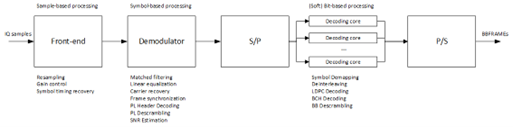
The architecture of the SWDM is implicitly dictated by the data types and rates which shall be processed at each step.
A combination of pipelining and parallelism is employed to leverage the constraints of the specific algorithmic blocks. This is facilitated by the underlying software platform, which is a modular single-process multi-threaded system, where the individual threads can have an affinity to a specific processor core as per the needs of the software.

A highly simplified overview of the receiver architecture is shown below.

Virtual Receiver (VR) platform system architecture

Plan

The project followed a familiar waterfall project process:

  • System Requirements Review, Q1 2022: Definition of applications and requirements, State-of-the-Art analysis, Creation of technical specification & Outline verification plan

  • Preliminary Design Review, Q3 2022: Select a Technical baseline selection & establish a Preliminary Design 

  • Critical Design Review, Q1 2023: Establish a Detailed Design, Integration Plan and Test Plan

  • Test Readiness Review, Q2 2024: Implementation of the deliverable Items and first test runs.

  • Final Acceptance Review, Q4 2024: Final Review and perform critical assessment of potential of developed items for commercial exploitation

Current Status

The activity has achieved the Final Acceptance Review (FAR).

The public final presentation is scheduled for the ARTES Final Presentation Days 2025.

AIDA

- Artificial-Intelligence-Assisted Performance and Anomaly Detection and Diagnostic

STATUS | Completed
STATUS DATE | 17/01/2022
ACTIVITY CODE | 5C.390
AIDA

Objectives

As of today, performances of antenna systems are evaluated analysing both measured and modelled data. If an anomaly occurs, an iterative process is made to determine the root cause. The goal of this project is to develop and validate AIDA (Artificial-Intelligence-Assisted Performance and Anomaly Detection and Diagnostic), a machine-learning-based software for the detection of RF anomalies and the identification of the associated root causes.

AIDA intends to contribute to the antenna experts analysis and to reduce the diagnosis time by implementing the following software capabilities:

  • Early identification of antenna system anomalies, using an AI approach to classify patterns data, implementing generalization strategies in order to foster re-use of a trained model for different antennas under test (AUTs).

  • Accurate anomaly quantification, thanks to a wide labelled database which is used for this purpose.

  • Verification of the anomaly classification and quantification output, comparing the measured patterns with the EM model data updated with the AIDA diagnostic output.

Challenges

The key challenges are the following:

  • Exploit artificial intelligence techniques (e.g. supervised machine learning) for diagnosing RF anomalies

  • Implement generalization techniques to foster re-use of the trained AI model for antennas having different dimensions or operating at different frequency bands with respect to the dataset used for the training

  • Use of real or simulated data with known output labels for training the AI model

  • Reduce the diagnosis time by a factor of 10/100 (i.e. from two weeks up to one day or less).

  • Develop a software framework for testing the AI model, and for execute comparison analyses between data.

System Architecture

AIDA is characterised by a typical three tier architecture composed by:

  • The AIDA database, which collects all the antennas patterns uploaded into the system (training and test data);

  • The AIDA Diagnostic SW, which executes the anomaly classification and quantification, and it contains the function usable for the computation of the reconstruction error; the AIDA Diagnostic SW functionalities can be accessed both from the command terminal and from the developed AIDA Front-end SW.

  • The AIDA Front-end SW, which is a web-based application from which all the features of the AIDA Diagnostic SW can be reached. Moreover, this software allows the user to investigate data from the database, plotting patterns and investigating diagnostic results.

The AIDA Training SW is an external module, which is responsible for the training of an AI algorithm, either imposing the training hyper-parameters, or using an hyper-parameter optimization; in the current version implemented, the AIDA Training SW functionalities can be accessed from the command terminal.

Plan

The project comprises the following working packages:

  • WP100: identify state-of-the-art AI methods suitable for the diagnostic system to be developed, defining a technical specification of the proposed solution, and demonstrating its feasibility.
  • WP200: prepare a preliminary training dataset for the selection of the candidate AI methodologies, and operate the trade-off analysis for the selection of the algorithm to be implemented.
  • WP300: prepare the final training dataset to be used for the training of the selected AI algorithm, implement the diagnostic strategy and implement the framework of the front-end software.
  • WP400: demonstrate the functionalities of the diagnostic solution, operating a test campaign.
  • WP500: summarise the results achieved during the project, identifying future developments points, and pointing out the most important lessons learnt. 

Current Status

The AIDA diagnostic solution has been tested with data of reflector and phased array antennas. Performances have been proved satisfying If the input is composed of antennas having the same operative conditions as the training dataset. If the operative conditions differ from the training dataset, the classification accuracy depends from the anomaly class considered. Possible improvement points have been addressed as particularly important to attain performance levels suitable for the market needs and future RF technologies.

KaTropical

- Measurement and assessment of second order statistics of Ka band SatCom systems in tropical regions

STATUS | Completed
STATUS DATE | 05/01/2022
ACTIVITY CODE | 3B.024

Objectives

The main objective of this activity was to improve the characterisation of the radio channel modelling and ground system requirements for the development of a Ka-band SatCom system covering tropical regions.

This includes the assessment of the accuracy of current prediction models with particular regard to statistical distribution of rain and cloud attenuation and the improvement of the statistical models for the parameters describing signal fade slope, signal fade duration and gain of site and time diversity techniques.

The results of this project were submitted to the ITU-R SG3.

Challenges

The setup and operation of ground propagation terminals in tropical regions together with ancillary equipment (disdrometer, … ) reveals a number of challenges. These include the logistics, data transfer, trouble shooting actions, provision of replacement parts and others more. Thanks to the great cooperation with the local Malaysian partners, Universiti Teknologi Malaysia (UTM) and University Tun Hussein Onn Malaysia (UTHM) all these challengegs could successful be met. The below figure shows the antenna of one of the Ka-band ground propagation terminals and the 2D-Video-Distrometer (2DVD).

katropical challenges


System Architecture

Malaysia’s climate can be classified as equatorial. Due to the geographical location, the climate in this region is characterized by uniform temperature and pressure, high humidity and abundant rainfall. The average annual amount of rain is 2340 mm.
The experimental locations for site diversity measurements are the premises of Universiti Teknologi Malaysia (UTM) (1.561° N, 103.645° E) and Universiti Tun Hussein Onn Malaysia (UTHM) (1.858° N, 103.089° E). The elevation angles of the receiving antennas are 25.49° and 26.15° respectively. The distance between the two sites is 70 km, as shown in below Figure.

katropical system architecture

In this region the propagation equipment was set up, including two ground propagation terminals, one disdrometer and a meteorological station measuring rainfall rate, air temperature, pressure, relative humidity, wind speed and wind direction.

Plan

The measurement campaign and the data analyses are successfully completed.

Current Status

The results of the measurement campaign and data analyses has already been submitted to the ITU-R SG3.

HIGH THROUGHPUT SATELLITE (HTS) GATEWAY Q/V – BAND FEED ANTENNA

STATUS | Completed
STATUS DATE | 03/01/2022
ACTIVITY CODE | 6B.040
HIGH THROUGHPUT SATELLITE (HTS) GATEWAY Q/V – BAND FEED ANTENNA

Objectives

The overall objective of the activity was the design of a Q/V-band gateway antenna that can be scaled in the range 7 to 13 meters for future feeder link gateways and which uses the same feed in all antenna configurations. The mechanical, electrical and RF designs should reach at least PDR level and the designed antenna should offer a high Q/V-band EIRP on the ground and a high efficiency in reception.

To optimally cover the aforementioned range of diameters, on the one hand HITEC´s existing high-performance 6.8m Ka-band design was upgraded and qualified for Q/V-band operation by incorporating a Q/V-band RF system and on the other hand the scalability has been demonstrated by the design of a new 11m Q/V-band antenna reusing the same RF system.

Challenges

The key challenges in this project were three-fold:

  • Reduction of the ohmic losses in interconnections between feed and amplifiers, which often scale with antenna size.
  • Optimization of the reflector shape and main reflector surface accuracy as well as tracking accuracy which play a particularly important role at such high frequencies.
  • Identification of a complete set of suitable COTS RF components to reduce risks on programmatic scheduling.

System Architecture

The Q/V-band gateway antennas designed for this activity contain the following main subsystems, with the components they comprise:

  • Radio-frequency (RF) subsystem
  • Motion control subsystem
  • HITEC local monitoring & control (M&C) subsystem
  • Electrical subsystem
  • Mechanical subsystem

The following figure illustrates the product breakdown structure including major components.

System architecture


Plan

The project plan for the activity foresaw the following main tasks:

  • Task 1: Component market study & refinement of the antenna specifications 
  • Task 2: Trade-off analysis and update of the performance budgets
  • Task 3: Design of a 6.8m Q/V-band limited motion antenna
  • Task 4: Design of an 11m Q/V-band limited motion antenna

Milestones:

  • KOM in April 2018
  • Trade-Off Analysis Review (TAR) in December 2019 (completion of tasks 1 and 2)
  • Mid Term Review (MTR) in May 2020 (completion of task 3)
  • Final Review (FR) and Final Presentation (FP) in October 2021 (completion of task 4 and the project)

Current Status

The project has been successfully completed. A reference model for the intended application has been established in terms of frequency plan and redundancy. Critical trade-offs have been carried out and optimized solutions for Q/V-band have been derived. HITEC Luxembourg´s existing 6.8m Ka-band antenna design has been adapted and qualified for Q/V-band, resulting in a design that is high-TRL and ready for commercialization. A new 11m antenna design has been developed specifically for Q/V-band applications up to PDR-level maturity.

Esa-DTH

- Pre-aligned Non-Intrusive Ku-band Direct-to-Home Antenna Using Advanced Manufacturing

STATUS | Completed
STATUS DATE | 22/11/2021
ACTIVITY CODE | 7B.038
Esa-DTH

Objectives

The objective of the activity is to design, develop and test Ku-band TV reception wall mounted antennas that are either customisable or self-aligning.
The targeted improvement is an enabling technology to allow volume production of affordable self-aligned or customised flat-mounted aesthetically appealing antennas both with minimal user installation effort.

Challenges

This activity aims at using manufacturing processes compatible with volume production of flat-mounted Ku-band TV reception antennas that reduce user installation effort thereby improving customer acceptance.

System Architecture

The solution is formed by a planar phased array with dual-linear polarization. And a platelet (multi-layer) waveguide configuration for the
pre-aligned custom beam forming network (BFN).

Plan

The project is organized as follows:

  • Preliminary Design Review (PDR) T0+6m
  • Critical Design Review (CDR) T0+12m
  • Test Readiness Review (TRR) T0+15m
  • Final Review (FR) T0+18m

Current Status

At present, an antenna in line with the design specifications has been realized and measured in the laboratory to validate the operating principle (TRL4). The results are in line with the simulations. The consortium is discussing with the Agency possible further developments to reach an higher TRL (TRL6).