Project programme: Ground Segment
EFFICIENT SILICON-BASED AMPLIFIER FOR KA-BAND USER TERMINALS (ARTES AT 6B.074) (ON DELEGATION REQUEST)
CRITICAL COMPONENTS FOR W-BAND FEEDER LINK APPLICATIONS (ARTES AT 6B.069)
5G4Space
Spin-in of 3GPP terrestrial radio access technology for SATCOM

PAGE CONTENTS
Objectives
In the past three years, the wireless world put a yet unforeseen coordinated effort in the definition of what is worldwide known as 5G. The principal arena where this effort has been worldwide coordinated is the 3rd Generation Partnership Project (3GPP) that has recently standardized its release 15 containing the first phase of 5G, dubbed as New Radio (NR) by 3GPP. The first phase addressed mainly the so called eMBB (enhanced Mobile Broadband) scenario through its standalone and non-standalone modes. The 3GPP activity is nonetheless progressing at full speed towards the definition of the second phase of 5G that will be contained in release 16 and 17, respectively foreseen by the end of 2019 and the end of 2020.
For the first time since the development of the terrestrial cellular systems, the Satcom community aims at identifying scenarios and technology adaptations allowing the inclusion of a Non-Terrestrial Network (NTN) component into the 5G ecosystem.
This study contributes to the standardization of the NTN component in release 17.
Challenges
This study contributes in:
- assessing the impact of the non-terrestrial environment on the technologies already developed for the terrestrial component;
- spin-in terrestrial technologies in order to make them operate in the non-terrestrial component
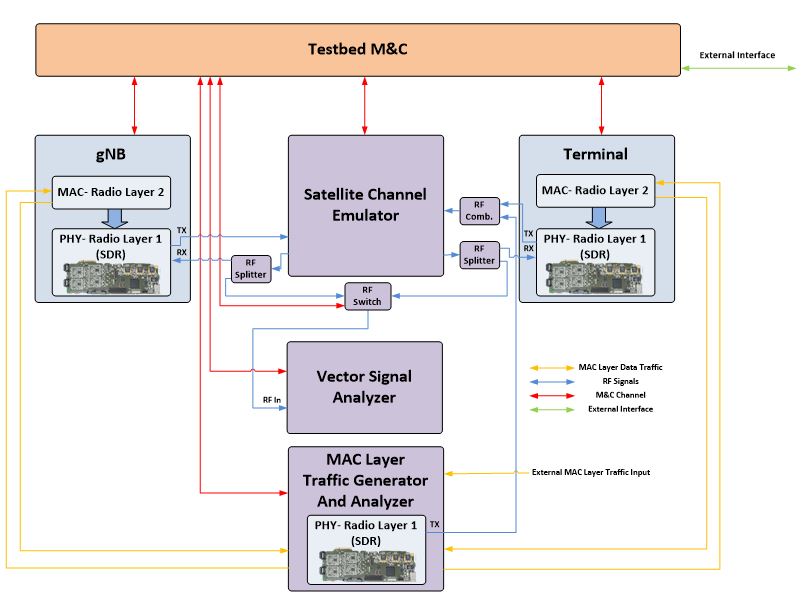
- developing a suitable platform for the spin-in assessment and for future standardization.
This study focuses on the adaptation of terrestrial technologies developed and studied within 3GPP for 5G systems to satellite scenarios and their implementation on HW and SW platforms.
System Architecture

We can recognize four applications:
- Monitor and Control Server, which implements all local functionalities
- GUI, which interacts with the MC Server and provides a user interface application to the operators.
- An External Adapter, which is able to interface with external units in order to potentially validate end-to-end performance
- A Device Interface, able to adapt to the various sub-systems interfaces with the M&C Server.
The M&C Server is composed of:
- Configuration Data: the configuration data set will be included in a SQLite database or in files with the configuration of the different scenarios envisaged.
- Log Files: they contain information related to the M&C operations. These log data will be recorded in a file.
- Access Manager DB: it is an authorized users’ database in which the operations permitted to the individual user are also defined.
Server: it is the executable running on the PC hosting the M&C. It implements the functionalities provided by a three layered server, including: 1) Core, which implements all the functionalities provided by the M&C Server; 2) Broker, which is the SW layer exposing the control interface of the M&C; 3) Controller, which is a SW layer decoupling the core implementation from the broker.
Plan
The main planning of the general tasks is reported below:

With the following relevant milestones:
- MS1: System Design Review [“SDR”] and acceptance of all related deliverables. Foreseen by mid-October 2019
- MS2: Critical Design Review [“CDR”] and acceptance of all related deliverables. Foreseen by mid-May 2020
- MS3: Test Readiness Review [“TRR”] and acceptance of all related deliverables. Foreseen by mid-September 2020
- MS4: Final Review [“FR”] and Contract Closure Documentation. Foreseen by January 2021
Current Status
The activities have just started on May 30th 2019.
Companies


WIDEBAND SOFTWARE DEFINED HUB (ARTES AT 6B.056)
WIDEBAND SOFTWARE DEFINED HUB (ARTES AT 6B.056)
SDR App Store
- Lime Microsystems SDR Mini for use in satellite communications

PAGE CONTENTS
Objectives
The SDR App Store is an initiative to stimulate the take-up of experimentation with the Lime SDR boards in the area of satellite communications. The activity has manufactured a number of Lime SDR boards which were ESA-branded and distributed them to a large number of interested parties.
In addition, a framework was created that could easily host newly developed applications (“SDR Apps”). This framework was developed in collaboration with Ubuntu Canonical and acts as an App Store for future applications using the Lime SDR boards.
Challenges
The Lime SDR App Store activity addressed the need for flexibility in satellite communications.
Plan
The Lime SDR App Store has consulted many parties which are involved in testbeds and prototyping using SDR radio, and used these requirements to shape the SDR App Store. After reaching out to this audience a number of SDR boards have been distributed, and in return the SDR-enabled SDR applications have been submitted to the SDR App Store.
Current Status
The project was kicked-off 2019 and is currently finalising its open call framework and preparing to launch the first round of open calls in May 2019.
Related Links
Companies

Lime Microsystems
United Kingdom
E2UT
Energy Efficient User Terminals for Massive Uncoordinated Access via Satellite

PAGE CONTENTS
Objectives
The objective of this project is to design and demonstrate solutions for compact and energy efficient Machine-to-Machine (M2M) user terminals for direct, massive uncoordinated access via satellite.
A novel access scheme is developed for optimizing energy management at physical and access layer, looking at a global access network and targeting low duty cycle and volume traffic.
Beside the smart energy management, the terminals shall be able to do some kind of energy harvesting for extending significantly the mean time between maintenance of the devices.

The project task are the following:
- System scenario, use case definitions, and technical requirements
- Consolidated air interface design specifications and functional benchmarking
- Detailed user terminal design
- User terminal prototype
- Test plan and verification procedures
- Verification platform
- Test campaign results
Challenges
Machine-to-Machine Communications (M2M) will interconnect billions of devices for a wide range of applications with low duty cycle and low volume traffic over the Internet of Things (IoT). A high number of small IoT nodes will serve for monitoring applications in remote locations, where in general the energy supply over the power grid is not possible. The maintenance of these devices will be difficult or not possible. These IoT nodes can only accommodate batteries with limited capacity, which is a challenging constraint for the energy supply.
System Architecture
The test & verification procedure of the entire system is performed with an entire setup / testbed of various different elements/devices as shown below to ensure compliance to the system requirements.

This testbed is used to perform at least:
- End-to-end physical and MAC layer tests
- Demodulator input signal quality measurements
- Physical layer adjustments
- Channel performance measurements
- Packet loss statistics measurements
- Energy consumption statistic measurements
- Battery capacity estimation measurements
- Emulation of satellite channel models
Plan
|
ID |
Meeting |
Date |
|
KO |
Kick-Off Meeting |
3-Oct-2018 |
|
SRR |
System Requirements Review |
27-Nov-2018 |
|
TSR |
Technology Selection Review |
17-May-2019 |
|
VRR |
Verification Readiness Review |
25-Feb-2020 |
|
FR |
Final Review |
23-Jun-2020 |
Current Status
Evaluation of use cases was performed and the most promising use cases were selected. From these use cases, the system requirements were deducted:
- Suitable frequency bands
- regulatory requirements to the specific frequency bands
- suitable combinations of space segment architectures
- terminal design aspects
- waveform selection
For the TSR milestone, strong emphasis laid on the performance comparison of candidate waveforms and systems. As a result, a slightly modified version of ETSI standard TS-UNB, called “TS-UNB-S” was selected as suitable communication system.
For the VRR milestone, the focus was on
- design and development of the energy-efficient IoT-terminals based on TS-UNB-S,
- design and development of the system verification environment.
After that, the verification process of the terminals and the emulation environment was successfully executed. The results were presented at the FR milestone meeting to the esa project officers. The activity can be seen as successfully closed.
Due to the current Corona/Covid-19 situation, final presentation and the demonstration at esa ESTEC facilities is postponed towards the next months.
Related Links

AIR INTERFACE DEVELOPMENT FOR ULTRA-LOW POWERED INTERNET OF THINGS SATELLITE APPLICATIONS ( ARTES AT 6B.058)
Ka-band radio characterisation for SatCom services in arctic and high latitude regions
Ka-band radio characterisation for SatCom services in arctic and high latitude regions
PAGE CONTENTS
Objectives
The project’s first objective is to aid GEO satellite system dimensioning by performing long-term study of Ka-band propagation effects within the designated coverage areas at High North locations. The outcome of the study will be used to refine and enhance relevant ITU-R radio wave propagation models and prediction methods for geostationary orbiting satellites serving high latitude low elevation angle locations on land, coastal areas, and at sea. Results will also become important for other orbits.
A second objective is to perform telecom measurements involving traffic data for a Ka-Band satellite. It involves analyses to what degree telecom data relates to propagation information.
A third objective is to gain experience with Ka-band band system operated at High North locations, normally in more challenging conditions that lower latitude locations.

Challenges
The key challenge is to collect high quality measurement data from several stations all operated by remote control, and some being at remote non-manned locations. The data availability needs to be very high such that valid statistical analysis can be performed and reliable conclusions ensured.
System Architecture
The propagation data have been measured using the satellite Ka-Sat at 9.1° E and the telecom data collected using Thor 7 at 1° W. The measurement network of the stations was set up with a 24/7 surveillance capability.

The propagation terminal consists of beacon measurement and meteorological stations. It collect and stores data locally, then at regular intervals upload data to the central sever.

The telecom experiment consisted of a fixed VSAT installation, using an iDirect Velocity modem running DVB-S2 on forward and MF-TDMA on return.
Plan
The project plan was as follows:
- 2012.09 Project kick-off meeting
- 2013.08 Propagation measurement start at the first station Nittedal
- 2013.10 Propagation measurement start at station Røst, the last before project extension
- 2015.07 Telecom measurement start
- 2015.10 Two-year propagation data completed
- 2015.12 Telecom measurement end
- 2016.04 Measurement start at Bjørnøya
- 2017.06 Projected completed with three years data collected at five stations, one year at one station, and six month telecom
Current Status
The project is completed with measured multiple year propagation data and six months telecom data from High North locations, several in maritime climates.
With 7-8 dB margin services can be provided at 99 % availability for elevation angles as low as 3.2 and 3 dB for elevation angles above 10.1°. Attenuation measurements support ITU-R prediction methods. Scintillation and multipath are not well predicted at the lowest elevation.
Telecom data were used to compare actual performance versus predicted and to verify the Thor 7 overall system performance. Results were used to improve the nominal spectral efficiencies on Thor 7.
Related Links
Companies