

PAGE CONTENTS
Objectives
The objective of this study was to assess the market potential and define a Roadmap for the development and commercial introduction of PLs embarking selected Photonic Equipment in future Telecommunication Satellites.
Benefits
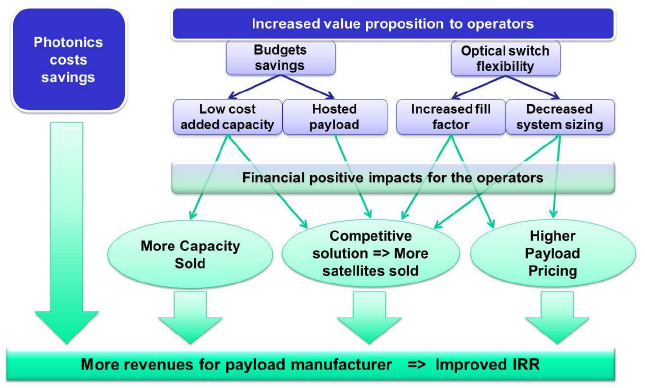
In this project two kinds of analysis have been performed. The first one consider only the impact of the application of photonic technology on the overall payload hardware costs, the second one (based on the previous one) consider the impacts of the application of photonic technologies on the Cost of Satellite In-Orbit Capacity delivery. Both analysis have been performed for all the considered missions and have been defined comparing a real payload features (payload mass, payload units mass, number of units, routing capability, units costs, payload costs, in-orbit costs) with the corresponding photonic version. The results shows that cost saving increases with payload capacity and flexibility. Final results for GEO broadband access large flexible mission, shows:
- A saving of 15% on total payload hardware cost
- A saving of more than 5% on the overall Cost of Satellite In-Orbit Capacity delivery (considering only 70Gbps class)
This delta would also increase when moving towards higher capacity and flexibility. It shall be noted that with a total capacity of 70 Gbps class, such mission is only an intermediated step towards new high capacity HTS/VHTS configurations, which target capacities up to 250Gbps/1Tbps respectively.

SYSTEM ARCHITECTURE
GEO Broadband access mission has been identified as the mission that can maximize the benefits derived from the migration to photonic tech.
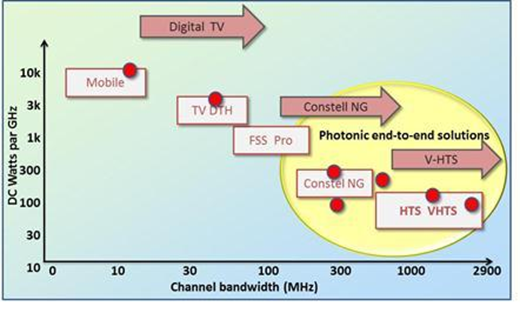
In addition the introduction of flexibility in broadband missions is also eased thanks to photonic technologies:
- In the case of medium flexibility requirements, this can be achieved by sub-bands routing: optical switching is an enabling technology for this function which cannot be provided by conventional RF switching when the number of input/outputs is becoming high.
- In the case of high flexibility features leading to the implementation of an Intermediate frequency processing unit: the number of frequency conversions (RF to IF and IF to RF) is significantly increased and here also the capability to replace several RF converters by a single photonic converter is key feature because the number of conventional RF converters needed would jeopardize the payload budgets and accommodation.
At payload level these missions consist mainly in using photonics multi-LO frequency conversion and switching capability to provide efficient frequency plan management and routing/switching capability.
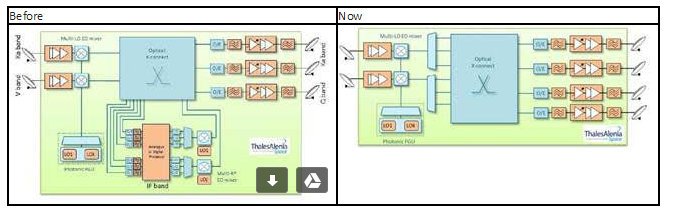
At the end, the emerging market of flexible HTS/VHTS will benefit from
all photonic features. In conclusions, photonic payloads can provide a full set of functions, with a minimum set of hardware.
Features
Photonic P/L architectures considered so far in previous and on-going projects, carried out by TAS, are characterized by the utilization of units with similar functionalities that can be considered as the main building blocks to be developed in order to build the 1st generation photonic analog PL. A generic architecture of such 1st generation photonic analog PL is proposed in the figure below that shows how these building blocks can take place.
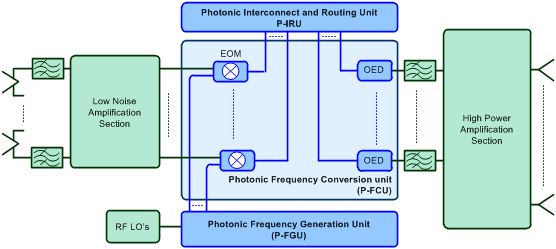
More specifically, these building blocks are:
- Photonic Frequency Generation Unit (P-FGU);
- Photonic Frequency Conversion Unit (P-FCU);
- Photonic Interconnect & Routing Unit (P-IRU).
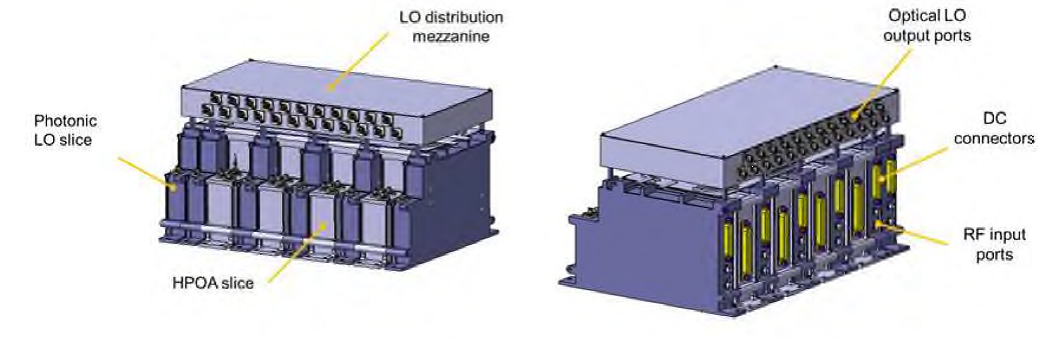
Similar importance might also be given to “Photonic RF optical communication links”, which could consist in the utilization of Fiber Optic cables instead of Coaxial Cables for the interconnection of the repeater units and for LO distribution.
A further candidate for introduction in future P/L is the Photonic Beam-Forming Unit or Beam-former, that could consist in a photonic beam-forming network made of photonic beam-forming matrices, and of E/O (Electrical/Optical) and O/E (Optical/Electrical) interfaces. At this stage, it has been demonstrated at laboratory breadboard level at is considered of lower maturity than the other functions.
Challenges
Benefits on TLC payload, coming from the introduction of photonic technologies, have been deeply analysed in different Projects. Basically discussed benefits are related to Mass Saving, Reduced Number of units requested for a payload, Room Saving / easier Accommodation, Power Saving ,Repeater Design simplification, mechanical flexibility, Available bandwidth, switching/routing to large payloads where current technologies become impractical…. All these conclusions represent surely benefits for the Satellite and Equipment Manufacturers, and by extension for the Satellite Operators. The real challenge of this project is to analyse how, all these benefits, could be translated in economical return for both operators and industry (in terms of ROI and IRR).
Plan
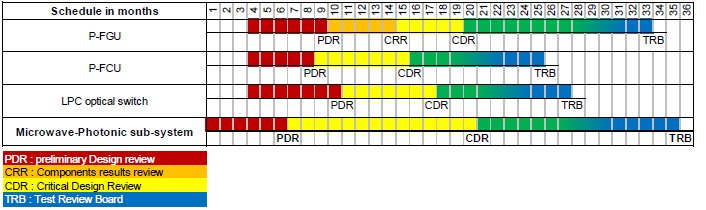
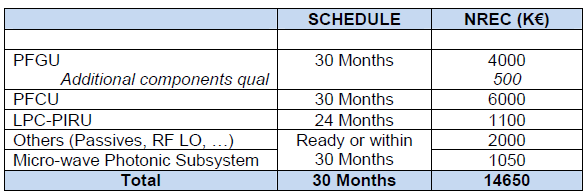
During this project have been defined a step by step approach for the photonic technology development, defining the Design development plan for each step. The proposal is to start with the development of the photonic equipment needed by the P/L for a Broadband-small non-flexible mission, for which 35 months roughly of Development Time and 14.650 M€ roughly of Development NRE Costs have been estimated.
The schedule is driven by the PFGU development, 30months, including 5 months for the sub-assy integration and tests:
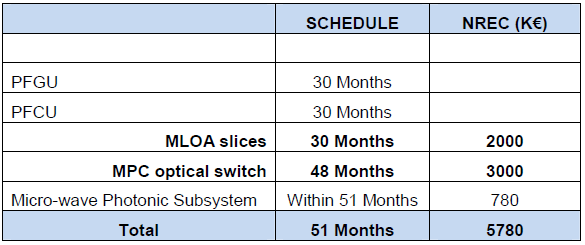
Second step foreseen the developments of the equipment needed by the payload for a broadband-large-flexible access mission. In this case, the development will take benefits of the previous developments and relevant NREC sustained costs. For this kind of payload the design development plan foreseen a 16 months of Development Time (to be added to the previous 35 months) and 5780 K€ Development NRE Costs (to be added to the previous 14650 K€).

For what concern the payload for Constellation Mission, the Microwave-Photonic alternative of multi-RF solution results in the following additional investment for Design and Development to TRL6:
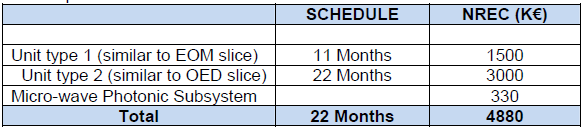
This configuration does not require high port count optical switching and can also be foreseen in parallel with the first broadband mission, including low port count switches.
Current Status
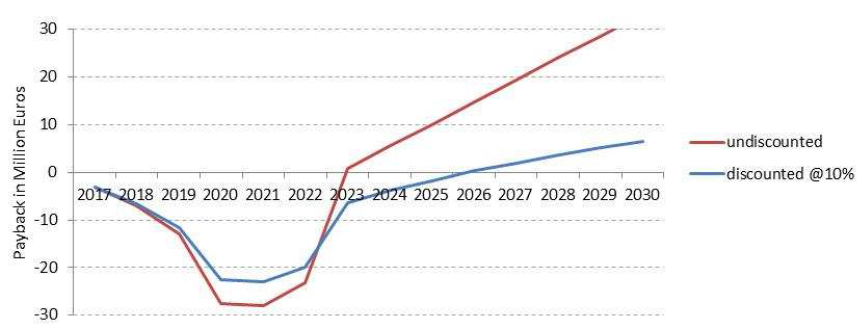
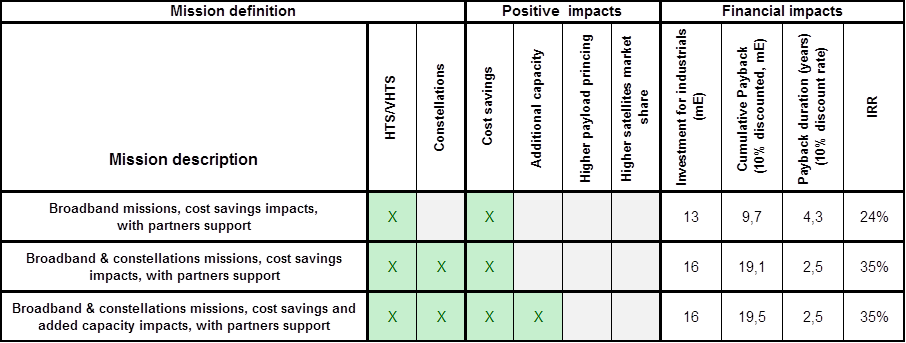
In the frame of this project, a preliminary estimation of the investments to be sustained have been performed, resulting in around 32M€ in 51 Months. With these figures both ROI/IRR parameters have been evaluated with 10years timeframe. Final Financial parameters evaluation, considering a 50% of investment sharing with an European space partner, are reported in the following table:
The roadmap for the technology development and related activities to meet IRR figures, is scheduled in two main steps:
2017-2020 period:
- A first bread-boarding and testing project starting as soon as possible shall provide a step in TRL (final development and unit qualification) for a full P/L proposal to Operators by 2020.
- In parallel, an early IOD is foreseen in order to get a first flight experience of telecom photonic payload.
- 2020 appears as a realistic date as it combines market expectations and TRL.
2021-2025 period:
- The first photonic based commercial P/L will developed and fly featuring first FMs of photonic units. This will constitute a major milestone for capability and efficiency of Telecom P/L
- Assuming sustained increase of VHTS development, a progressive upgrade of products will be engaged, e.g. to cope higher frequency band usage ( Q/V band) or to improve the capacity
2025 appears as a realistic date for the Second generation of Photonic based payload (High port count photonic switch)
