

PAGE CONTENTS
Objectives
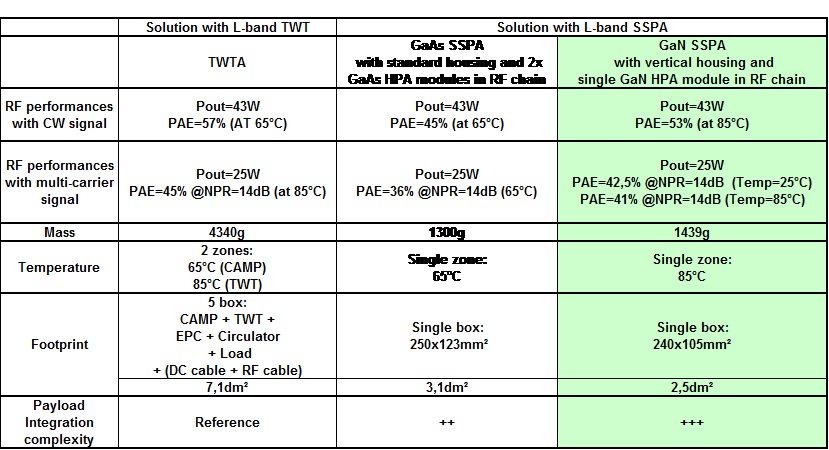
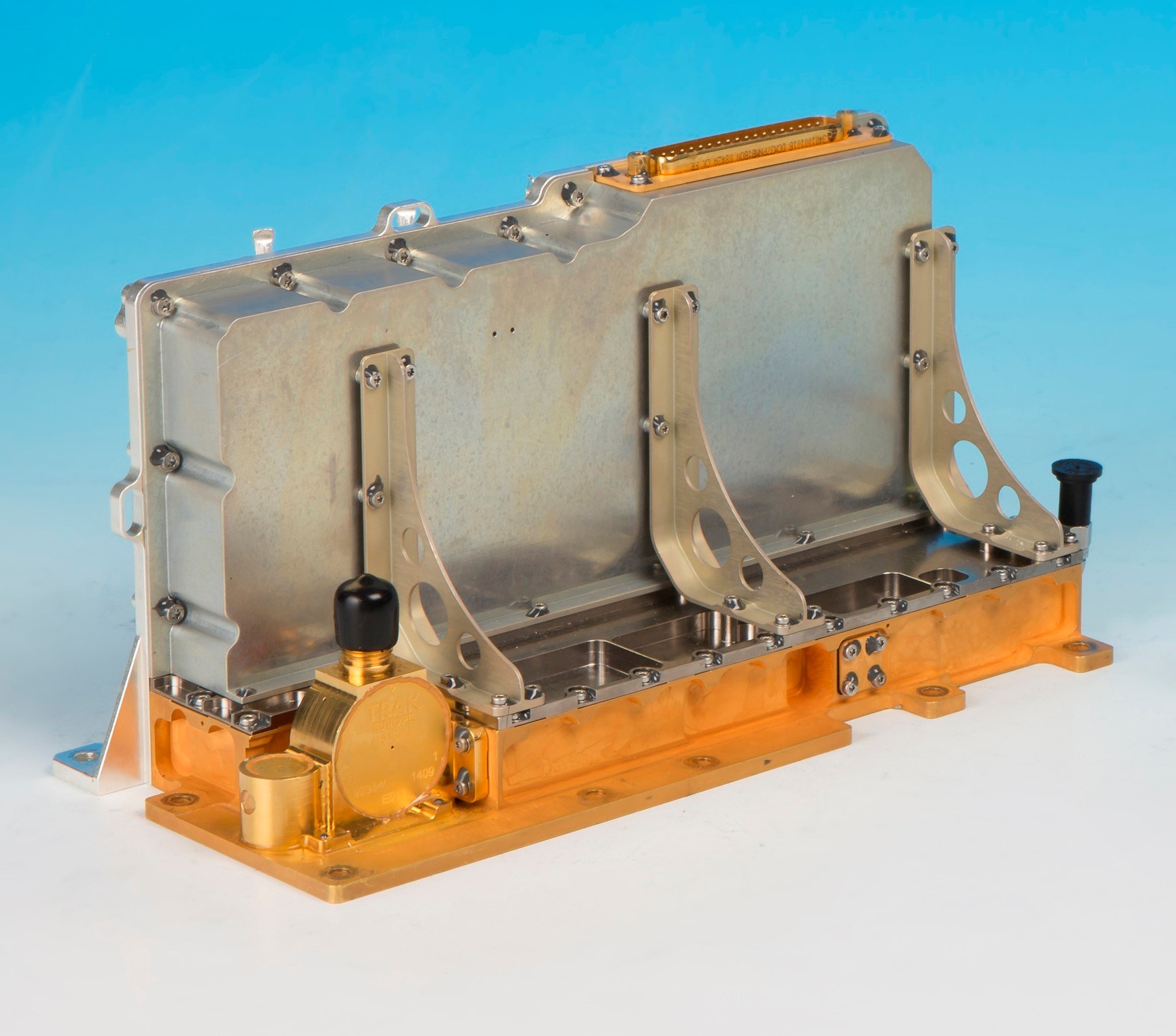
In the frame of a satellite dedicated to MSS applications (Mobile Satellite Services), analysis about a payload integrating many 50W L-band GaN SSPA units show a strong predominance for the footprint criterion. Based on these analysis, a vertical structure needed to be used for this new 50W L-band GaN SSPA product. Furthermore, it has been demonstrated that a solution with a vertical housing brings 20% of footprint reduction compared to a solution with standard housing. A delta mass of 200g has been estimated between L band SSPA with standard housing (mass reference) and a L-band SSPA with vertical housing (mass reference + 200g): this represents a limited impact (+20kg)for the payload mass which includes 100x SSPA units. A Trade-Off between LTWTA and GaN SSPA solutions has been conducted. Results are presented in table below and showing the positive impact of the GaN SSPA introduction into the satellite payload:
Challenges
To answer to the requirements imposed by the technical aspects described below, the thermal efficiency of the new equipment structure must be improved:
- A vertical architecture imposed by the objectives of a reduced footprint equipment
- A high temperature (+85°C in acceptance) for flight operating mode
A high heat flux at the interface of the satellite panel and linked to the use of GaN technology for power RF section
System Architecture
The development effort is focused on the 4 main parts of the SSPA equipment : • The linearized RF section including a GaN output section (MLA+HPA). The UMS GH50 technology is used; • The DC/DC section (EPC card) designed to cope with the new RF GaAS and GaN section, the thermal constraints (Tcase=85°C) and the mechanical constraints(EPC card used in vertical position, new material used for PCB); • A TMTC section designed to manage the temperature compensation (gain and power compensation), the overdrive Limitation circuit OLC, the bias voltage regulation • A new vertical mechanical structure offering reduced footprint and using thermal management solution to answer to the requirements imposed by the vertical architecture.
Plan
The activities are dedicated to the development and the tests of this EM SSPA equipment:
- Complete detailed trade-off to select thermal management solutions used in the mechanical structure
- Design, manufacturing and test of the GaAs and RF section
- Design, manufacturing and test of the EPC-TMTC card
- Design and manufacturing of the mechanical structure including thermal management solutions selected after a detailed trade-off
- Assembly and test of the EM L-band 50W GaN SSPA
- Initial Electrical Tests (CW and multi-carrier mode)
- Mechanical tests (shocks and vibrations) covering different platforms
- Thermal Vacuum Tests
- Final Electrical Tests (CW, 2tones and multi-carrier mode)
Final review to validate the development and the performance.
Current Status
All key reviews have been held successfully. The L-band 50W 85°C GaN SSPA has been fully tested with the expected performance.
This L-band equipment would be qualified in the frame of an future ESA ARTES 3-4 study. The contract is now closed.
