
PAGE CONTENTS
Objectives
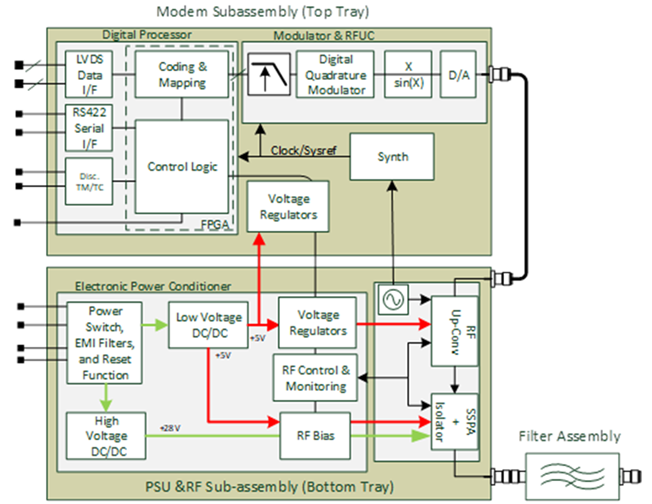
The project was developing an X-band transmitter (8.025GHz to 8.4GHz) using a high-speed baseband processor, coded and modulated to the latest CCSDS standards, in a compact highly integrated and power efficient design. The modulation drives a nonlinear SSPA followed by an integrated post-amplification RF shaping filter (as specified by ECSS-50-05C). Such an approach offers high efficiency at high data rates with low risk. In addition to this mode of operation, the system architecture readily supports linear modulation scheme such as QPSK.
To meet parallel to serial data stream processing as well as baseband processing the intention is to leverage the latest commercial FPGA technology, including commercial IP cores where needed.
The project took an evolutive approach that allowed a stepped development to more advanced coding and modulation techniques.
The result was a more flexible, software configurable product designed to give mission assurance with optimised cost of ownership for the evolving small sat world.
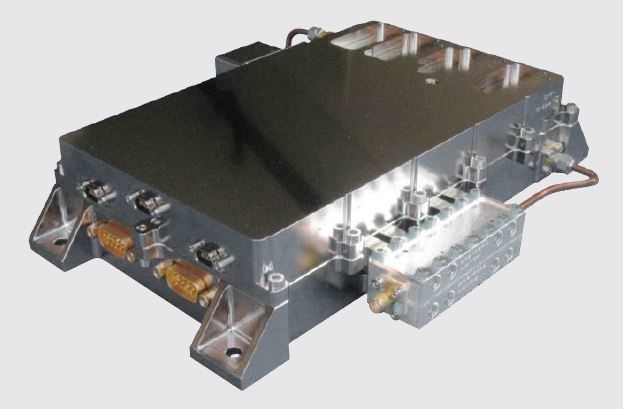
Picture credit: COM DEV Europe Ltd, Heritage C-band product
Benefits
The software defined architecture allowed for reconfigurability and fine tuning to individual end customer needs. Software configurability also enabled:
- flexible modulation
- flexible data-rate
- flexible output power
Connecting the baseband processor directly to an X-band modulator and subsequent high power high-efficiency GaN based power amplifier delivered savings in mass, power and volume.
- Software defined radio (SDR) based implementation
- Non-ITAR commercial-off-the-shelf (COTS) components
- Low mass and low volume unit
- Programmable output frequency
- Selectable coding
- High efficiency Gallium Nitride (GaN) amplifier-based design for low power consumption
This solution was aimed at missions in low earth orbit (LEO) with a balance of affordability, flexibility and total cost of ownership in mind, enabling smaller, lower cost, more agile platforms in our evolving industry.
Features
Units were built in accordance with ECSS class 3 (NASA level 2) standards, taking a radiation tolerant, rather than radiation hardened, approach to deliver mission assurance.
- Low mass, low volume unit
- SDR based implementation with flexible modulation, data rate and output power
- QPSK/8PSK modulation schemes
- Programmable output frequency
- LVDS synchronous data ports with auto detection
- Low power consumption
- High efficiency GaN amplifier based design.
Full product specification is available from Mark.Watherston@honeywell.com
Challenges
The key challenges were in appropriate component selection for the given design philosophy and the system architecture choices to meet the exacting radiation, thermal, mechanical and electrical environmental factors, while maximising product functionality and configurability. Key experiences in flexible TT&C and heritage flight datalink products, where pragmatic qualification approaches were validated were essential to development success. Our development also required inputs from as many potential users as possible to ensure that its capabilities meet customer needs.
System Architecture
Plan
- MS1 PDR: Architecture development, Concept development & breadboard design
- MS2 CDR: detailed design and MAIT of EM unit
- MS3 TRR: EQM MAIT, test system development and release
- MS4 FR: Qualification of EQM and development.
Current Status
This activity is now completed.