

PAGE CONTENTS
Objectives
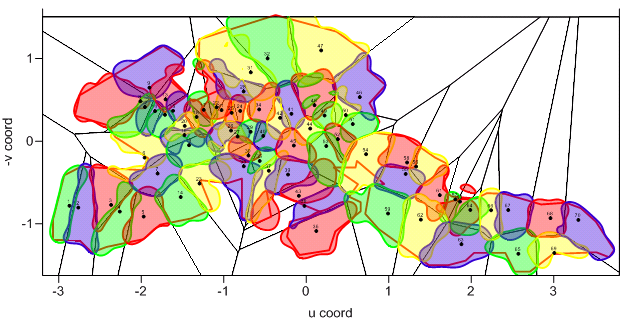
The goal of this project has been to investigate an innovative array fed reflector antenna, based on a passive multi-feed-per-beam architecture, enabling the generation of shaped beams of different size and shape, whose profiles are able to match the particular shape of the areas they are designed to cover.
The areas are defined through a Voronoi tessellation, on the basis of the traffic demand distribution on an European coverage. The shaped beams are obtained through the proper excitation of clusters of feed with dedicated BFNs.
Benefits
The proposed configuration achieves an improvement in the usable capacity of the system with respect to a regular multi beam configuration, in particular thanks to very efficient distribution of the beams with respect to the traffic demand, while showing better performances in terms of co-channel interference with respect to a single beam per feed configuration employing feeds of different sizes.
Features
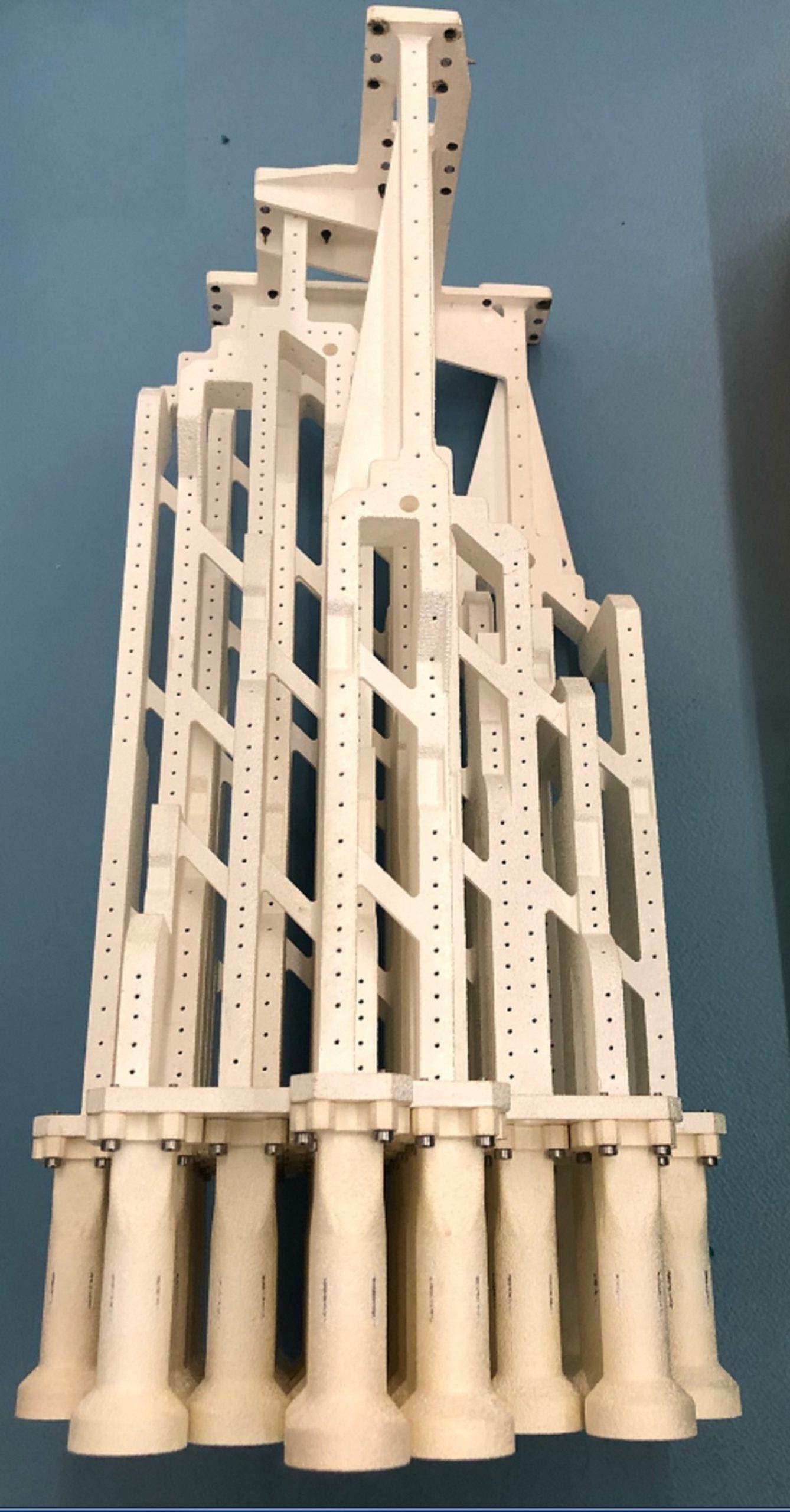
The development of the functional demonstrator is a remarkable result, given the complexity of the realized BFN. RF performances achievable with additive manufacturing and surface coating process are suitable to the design of many BFNs and antenna feeding components, where the impact of residual inaccuracies and moderately higher losses (wrt standard manufacturing approaches) can be compensated by suitable system margins. The benefits in terms of design flexibility and improvements in manufacturing, assembly and testing, becomes key drivers for the implementation of very complex antenna architectures with large number of beams and radiating elements.
Challenges
The proposed solution, being a passive Multi-Feed per Beam antenna, requires a complex Beam Forming Network. Classical manufacturing techniques requires the realization and assembly of several components, with the associated costs and risks. These drawbacks can be mitigated by employing the emerging Additive Manufacturing techniques. Therefore, a fully 3D manufactured functional demonstrator has been developed to verify if the performances of the proposed antenna configuration can be guaranteed with the accuracies obtainable by this kind of manufacturing techniques.
System Architecture
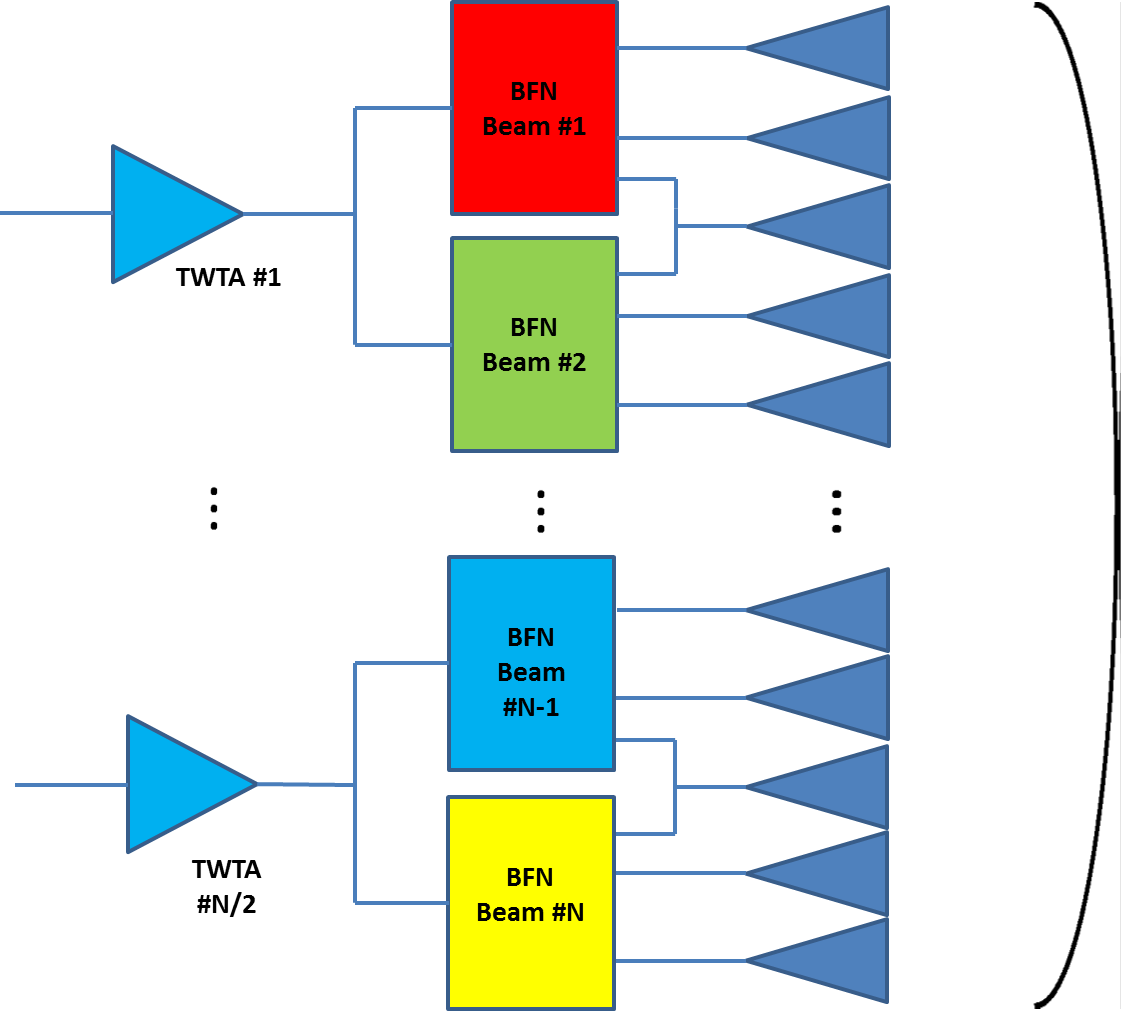
The system is a Focal Array Fed Reflector antenna, in which a regular cluster of elementary radiators placed on the focal plane illuminate a reflector. The radiators are grouped in 70 sub-arrays, each one dedicated to the generation of a shaped beam.
Waveguide Beam Forming Networks provide the excitation (amplitude and phase) to each elementary radiators. The elementary radiators operate in circular polarization, and with the use of septum polarizers, some peripheral radiators are shared between adjacent beams.
The user link operates in Ka-band (19.7-20.2GHz). The bandwidth allocation to beams is carried out according to a standard 4-colours reuse scheme, which involves channel frequencies and carrier polarizations. The amplification section comprises 35 TWTAs with 130W saturated power, operating with a fixed output back-off of 3dB. Each TWTA feeds 2 different beams.
Plan
The activity is divided in two contractual phases.
• Phase 1: antenna requirements is identified and consolidated, and several antenna architectures are traded off. Two different array fed antennas are identified and considered as preferred baseline antenna solutions. The most promising concept is selected and designed in detail.
SRR(MS1) 03/07/2017
PDR(MS2) 11/10/2017
CDR(MS3) 17/05/2018
• Phase 2: manufacturing and RF testing of an antenna demonstrator. The demonstrator is a subset of the full antenna. It proves the adequacy of Additive Manufacturing techniques for the realization of complex BFNs. Recommendations for future developments are identified.
TRR(MS4) 18/10/2018
TRB 21/11/2019
FR(MS5) 13/12/2019
Current Status
The project has been developed from feasibility study to a functional demonstrator, and it is currently concluded.
