


PAGE CONTENTS
Objectives
The project aim was to take the previous ‘breadboard’ development of a High Pressure Proportional Valve that started in 2008, further develop all aspects of this design and then build an Electronic Pressure Regulation sub-system and take it through extensive development and Engineering Model testing with a range of commonly used spacecraft propellants.
System Schematic (shown with redundant branch)

The valves feature Nammo’s heritage hard sealing technology, making the whole system compatible with Xenon, Helium, Nitrogen, Hydrazine, and MON. Note the use of a specifically designed Heater unit in the above schematic to eliminate Joule Thompson issues regarding Xenon phase change through orifices at higher flow rates such as those required for Cold Gas Thrusters. The heater is not required for the other gases and propellants.
Benefits
Benefits of Electronic Pressure Regulation
In-flight pressure variation and control throughout mission life. Programmable by telecommand.
Features
Key Features include:
- Compatible with all heritage spacecraft propellants and pressurants.
- Suitable for flow control of liquids and gases.
- Regulation accuracy of <0.05 bar (mechanical regulation is typically >0.2 bar).
- Response to 90% of new level <1 second.
- No need for multiple regulators (as in the mechanical case).
- Low leak rate (<2 x 10⁻⁵ scc/sec Helium internal).
- High Flow capacity > 600mg/s Xenon at EoL, >600mg/s Helium at EoL.
- Up to 310 bar MEOP.
- Pressure set point range is 0.5 to 22 bar.
- In-orbit data logging.
The Nammo EPR system design for Electric Propulsion applications includes thermal conditioning of Xenon (or Nitrogen) to prevent Joule-Thompson issues and regulate outlet pressure & minimum temperature.
The Nammo High Pressure Proportional Valve
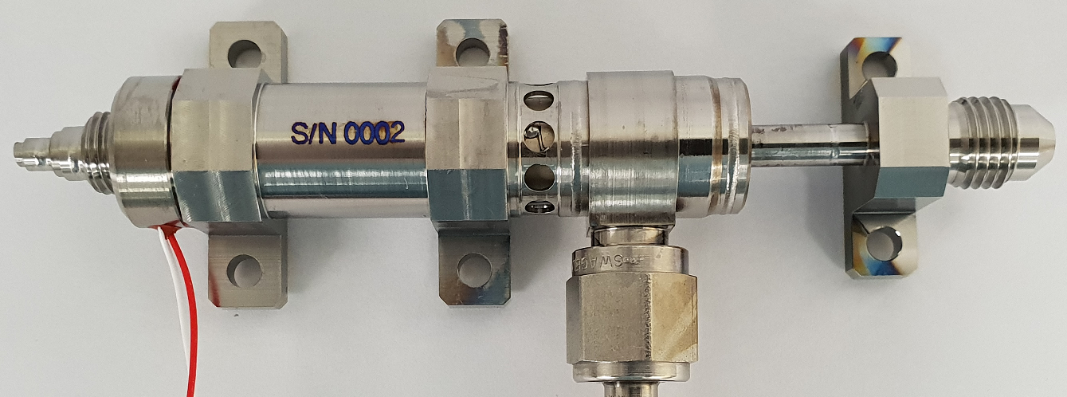
The development of this valve was the key to unlocking proportional control of flow and pressure in the EPR.
Challenges
The key challenges associated with meeting the demanding project objectives were:
- Coping with a pressure range from 0 to 310bara, a flow range of <3 to 600mg/s Xenon & Helium and accommodating 3 different propellants (Xenon, Nitrogen and Helium) with a single proportionally regulating valve design.
- Overcoming Xenon Joule Thompson issues
- Developing hard material sealing technology
- Thermally compensating design
System Architecture

The Engineering Model EPR can be seen above in ‘as tested’ configuration. The gold plated Xenon heater can be seen on the left. This flows pre-conditioned Xenon into the High Pressure Proportional Valve (HPPV) immediately to its right and thence to the thruster interface at the bottom of the picture.

The HPPV seen at the top is functioning as a high pressure isolation valve as this has been proven at 310bara to perform to requirements. The valve is low mass and compact when compared with mechanical isolation valves, therefore an ideal choice for our system.
Plan
The ARTES project took the Nammo Electronic Pressure Regulator system through from design concept to an all-welded, flight representative, extensively tested Engineering Model. The testing was equivalent to the perceived flight Qualification Testing that represents the next stage of the EPR readiness for flight.
Current Status
As stated above, the EPR is at a development stage where it is ready to undergo a Critical Design Review (CDR). Upon successful completion of the CDR the Electronic Pressure Regulator is ready to undergo full qualification. Full qualification would involve qualification level environmental testing (vibration, shock, thermal cycling, etc.) and qualification level testing including on/off cycles and Tvac testing.
The Nammo thermal vacuum facility used for EM testing is shown below.

Companies
