
PAGE CONTENTS
Objectives
The objective of the project is to enhance existing SatLink VSAT network capabilities by further developing functionality related to mobility, security, and bandwidth efficiency by:
- Further developing seamlessly Global roaming and enhancing the QoE for mobile and maritime customers through Global NMS and Mobility Controller.
- Providing the next generation SatLink VSAT and HUB modems.
- Enabling new Security measures in these areas: communications, encryption and equipment.
- Upgrading forward link to S2X and increase throughput.
- Preparing technology platform for future higher data rates.
Benefits
SatLink beyond 2020 offers:
- Further developed seamless roaming enhancing the QoE for mobile VSAT users through centralized mobility control.
SatLink “proactive beam switching” is a new unique feature that is especially designed for networks with land-mobile and maritime mobile users and aims to enhance the end user experience as well as service provider bandwidth utilization.
- New generation SatLink VSAT and HUB modems.
New modems with state-of-the-art technology, including support for DVB-S2X and higher beam throughput.
- Enabling new Security measures in these areas: communications, encryption and equipment.
Fulfilling customer security requirements to both local and remote connections.
- Preparing technology platform for future higher data rates, with the SatLink Network fully supporting (V)HTS satellites.
Features
SatLink Beyond 2020 supports the following features:
- High bandwidth efficiency through DVB-S2X Adaptive Coding and Modulation (ACM) and DVB-RCS2 ACM.
- Security by protecting administrative traffic over the interfaces and protocols, and by offering equipment security.
- QoS including Stochastic Fair Queuing of Best Effort traffic, improved fair use of resources.
- Automated Pro-active seamless beam-switching, increasing availability and QoE for mobile users. Sustaining the accelerated TCP connections further enhances beam switching within the same HUB by continuing intercepted TCP connections.
- Enterprise networking with transparent user VLAN tagging.
- High utilization of resources through mechanisms like dynamic reconfiguration of carriers and sharing of antenna platform between several VSAT modems.
Challenges
It is important to ensure a seamless and cost efficient upgrade path to DVB-S2X for existing SatLink customers by:
- Supporting networks operating DVB-S2 and DVB-S2X in parallel and successively upgrading remotes.
- Enabling option of HW upgrade of existing remote modems by mounting a DVB-S2X Plug-in receiver or use of a new DVB-S2X compatible remote modem.
System Architecture
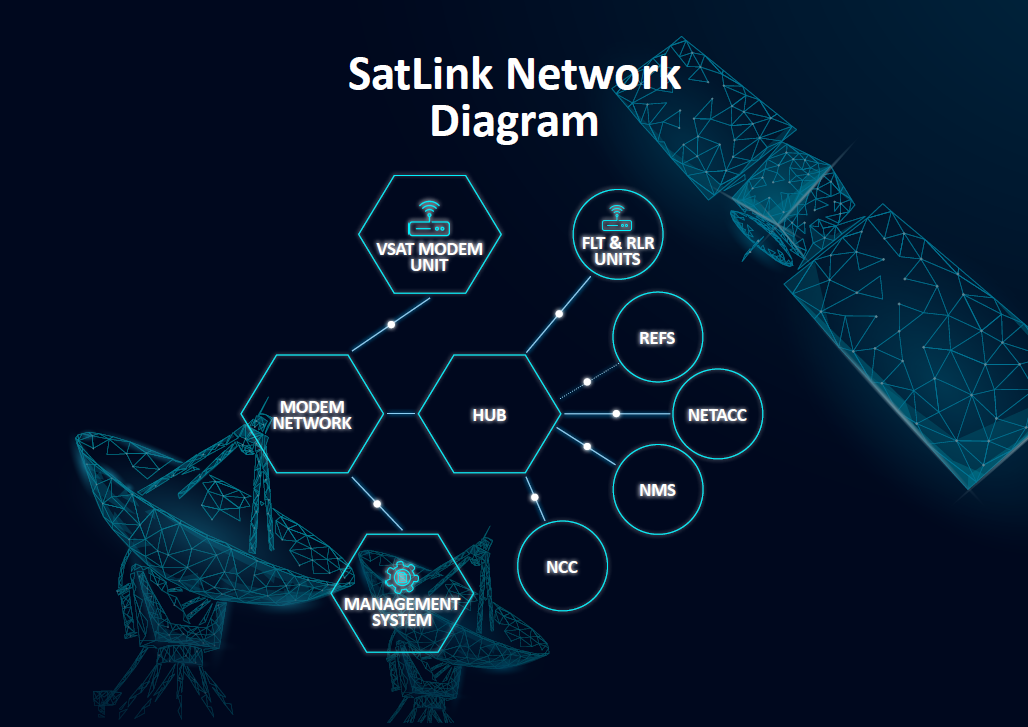
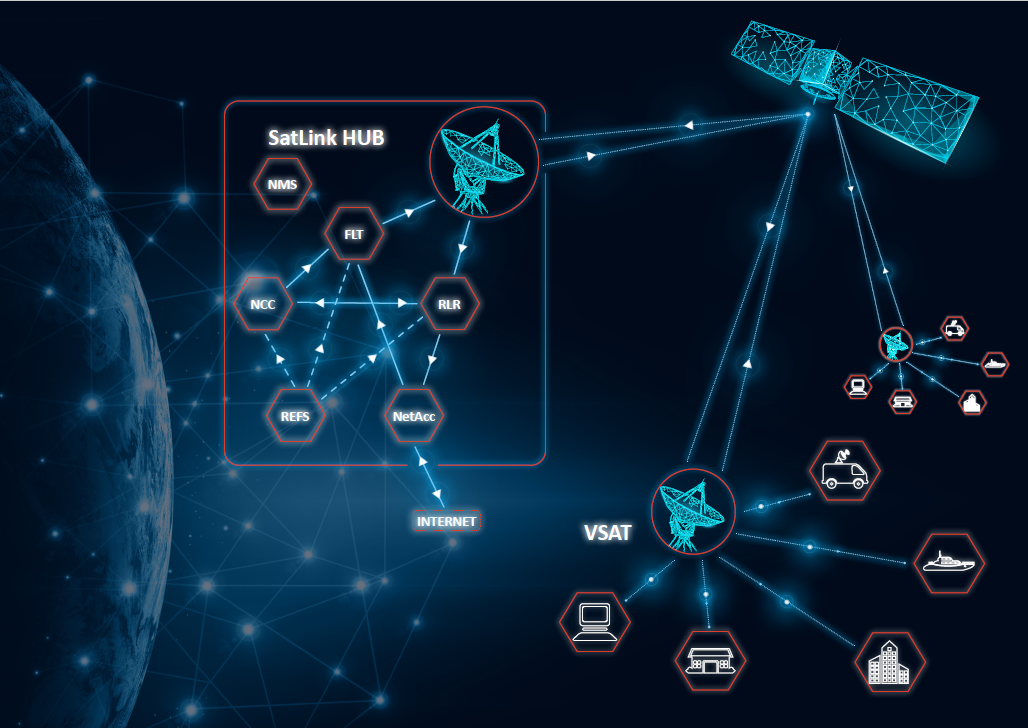
The SatLink satellite modem networking system provides broadband IP networking capability for operators that offers end-users broadband IP services by using VSATs and geostationary satellites. A modem network can be utilised by a single operator or it can be used to host virtual network operators (VNO) as desired. Each VNO has limited and restricted access to the management system and may manage a subset of the VSAT Modem Units(VMUs). The network is suited for end-users in fixed locations, on maritime vessels and on land-mobile units. Interconnection with terrestrial WAN infrastructure can be provided e.g. by having the hub hosted in a satellite teleport with good WAN interconnectivity.
The satellite networking topology that is supported is hub-spoke networking for IP traffic, using DVB-S2, DVB-S2X and DVB-RCS2 signals.
Plan
The project duration is 3 years starting Q2 2020, divided into 3 stages where in addition to continuously enhancing and developing new features for mobility, security and bandwidth efficiency, there is development of new DVB-S2X compatible HUB and VSAT modems, main HW developments per stage are:
- Stage 1: New DVB-S2X compatible Hub Transmitter and a DVB-S2x plug in receiver for remotes.
- Stage 2: New DVB-S2X compatible VSAT modems.
- Stage 3: New combined transmitter and receiver for the Hub.
Current Status
First stage of development.