


PAGE CONTENTS
Objectives
• PD-NOMA Technique Development
Design and assessment of a Power-Domain NOMA (PD-NOMA) scheme for satellite return links, with a focus on heterogeneous terminals and geostationary Earth orbit (GEO) Ku-band scenarios, and benchmarking against classical OMA techniques (FDMA/TDMA).
• End-to-End Demonstration at TRL-5
Implementation of a complete PD-NOMA baseline (terminal and gateway) and validation in both laboratory and live over-the-air conditions, raising the Technology Readiness Level (TRL) from TRL-3 to TRL-5.
• Throughput Improvement
Demonstration of a measurable increase of aggregate return-link throughput with respect to OMA, confirmed through link-level, system-level and end-to-end testing.
• Latency Reduction
Validation that the throughput gain achieved by PD-NOMA translates into a reduction of overall service latency (time needed for multiplexed users to offload their traffic).
• Standard and System Feasibility
Assessment of PD-NOMA applicability within DVB-RCS2-like and 3GPP new radio-non-terrestrial network (NR-NTN) frameworks, including compliance with off-axis emission regulations and identification of potential integration paths into existing standards.
Benefits
• Demonstrated increase in aggregate return-link throughput compared to OMA schemes (FDMA/TDMA) in both DVB-RCS2-like and 3GPP-NTN-like scenarios
• Minimal impact on terminal complexity, as PD-NOMA mainly affects gateway-side processing and can operate with robust MODCODs already supported by many existing terminals.
• Efficient use of heterogeneous terminal populations, turning natural EIRP and SNR imbalances into a resource for multiplexing instead of a limitation.
• Compatibility with existing standards and regulations, with feasibility demonstrated for DVB-RCS2-like and 3GPP NR-NTN return links and compliance with off-axis emission masks in the considered scenarios.
• Advantages over FDMA
o Higher efficiency than FDMA HOMs:
FDMA often relies on higher-order modulations, which require a larger number of pilot symbols and reduce the effective throughput. PD-NOMA, operating with more robust lower-order MODCODs, achieves higher net efficiency under comparable conditions.
o Improved robustness:
The lower-order MODCODs naturally used in PD-NOMA are more resilient to channel impairments, ensuring more stable performance in realistic satellite conditions.
o Favourable off-axis emission behaviour:
Since PD-NOMA spreads terminal power over a wider bandwidth, it can operate closer to emission-mask limits without exceeding them. Equivalent FDMA transmissions may violate the mask, forcing terminals—especially high-power ones—to reduce output power, reducing FDMA throughput.
• Advantages over TDMA
o No duty-cycle penalty:
TDMA terminals transmit only during assigned time slots. In theory, they could increase instantaneous power by 1/β (β = duty cycle) to maintain average power, but in practice this might be not possible due to terminal hardware and regulatory constraints.
o Continuous full-band transmission:
PD-NOMA allows each terminal to transmit continuously over the full available bandwidth, as if it were the only user of the channel. Multiplexing is handled entirely at the gateway via power-domain separation and SIC, without requiring time-based coordination.
Features
• PD-NOMA-enabled return-link air interface, including configurable MODCODs, power-domain multiplexing and SIC-based demodulation at the gateway.
• Advanced SIC processing at gateway side, with multiple demodulation chains, burst reconstruction, channel-impairment emulation and sample-level interference subtraction.
• Support for heterogeneous terminals, including different antenna sizes, EIRP levels and link margins, and suitability for both ground and airborne terminals.
• Flexible verification platform, combining a laboratory testbed (with controlled impairments) and a live GEO setup for over-the-air end-to-end testing.
• Grant-based resource request by the terminal.
Challenges
• Implementation, tuning and validation of Successive Interference Cancellation (SIC) at the gateway for heterogeneous terminals and higher-order modulations, under realistic GEO channel impairments.
• Characterisation of the different impairments that could impact the effectiveness of NOMA methodologies and identification of corresponding realistic and accurate models.
• Analysis and tuning of several algorithms (e.g. estimation algorithms) in order to deal with the different characteristics of the received signals.
• Accurate modelling and emulation of impairments (phase noise, non-linearities, Doppler, frequency and timing offsets, fading) and verification of their impact on PD-NOMA performance at simulation and testbed level.
• Porting of MATLAB algorithms into an existing Verification Platform originally designed for spread-spectrum random access, requiring significant architectural adaptations (framing, preambles, filtering, frequency estimation).
• Stability and robustness of the live setup, including radio frequency (RF) chain integration, calibration and synchronisation across transmit/receiver chains.
System Architecture
At architecture level, the system involves a number of terminals, a gateway to receive information from the terminals, a feeder link to send information to the terminals, and a HUB to manage communication, as shown in the following figure.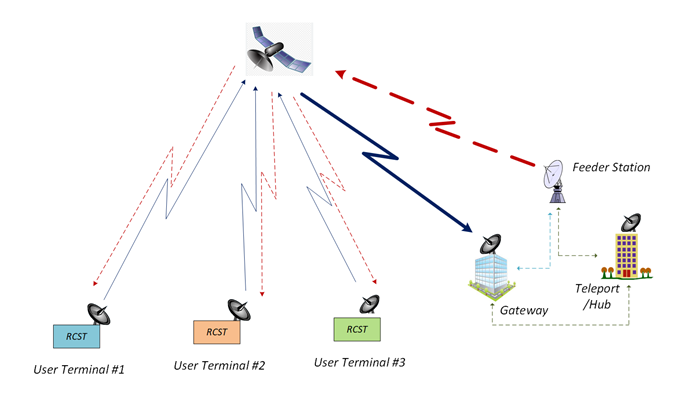 On the terminal side, the transmitter generates DVB or 3GPP waveforms with controlled power levels, predefined MODCODs and burst-based framing compatible with a DVB-RCS2-like or 3GPP-NTN standard.
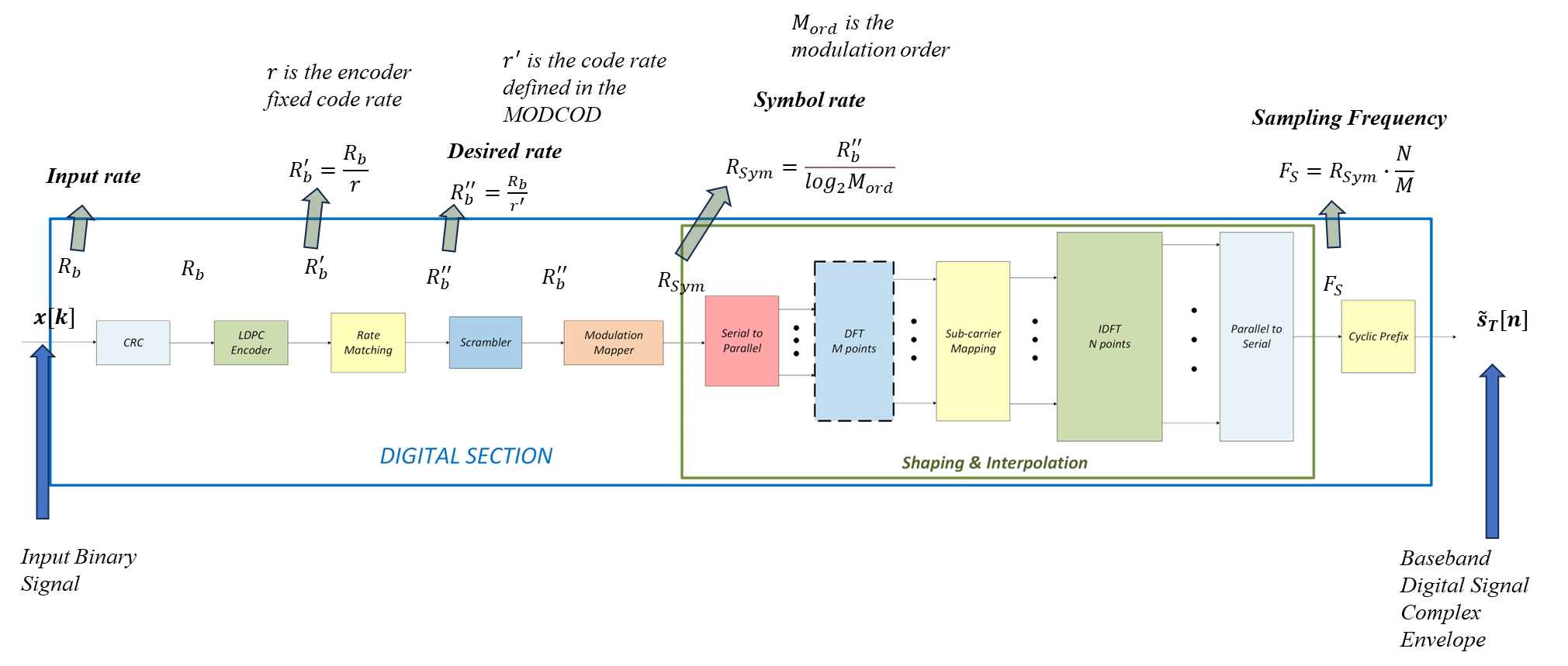
A logical diagram of the air interface for the DVB-RCS2 like (including RF section) and 3GPP-NTN (only digital section) respectively is shown below.

 On the gateway side, the receiver implements a multi-stage SIC chain, including synchronization, channel estimation, demodulation, burst/frame reconstruction and interference cancellation, enabling the separation of multiple users sharing the same time–frequency resource.

In this stage the signal with the highest SNR is first acquired and demodulated, then this is cancelled to allow processing of the following one and so on until the last signal component to be demodulated.
The verification platform integrates RF front-ends, impairment emulators and baseband processing for both PD-NOMA and OMA (FDMA/TDMA) modes according to DVB-RCS2 like mode, allowing direct performance comparison under identical conditions. The architecture supports both single-beam and multi-beam scenarios, and has been exercised in a live GEO satellite link to validate end-to-end PD-NOMA operation.
Plan
The project plan foresees a unique phase which includes the following milestones after the KO meeting (T0):
- System Requirement Review (T0+3M)
- Critical Design Review (T0+8M)
- Test Readiness Review (T0+15M)
- Final Review (T0+18M)
The total duration of the project was 18 months.
Current Status
With reference to the project Gantt diagram, the activities related to all the planned Work Packages have been successfully completed.

