

PAGE CONTENTS
Objectives
The main objective of this ARTES project is the development of a partial prototype of a wideband integrated frequency converter in order to validate the design and mitigate the risks associated to the final product development.
Following aspects characterize this partial prototype realized in the scope of that activity:
-
One Frequency conversion module
-
Ka-Band frequency range
-
Down conversion
-
Indoor variant
-
Partial implementation of Core Controller functions (e.g. Status, Control, Configuration and Local GUI)
Benefits
The system is modular and expandable, such that it can be scaled and deployed in different configurations (up/down frequency converter, multi vs. single frequency band, multiple channels) and form factors (19” rack unit indoor, outdoor enclosure, small form factor plug-in module) in order to match gradual operational requirements of the missions deployed.
Three different use cases (operational scenarios) are envisaged for the WIF2C product:
-
Ground stations on traditional mechanically steerable dishes
-
Next generation ground stations based on phased array architectures
-
Radar applications
Features
The role of the product is to support multiple wideband frequency up/down conversation chains in a phased array ground station architecture for small size gateways and mobile user terminals antennas.
It performs the following functions:
-
Frequency up and/or down-conversion from IF to RF and/or RF to IF, respectively
-
Signal amplification and conditioning
-
Image rejection, spurious, harmonics and out of band signals filtering
-
Local Oscillator and reference signals generation
-
Optional switching and automatic redundancy management
-
Monitoring and Control (M&C) functions for remote configuration, operation and management, as well as auxiliary interface for local operations
The WIF2C product provides the necessary RF (IF) interfaces, frequency reference and control interconnections in addition to frequency conversion stages.
It can be customised to support multiple frequency bands such that it can be adapted for different spacecrafts.
Challenges
The main challenges are:
-
the design meeting the flatness constraint of the frequency response in the used bandwidth and showing good spectral purity with low phase noise
-
the design of a solution that covers the whole RF band (17.7-21.2 GHz) to serve different applications
-
the design of a stable local oscillator and its distribution to all frequency conversion stages
-
the physical size of the frequency conversion modules. It is key to arrive at small foot-print modules to maximize the capacity of the platform in terms of numbers and types of frequency channels supported in a small/medium size platform
System Architecture
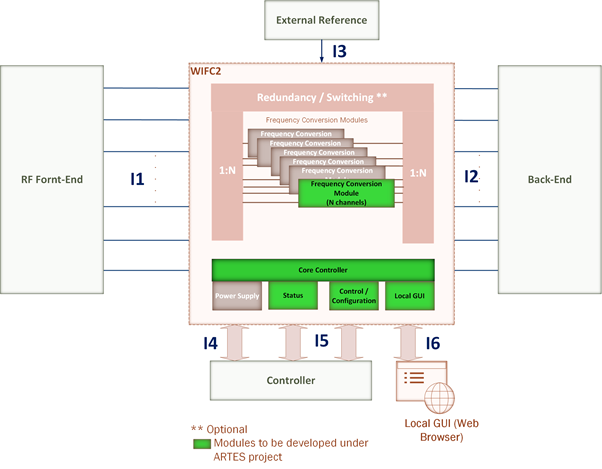
The top level block diagram of this WIF2C product is illustrated by the following figure:
-
Frequency Conversion module includes all components (local oscillators with synthesizers, OCXO-reference, mixers, filters, amplifiers), needed for the frequency translation.
-
The control / configuration module is in charge of control & configuration management of the product modules (e.g activation, maintenance, update and change between configurations).
-
The status module is responsible for reporting the values of the equipment parameters, including those of the M&C system itself, to the different clients, as well as any changes in the status parameters.
-
Local User interface embedded in the unit for local operator configuration, contingencies resolution, testing, validation.
Plan
This activity is organized in 2 phases as followed:
-
Definition Phase
-
User & Technical Requirements Definition
-
-
Technology Phase
-
Preliminary Design
-
Detailed Design
-
Development & Manufacturing
-
Final Verification
-
Project Closure
-
Current Status
The project achieved the Critical Design Review (CDR) milestone and is moving towards the Test Readiness Review (TRR) milestone.