

A joint endeavour between industry, research centres and universities across the Agency’s Member States. Coordinated by ESA’s directorates of Connectivity and Secure Communications, and Operations, and Technology, Engineering and Quality.
Global telecommunication systems require networking and optical technologies in order to provide the appropriate tools to address the growing capacity needs of our society. Future telecom satellites are to be seamlessly integrated into the terrestrial high-capacity networks, to extend the network in space. This means that large coverage can be achieved, and latency and connection costs can be reduced to remote areas.
Networking in space would benefit from interoperability because it allows the extension of the space network by adding new nodes in a progressive way. The first step of interoperability is compatibility between optical terminals, to make sure that free-space optical links can be established and used for data exchange and control and management purposes.
In recent decades, optical satellite communication has been successfully achieved from different orbits, developing and demonstrating key technologies for high data-rate communications. Throughout this time, several initiatives have focused on the standardisation and specification of optical communications in space, aiming for Interoperability in various scenarios.
The Consultative Committee for Space Data Systems (CCSDS) has been coordinating the initiatives of the space agencies around the world to define a set of standards to cover the main applications using optical communications in space.
- For high-data rate intersatellite links, in December 2018, CCSDS published as an orange book the experimental specification based on the experience achieved in the European Data Relay System (EDRS): “Optical High Data Rate Communication (HDR) – 1064 nm”.
- For deep-space links, in August 2019, CCSDS published as a blue book the recommended standard for the communications physical layer, where high-photon efficiency is needed.
- For direct downlinks, in July 2020, CCSDS published as pink sheets, the draft of a recommended standard aiming to low-complexity communication systems.
The USA Space Development Agency (SDA) published the “Optical Communications Terminal (OCT) Standard” specifying the main aspects of an optical terminal to achieve interoperability in free-space communications in a satellite constellation.
ESA welcomes this first step towards a global standard, and follows international stakeholders in the desire to extend it beyond the present <10 Gbit/s capabilities.
Overview of ESTOL
The document shall address optical bidirectional inter-satellite and ground-to-satellite links and it is divided into two major chapters: the physical layer requirements and the data link layer requirements.
The objective of ESTOL is to achieve an agnostic definition of requirements in terms of terminal design, to allow industry to develop its own solutions in the most flexible and efficient way.
The physical layer requirements chapter defines:
For example, the wavelength plan is defined, as well as the modulation schemes and the expected signal levels at the aperture of the optical terminals.
The data link layer requirements chapter defines:
The different options for transmitting data over the air-interface are defined in the document, as well as the control and management approach.
The specification of the air-interface includes requirements from the SDA OCT standard, as it is understood that commercial products have been developed following this standard. At the same time, OpenROADM has been also considered because commercial transceivers are implementing this standard for high-data rate fibre communications, allowing the use of both client signals OTN (Optical Transport Networking) and Ethernet. That enables the possibility of performing both circuit and packet switching.
Terabit/sec optical links air-interface
A high-throughput optical satellite network involves optical bidirectional inter-satellite and ground-to-satellite links. Achieving a flexible and scalable network, as addressed in terrestrial networks, requires inter-networking. A generic representation of an optical satellite network, as an extension of the optical terrestrial network is shown in Figure 1.
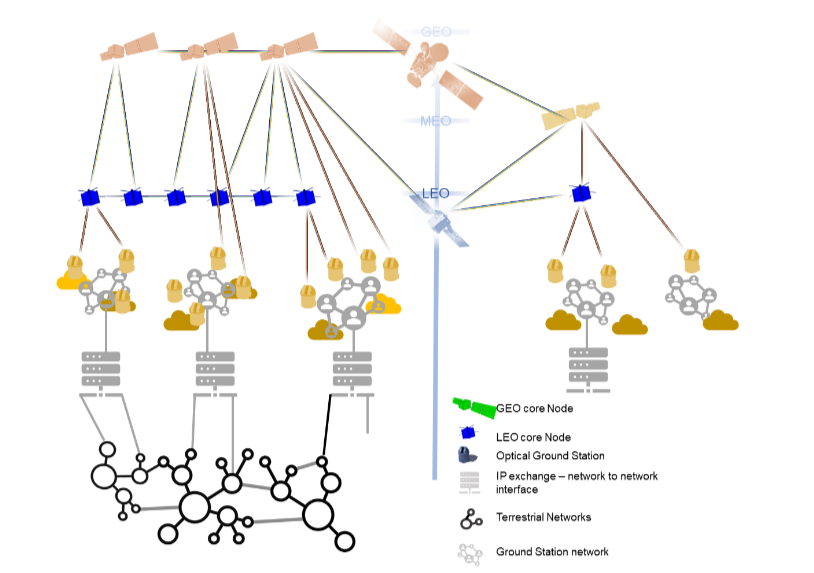
Inter-networking, i.e. interoperability between networks, must address many different aspects, including:
Consequently, in view of the future development of high-capacity satellite networks, ESA has supported and coordinated discussions on the definition of the air-interface, specifying the free-space optical links among satellites and ground nodes. This specification shall guarantee compatibility and foster harmonisation of both the technology developments and future commercial products. This is seen as a first step to achieving inter-operability between satellite-based optical networks and terrestrial infrastructure.
Since mid-2022, ESA (under the Strategic Programme Line on Optical and Quantum Technologies) and its stakeholders have also held a series of workshops to assess the interface specifications for next generation optical inter-satellite links and optical space-to-ground links on standards and interfaces.
Stakeholders in these discussions also clearly indicated the need for common standards beyond the air interface. The “ESA Specifications for Terabit/sec Optical Links” (ESTOL) is the result of the contributions from industry, research centres and universities of ESA member-states, coordinated and aggregated by the Agency.
ESTOL’s goal is to foster the development of interoperable commercial products implementing technologies for high data-rate optical links, connecting ground and space network nodes of optical high-capacity satellite networks. ESTOL aims to make use of available standards from space communications, but also from terrestrial networks, to maximise the re-use of commercially available products.
The High thRoughput Optical Network (HydRON) project takes ESTOL as its point of reference to implement its specification in the development of future satellite networks and their related technologies and it sets as own goal the demonstration of the air-interface defined in ESTOL.
Contributors
ESTOL’s development was driven by European and Canadian stakeholders in the satellite communications market. The contributors comprise the following industry partners, research centres and universities under the coordination of ESA (in alphabetical order):


ESTOL is being supported by contributors and observers from Japan:
Within ESA, the present document is a result of a cross-directorate effort with the support from the Directorate of Connectivity and Secure Communications, Directorate of Operations and Directorate of Technology, Engineering & Quality.
This list is being updated as new contributions from different entities are received.
Versions and current status
The outcome and conclusions of the latest ongoing discussions are collected in the current version of the ESTOL specification, which can be downloaded here. Please note that this is a living document that will evolve with the inputs of the contributors.
The list of all versions with the changes applied is documented in the following table:
| Version* | Reason for change | Date |
| 0.1 | New document for discussion (internal) | 05/07/2023 |
| 1.0 | New document on optical intersatellite links | 19/07/2023 |
| 1.1 | PAT update (internal) | 31/07/2023 |
| 2.0 | Satellite-to-ground links included (internal) | 17/01/2024 |
| 2.1 | Wavelength plan and sensitivity values update (internal) | 22/03/2024 |
| 2.2 | PAT and sensitivity values update | 01/07/2024 |
RELATED LINKS & CONTACTS
CONTACT
Harald Mathias Hauschildt
ESA’s European Space Research and Technology Centre (ESTEC)
Keplerlaan 1
2201 AZ Noordwijk, The Netherlands
+31 (0)7156 58257
Harald.Hauschildt@esa.int
