
PAGE CONTENTS
Objectives
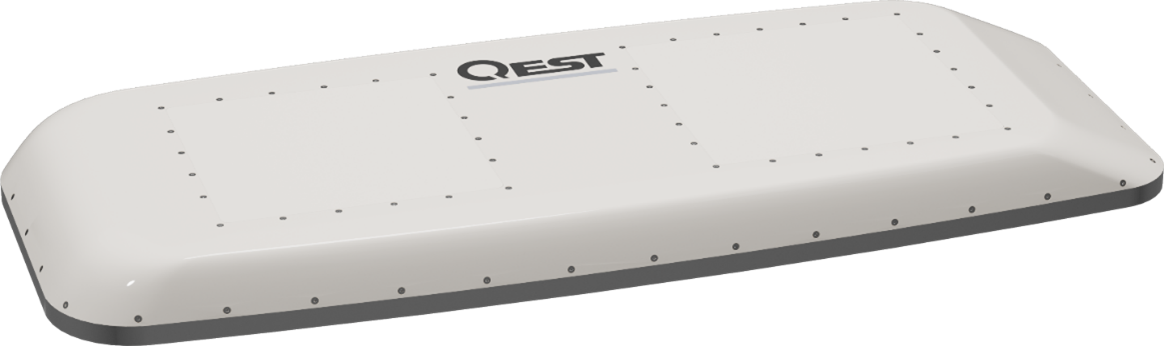
The QEST Ka Q-EPA Antenna Assembly project is focused on developing a Ka-Band airborne satellite communication antenna system that supports next-generation Ka-Band LEO satellite technology and is compatible with Ka-Band GEO satellite networks.
This project targets commercial aviation as the initial global entry market. However, the core antenna technology is designed to be modular, enabling adaptation for various airborne applications such as business jets, governmental aircraft, and other satellite-on-the-move use cases.
The primary objective of the project’s technology phase is to develop and manufacture engineering model hardware. This hardware will undergo laboratory testing to validate the technology in a Telesat LEO/GEO satellite network environment through over-the-air testing.
Challenges
The project aims to deliver an antenna technology that combines the following key attributes:
• Low profile
• Fast satellite tracking
• High performance
• Low power consumption
Phased array technology is critical to achieving a low-profile design while enabling rapid electronic beam steering.
QEST addresses the challenge of combining these capabilities with minimal power usage through its patented Q-EPA technology.
System Architecture
The receive and transmit panels of the Q-EPA antenna establish links to any compatible Ka-Band satellite—both LEO and GEO—via radio frequency signals. Unlike mechanically steered systems, the Q-EPA antenna uses advanced phased array technology to electronically steer its beam with high precision.
Signal processing and amplification are managed by the RF amplifier module, which includes a high-power amplifier for the transmit path and a dedicated low-noise amplifier (LNA) for the receive path.
At the heart of the system is the Antenna Control Unit (ACU), a central computing platform responsible for managing all aspects of antenna operation. This includes panel coordination, beam pointing, and real-time satellite tracking. The ACU executes precise control algorithms and interfaces with external systems to ensure seamless communication, even in dynamic airborne or mobile environments.
Plan
The project’s technology phase runs from the second quarter of 2025 to the last quarter of 2026 and encompasses the development of Rx/Tx submodules and panels, electronics, antenna outline modules, aircraft installation design, design for manufacturability, and final system testing.
The initial milestones focus on evaluating system requirements through a Specification & Requirement Review. This is followed by the antenna development phase, where these requirements are translated into a functional technology, assessed during the Preliminary Design Review and Submodule Review.
Prototypes are built during the Integration Review phase and subsequently undergo rigorous over-the-air testing, during which the antenna establishes live communication with an operational satellite network. This testing phase serves as the primary evaluation of system performance and concludes with the Final Review, confirming the technology’s readiness for deployment.
Current Status
The project will result in a functional prototype of the Ka Q-EPA satellite antenna. The underlying Q-EPA technology is already proven through successful testing in the Ku-frequency band.
The antenna requirements are well-defined, and the assembly of the first Ka-band test panel is currently underway.