PAGE CONTENTS
Objectives
The CONAN project aimed to design, manufacture, and validate a radiation-tolerant integrated circuit implementing a fully autonomous and configurable Electronic Circuit Breaker and Latch-up Current Limiter controller for spacecraft power distribution units (PCDUs). The objective was to provide a single, compact semiconductor solution capable of managing high-voltage bus protection, telemetry acquisition, and redundant switching within the 20V to 130V range used on telecommunications platforms.
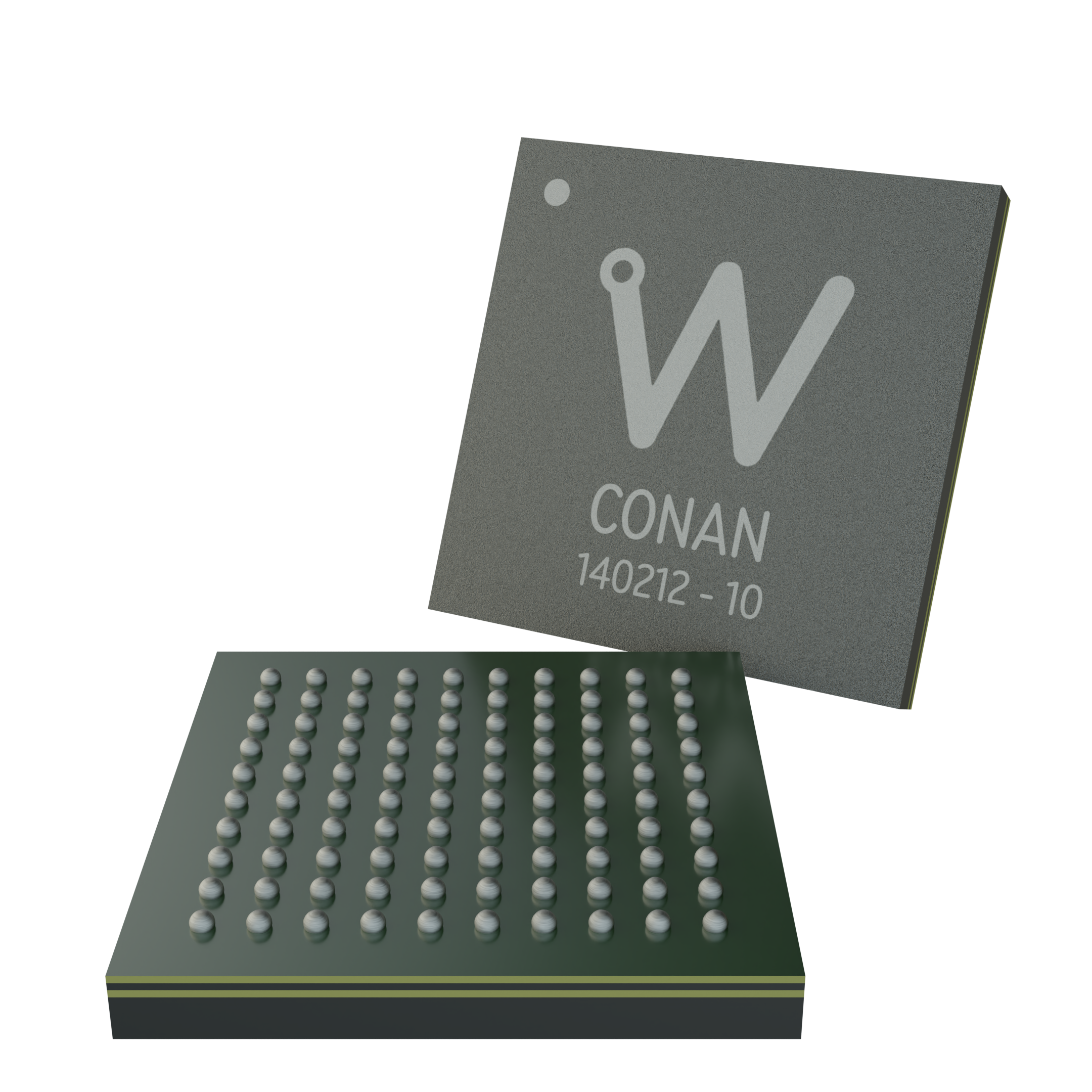
The activity covered the complete ASIC development flow—from requirements capture and architecture definition through detailed design, fabrication, and laboratory validation. The resulting device integrates programmable current protection, dual-bus communication, telemetry conversion, heater control, and self-protection features in a 15 mm × 15 mm BGA package.
The project’s primary goal was to increase the reliability and efficiency of spacecraft electrical power distribution while reducing system mass, complexity, and non-recurring engineering costs. The CONAN controller offers European primes and new space companies a new building block for next-generation PCDUs, enabling safer and more intelligent power management architectures across future telecom and scientific missions.
Benefits
The CONAN ASIC introduces a compact, programmable, and radiation-tolerant alternative to discrete LCL and R-LCL implementations currently used in spacecraft power distribution. It significantly reduces printed-circuit board area, component count, and design risk while increasing telemetry richness and configurability. By embedding programmable thresholds, automatic restart logic, and dual-bus communication in a single device, CONAN enables system designers to optimize protection behaviour without hardware changes.
Compared with legacy solutions, CONAN lowers non-recurring engineering costs for PCDU manufacturers and simplifies procurement logistics by integrating protection, control, and monitoring into one European-sourced component. Its radiation tolerance and wide voltage capability support long-lived telecommunication platforms, scientific spacecraft, and exploration missions where electrical robustness and redundancy are critical. The resulting product strengthens European autonomy in space-qualified power-management semiconductors.
Features
The CONAN ASIC integrates all electronic functions required to control one or two external PMOS transistors and supervises current, voltage, temperature, and operational status. The current limit and trip timing are programmable either through serial interface commands or by external resistors for stand-alone operation.
The device features redundant hardened serial interfaces compatible with space communication protocols, integrated ADCs for telemetry conversion, and eight auxiliary heater control channels. Internal protection mechanisms include over-current, under-voltage, over-temperature, and self-protection for the high-voltage gate drivers.
Operating from a 20 V to 130 V bus, CONAN supports both nominal and redundant switching paths. It is delivered in a 100-pin BGA package (15 mm × 15 mm) optimized for space assembly constraints and thermal performance.
Challenges
Developing a mixed-signal ASIC operating up to 130 V in a radiation-tolerant process represented a significant design and validation challenge. Achieving stable high-voltage control while maintaining precision telemetry and low-power consumption required careful isolation between analog, digital, and power domains. Ensuring robustness against failure propagation constrained architecture and layout choices. Coordination between system integrators, foundry, and test facilities was essential to achieve performance repeatability and space qualification margins within the project timeframe.
System Architecture
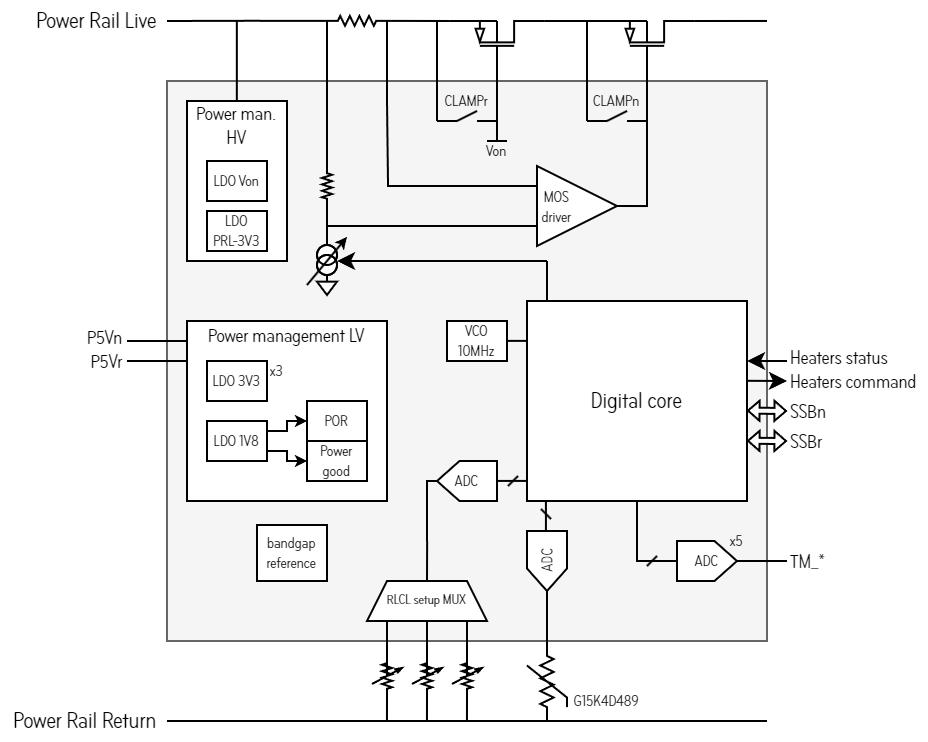
The CONAN architecture combines high-voltage analog blocks for current sensing and MOSFET gate control with low-voltage digital logic and telemetry management. The core comprises an analog front-end, protection comparators, ADCs, a clock-management unit, and a micro-sequencer controlling state transitions between protection modes. Digital communication is handled by two fully redundant serial interfaces, ensuring command and telemetry robustness.
An internal biasing and reference subsystem provides stable voltage and current references across temperature and radiation conditions. Separate analog and digital supply domains minimize cross-talk and allow flexible integration into complex PCDU topologies. The architecture was validated by electrical simulation, post-layout verification, and laboratory testing to confirm functional margins over radiation, temperature, and voltage variations.
Plan
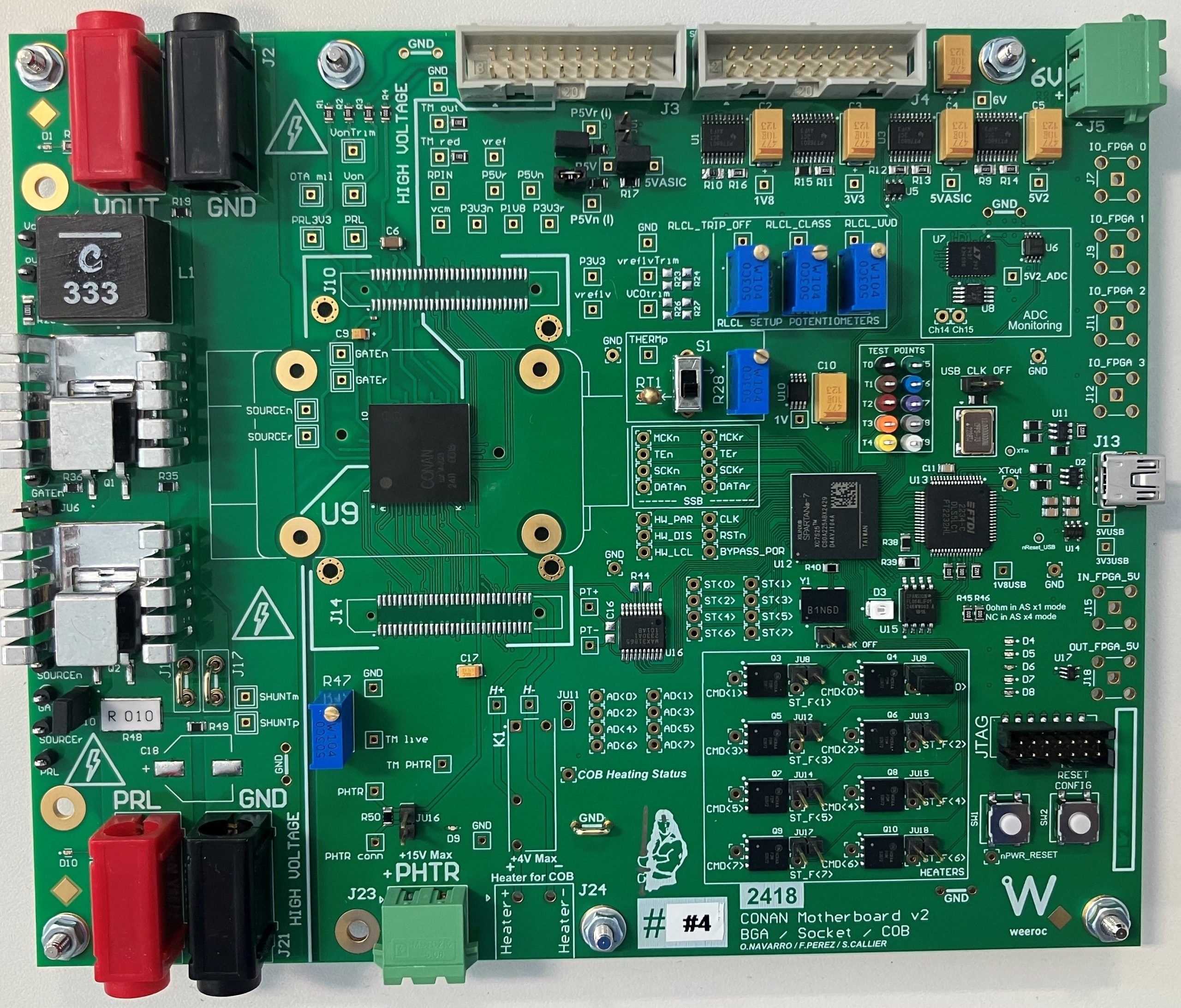
The project comprised three main phases: design and fabrication of the ASIC, functional and electrical characterization, and final validation under radiation and temperature conditions. Each milestone was associated with ESA reviews: Design Review, Test Readiness Review, and Final Review. Following delivery of the validation results and Final Report, the ARTES Advanced Technology activity was successfully closed, providing a ready-to-industrialise component for subsequent product qualification under ARTES Competitiveness & Growth.
Current Status
The CONAN project has been successfully completed. The ASIC was designed, manufactured, and validated through comprehensive electrical, thermal, and radiation testing. All major performance objectives were met, and the device demonstrated stable operation across the full voltage and temperature ranges required for telecom satellite platforms. The Final Review confirmed completion of the ARTES Advanced Technology activity, with Weeroc and Airbus Defence and Space defining the roadmap for industrialisation and qualification under the ARTES Competitiveness & Growth framework. The CONAN ASIC is now ready for adoption in next-generation European spacecraft power distribution units.