


PAGE CONTENTS
Objectives
Development of efficient digital beamforming algorithms: The activity focuses on developing low-complexity and highly efficient digital beamforming algorithms for satellite communication payloads based on digital processors, with the objective of reducing implementation complexity while maintaining flexibility and performance.
Exploitation of beam and array symmetry: Mathematical techniques exploiting the spatial symmetry of both the beams and the radiating elements are investigated to simplify the processing chain. This approach aims to reduce the required operations to a set of additions and subtractions, and in many cases to avoid multiplication operations entirely.
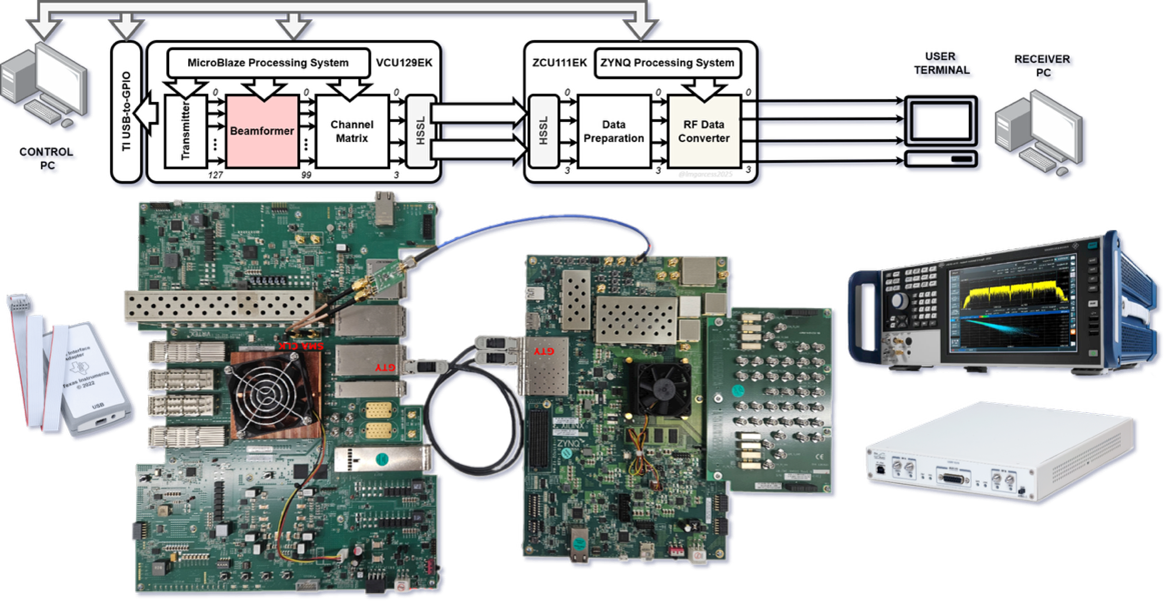
Representative digital processor testbed: A representative digital processor testbed is developed to implement and validate the proposed algorithms and processing techniques under realistic conditions, providing a practical demonstration of their feasibility.
Reduction of power, mass, and hardware complexity: The activity targets significant reductions in power consumption, mass, and volume, while also improving integration efficiency. In particular, it aims for a 50% reduction in power consumption and a 50% reduction in the number of ASIC/FPGA components compared with current digital beamforming implementations.
Advancement toward flexible high-capacity payloads: The activity is intended as an enabling technology for the development of highly flexible, high-capacity digital payloads based on large antenna arrays, increasing their practical readiness for future SATCOM systems.
Technology Readiness Level (TRL) increase: The activity aims to raise the Technology Readiness Level from TRL 2 to TRL 4 through algorithm development, implementation, and validation on the representative processor testbed.
Benefits
Reduced power consumption: The proposed architecture targets a major reduction in power consumption compared with conventional digital beamforming implementations by combining FFT-based processing, sparse-matrix precoding, and hardware-efficient routing.
Lower FPGA/ASIC resource usage: The use of sparse matrix mapping, cluster-based precoding, and quantized twiddle factors reduces logic, DSP, and hardware requirements, enabling a lighter digital implementation.
Reduced DSP Utilisation: Twiddle-factor quantization and low-complexity precoding reduce dependence on DSP blocks, freeing resources for other processing functions or enabling lower-cost implementations.
Simplified interconnection and routing: The Benes Permutation Network provides an efficient routing solution with low logic usage, making dynamic signal assignment more practical and scalable.
Improved scalability: The structured combination of routing, precoding, FFT, and spatial windowing makes the architecture well suited for large multi-beam payloads and future high-capacity satellite systems.
Efficient payload resource Utilisation: The architecture supports overlapping beams and flexible beam combinations, allowing coverage to be adapted efficiently to traffic or service-area requirements.
Beam steering beyond the FFT grid: Although the FFT provides a uniform beam grid, the system can generate coverage toward arbitrary directions or non-uniform target areas through suitable combinations of beams.
Features
FFT-Based Digital Beamforming Core: The product is built around a 2D FFT-based digital beamforming architecture that provides an efficient and structured framework for multi-beam SATCOM payload processing.
Dynamic user-to-beam routing: The routing stage supports dynamic mapping between user signals and beamforming inputs, enabling flexible allocation of resources according to traffic demand and coverage needs.
Benes permutation network routing: The routing architecture is based on a Benes Permutation Network, providing low-power and low-logic-complexity signal interconnection with scalable and flexible user-to-beam assignment.
Linear precoder module with sparse matrix mapping: The linear precoder uses a sparse matrix model to reduce implementation complexity and resource consumption while preserving the required beamforming flexibility.
Cluster-based local precoding: The precoding stage supports grouping in clusters, enabling localised processing and reducing the computational burden of the overall architecture.
Reduced DSP usage: The linear precoder and FFT processing chain are designed to significantly reduce DSP usage, including a reported 32× DSP reduction in the precoding stage.
Two Parallel FFT Implementation Options:
The architecture supports two parallel implementations of the 2D 16-point FFT:
• a non-quantised twiddle-factor version for high precision, using DSP resources;
• a quantised twiddle-factor version that avoids DSP usage and enables resource reallocation.
Spatial windowing stage: A spatial window is applied after the FFT to shape the beam pattern, control overlap, and support more efficient coverage generation.
Support for overlapping beams and flexible coverage: The architecture enables efficient coverage generation with overlapping beams and supports steering beyond the strict uniform FFT grid through appropriate beam combination.
Challenges
High-computational complexity of digital beamforming: Conventional digital beamforming for large SATCOM antenna arrays requires a high number of operations, particularly multiplications, which leads to substantial processing complexity and limits efficient real-time implementation.
Power consumption constraints in on-board processing: Digital beamforming implementations based on current processing architectures can consume significant power, which is a major challenge for satellite payloads where power resources are limited.
Mass, volume, and integration limitations: The use of multiple ASICs/FPGAs and associated hardware increases the mass, volume, and integration complexity of the payload, making the implementation of highly flexible digital beamforming architectures more difficult.
Scalability to large array antennas: As the number of antenna elements and beams increases, the processing requirements grow rapidly. Ensuring scalability while maintaining manageable hardware complexity is therefore a key challenge.
Efficient exploitation of spatial symmetry: Although the spatial symmetry of beams and radiating elements offers strong potential for simplification, translating these mathematical properties into practical low-complexity algorithms and architectures remains challenging.
Validation on representative hardware: Demonstrating the feasibility of the proposed techniques requires implementation and testing on a representative digital processor testbed, which is essential to bridge the gap between theoretical development and practical applicability.
System Architecture
The proposed system is a 2D FFT-based digital beamforming architecture designed for efficient implementation in SATCOM payloads. The processing chain starts with a routing stage, which dynamically maps user signals to the beamforming network. This routing is based on a Benes Permutation Network (BPN), enabling flexible user-to-beam assignment with low power and logic usage.
After routing, the signals are processed by a linear precoder module, where a sparse matrix is used to reduce resource consumption. The precoding stage is organized in clusters, allowing local precoding and significantly decreasing DSP usage compared with conventional implementations.
The precoded signals are then fed into a 2D 16-point FFT block, which performs the core beamforming operation. Two implementation options are considered for this stage: a non-quantized twiddle-factor version, which provides higher precision at the cost of DSP usage, and a quantized twiddle-factor version, which removes DSP dependence and enables hardware resource savings. Trade-off analysis shows that quantisation, rounding, truncation, and bit-width selection directly affect the resulting SNR and must therefore be carefully optimised.
Following the FFT stage, a spatial windowing block is applied to shape the beam pattern and improve coverage control. The overall architecture is implemented on a fixed 10×10 subarray, which reduces the number of antennas and RF chains while making efficient use of payload resources. In addition, the use of overlapping beams allows the system to extend coverage beyond the strict uniform FFT grid and to address more general, non-uniform service areas through appropriate beam combination.

Plan
Current Status
TAR Finalised.

