Sunrise

Ongoing
Space for 5G

The Sunrise Partnership Project is focused on developing next-generation satellite communications and associated technologies
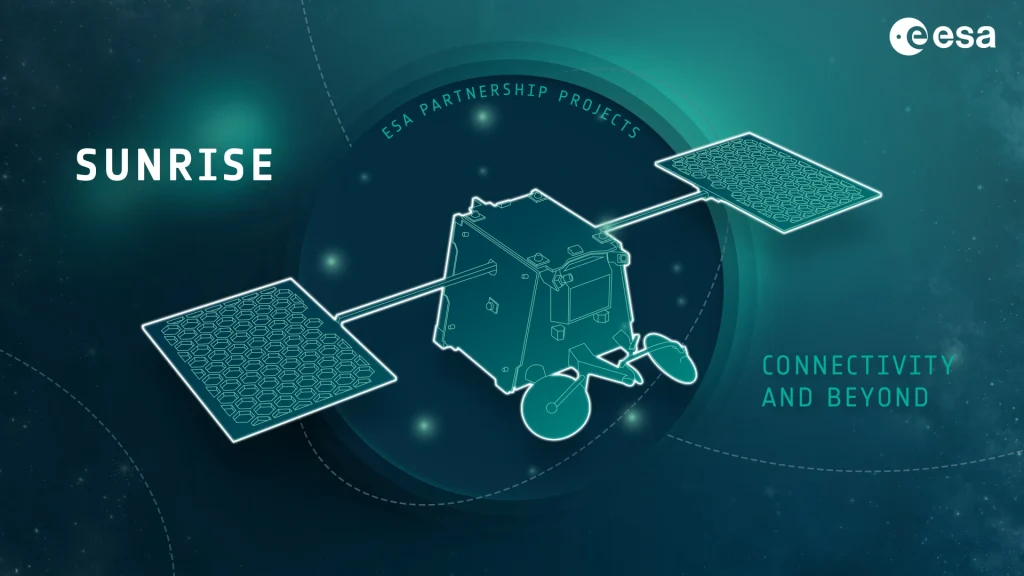
Sunrise project key visual

The project is structured as a public-private partnership, supporting European industry, promoting competitiveness, and enabling novel capabilities in Earth orbit for telecommunications, connectivity, servicing and sustainability.

The satellite communications industry is undergoing rapid transformation: the rise of low-Earth orbit (LEO) constellations, convergence of satellite and terrestrial 5G/6G networks, increasing demand for direct-to-device services, as well as heightened focus on sustainability, including debris removal and end-of-life servicing. ESA’s Sunrise project responds to these trends by helping European industry develop, mature and validate enabling technologies across payloads, user terminals, active antennas, beam-hopping, servicing, active debris removal in orbit, and multi-orbit systems.

The project also addresses Europe’s strategic imperative of maintaining sovereign access to space-based telecommunications infrastructure and enabling European companies to remain competitive in a global market. Moving from traditional GEO telecommunications models to LEO / medium Earth orbit (MEO) hybrids, beam-hopping, flexible user terminals and servicing, Sunrise is part of ESA’s Partnership Project programme line.

The project exemplifies how public-private collaboration can drive breakthrough technologies, industrial innovation and strategic autonomy.


Sunrise’s phases


Sunrise is organised in phases, each addressing different maturity levels and industrialisation steps

Phase 1 and 2 focuses on identifying key technologies and validating them (ground prototypes, in-orbit demonstrators). For example, early work with OneWeb, before its merger with Eutelsat Group, addressed digital payloads, user terminals and 5G convergence.
Phase 3, which was launched formally in May 2024, emphasises industrialisation, production readiness, small-sat/constellation deployment, mass-manufacturing and sustainability. The contract signed on 15 May 2024 at ESA HQ in Paris marks this milestone.
The project is supported by several ESA Member States, including the UK, Austria, Italy and Romania, and relies on European industry clusters – for example, SMEs and supply-chain participants across Europe – and the UK Space Agency.


Major technological focus areas

Sunrise covers several interrelated technology domains

Beam-hopping and digital payloads
Demonstrating flexible beam steering and dynamic resource allocation to improve satellite system efficiency.
Integration of 5G/6G and satellite connectivity
Supporting hybrid terrestrial-satellite networks, enabling 5G non-terrestrial networks (NTN) readiness, user-terminal development, and direct-to-device possibilities.
End-of-life servicing and active debris removal (ADR)
Under Sunrise, ESA and industry partners such as Astroscale UK are developing commercial servicing solutions for satellite end-of-life.
Mass-manufacturing and industrial scalability
Phase 3 emphasises industrial production readiness of satellite platforms, modular subsystems, supply-chain readiness and economics of scale for constellations.
Multi-Orbit solutions and new services
Beyond single-orbit telecommunications, Sunrise supports technologies for LEO, MEO and hybrid systems (connectivity, remote-sensing payloads, AIS/ADS-B surveillance) enabled through the partnership.


Impacts and benefits 

The Sunrise project carries significant strategic benefits for Europe

ndustrial competitiveness
By derisking cutting-edge technologies and co-funding demonstrators, it helps European operators and suppliers to remain competitive in global satellite markets (particularly LEO/MEO constellations and 5G/6G integration).
Sovereignty and autonomy
Supporting European operators and industry ensures Europe retains independent access to satellite communication infrastructure and associated technologies.
Innovation ecosystem
Enables collaboration across large operators (Eutelsat Group), service providers, SMEs and research organisations. This stimulates supply-chain growth, technology spin-offs and new business models.
Sustainability & long-term space usage
The inclusion of ADR and servicing activities under Sunrise addresses orbital debris and sustainability concerns, aligning with global space-sustainability goals.
New business models
Moves away from classical GEO telecommunications and into hybrid, multi-orbit, flexible and service-oriented architectures, opening opportunities in direct-to-device, mobility, Internet of Things (IoT) and other emerging markets.


Sunrise Next Gen

Sunrise Next Gen, which supports ESA’s goals by advancing mobile convergence between terrestrial and non-terrestrial networks, is focused on several key objectives

Enabling a seamless transition towards unified terrestrial/non-terrestrial (TN/NTN) architectures, anticipating future 5G/6G standards.
Improving capacity, flexibility, and spectral efficiency through advanced beamforming and dynamic resource allocation.
Integrate Positioning, Navigation, and Timing (PNT) capabilities for resilience against interference and spoofing.
De-risking and validating space, ground, and user segment innovations to maintain European competitiveness.
Incorporating industrialisation and scalability from the outset to enable mass production of satellites, gateways, and user terminals.
Promote European sourcing of critical components to reduce dependence on non-European suppliers.


Evolution of Sunrise 

Phase 1 (2019 – 2020)
Preparatory studies identifying critical technologies.
Phase 2 (2021 – 2026)
Technology maturation and in-orbit validation via the JoeySat demonstration satellite. JoeySat successfully tested dynamic beam-hopping and flexible payloads, surpassing its planned mission lifetime.
Phase 3 (2024 – 2028)
Supports the ongoing development of technologies for NextGen batches 1 and 2, focusing on new space hardware and user terminals.
Phase 4 (2026 – 2029)
Focuses on the development and qualification of innovative payloads, user terminals, antennas, and ground segment technologies for Batch 3. It will also support responsible space activities such as active debris removal and end-of-life management.

RELATED LINKS & CONTACS