
PAGE CONTENTS
Objectives
5G-HOSTS-SAT focuses on experimental validation of various vertical services in 5G environments enhanced with satellite technologies. The final aim is to identify business drivers, technical challenges and practical solutions to foster and facilitate the creation of new applications in sectors that particularly benefit from the integration of satellite in 5G networks.
This is achieved through three objectives:
• The creation of a multi-site testbed and validation framework for test, troubleshooting, and performance evaluation of vertical applications in satellite-enabled 5G networks. The latest 5G technologies in 5G RAN and core are enhanced with innovative features for orchestration, network exposure, monitoring, AI-driven automation and programmable satellite networks, combined with edge/cloud and MLOps platforms for distributed AI-driven applications and smart devices. Standard architectures and open interfaces allow to replicate realistic operational environments and build customisable scenarios.
• The enhancement of concrete vertical applications in various business sectors to exploit the new features offered by 5G-SatCom integration.
• The direct involvement of vertical industries in extensive OTA field trials, with network and infrastructure KPI monitoring, service performance evaluation and application tuning. The first phase involved verticals from smart agriculture and PPDR sectors, in collaborations with Civil Protection of Friuli Venezia Giulia. The second phase is extended to smart ports, smart livestock management, multimedia content production and distribution, and Transport and remote environment monitoring.
Benefits
The 5G-HOSTS-SAT project delivers several products:
• A 5G-SatCom testbed for OTA trials of vertical services, with a configurable and programmable platform for service and network orchestration, network exposure APIs, monitoring and SDN control, extended to the hybrid satellite/terrestrial backhaul. The solution integrates service-aware network orchestration and automation for end-to-end network slicing, resource orchestration in cloud/edge continuum, MLOps platforms for edge AI, and traffic steering with per-flow granularity.
• Mission Critical (MC) applications for PPDR services (phase 1), optimised for on-demand and reliable deployments in remote or disaster areas difficult to reach, with automatic configuration of satellite connectivity. Key benefits are QoS guarantees for traffic of various MC applications, user prioritization, slice isolation, and pre-emption to support high-priority traffic on custom network slices.
• A smart agriculture application for precision irrigation (phase 1), empowering Internet of Things (IoT) sensors and actuators connected via 5G network and self-calibration ML techniques. The solution guarantees more efficient irrigation scheduling reducing water and energy consumption.
• A smart port application for reliable monitoring of port areas (phase 2), to be trialled in the Tuscany archipelago (Isola d’Elba and Isola di Capraia). The application integrates IoT sensors and AI-based video surveillance, enabling remote operators to receive alerts and visualize the target areas in real-time.
• A smart livestock application for GreenHouse Gas (GHG) monitoring in agrosilvopastoral landscapes (phase 2), with sensor data collected via 5G network, processed at the edge and distributed to the cloud via GEO satellite.
• A multimedia application for production and distribution of multimedia contents from remote areas (phase 2), exploiting private 5G local networks and aggregation of LEO satellite connections for improved video distribution.
A remote environment monitoring application assisted by Unmanned Guided Vehicles (UGV) with hybrid 5G and LEO satellite connectivity and edge capabilities for AI-based video surveillance and sensor data analytics.
Features
The 5G-HOSTS-SAT testbed integrates a programmable 5G hybrid backhaul that can be configured to switch automatically between terrestrial and satellite links on per-flow and per-slice basis. This is enabled through the STARFISH platform, which exposes open interfaces for monitoring and on-demand configuration of satellite connectivity. The service and network orchestrator allows to jointly allocate computing resources for distributed applications in the edge/cloud continuum and manage the provisioning of dedicated end-to-end network slices in multi-domain scenarios. An exposure gateway compliant with CAMARA APIs and GSMA Open Gateway architecture enables advanced interactions between applications and infrastructures, for Quality on Demand and dynamic edge application management. At runtime, Artificial Intelligence and Machine Learning (AI/ML) techniques implement the closed-loop automation logic that drives the traffic steering between terrestrial and satellite links, according to real-time network monitoring data, application load and service demands. The light-weight service-driven local orchestration in private 5G bubbles allows the dynamic deployment of fully autonomous 5G networks and AI-based edge/extreme-edge applications over portable devices, extreme edge nodes, or UGVs, fundamental for PPDR, smart ports, and remote environment monitoring scenarios. The combined usage of edge and cloud resources enables the adoption of distributed AI techniques in the smart agriculture sector for more efficient irrigation control, as well as pervasive collection of heterogeneous IoT data in the smart livestock sector, further facilitated by the satellite coverage that allows to reach large or fragmented crop systems minimising the CAPEX.
Challenges
5G-HOSTS-SAT challenges are related to the creation of a flexible, modular and highly customisable experimental environment integrating 5G-SatCom technologies, including GEO and LEO, with a set of monitoring, orchestration and testing tools to facilitate trials in several vertical sectors.
Application developers and service providers need a friendly platform which automates the configuration of the testing environment, hiding the complexity of 5G, satellite, and edge/cloud resources and gives the opportunity to exploit advanced infrastructure capabilities. These include bi-directional interactions with the network for Quality on Demand and retrieval of network insights to dynamically improve application performances. Moreover, the integration of MLOps and edge platforms enables the deployment of vertical applications based on edge AI for advanced service features. Test execution, troubleshooting and results analysis must be facilitated with tools to correlate network KPIs, computing and service metrics and perform automatic diagnostic. The trial environments should guarantee the service capabilities and QoS performance of realistic and operational infrastructures, while offering open interfaces to test innovative solutions for joint orchestration and automation of 5G-SatCom networks and vertical applications.
System Architecture
The 5G-HOSTS-SAT testbed on field hosts local 5G networks, e.g., Non-Public Networks, equipped with edge computing resources to run local applications and AI workloads. A programmable hybrid terrestrial/satellite backhaul, provides the transport connectivity to the “core” elements of the 5G Core Network, enabling access to Internet and cloud services. The adoption of cloud native functions allows to split the 5G CN between edge and core domains depending on use case requirements. Direct satellite access integrated in 5G networks for efficient collection of sensor data from remote areas is also available to support mIoT traffic flows. Fully autonomous 5G networks for PPDR, remote video-surveillance for smart ports or environment monitoring deploy user and control plane components at the edge, with temporary satellite backhaul connectivity established on demand for periodical synchronization with the control centre or remote visualization of video streams. Distributed services with applications executed partially in the cloud maintain only a local UPF at the edge, while the rest is deployed on the core side, with a continuous backhaul connectivity.
Using SDN techniques and backhaul programmability, the traffic is dynamically steered through terrestrial or satellite link, following per-slice or per-flow criteria. Moreover, through the STARFISH platform it is possible to adjust the satellite connectivity depending on the service requirements. This is handled through the integration between SDN controller and orchestrator logic, in order to take joint decisions that combine service and networking aspects in an end-to-end manner. The introduction of LEO satellite connections in phase 2 allows to cover scenarios requiring lower latencies, including the adoption of UGVs for remote monitoring and surveillance and the possibility to bundle multiple satellite links from different LEO connection providers to improve video distribution from remote areas.
Plan
The first 5G-HOSTS-SAT phase had a workplan structured in four milestones. The baseline design (6 months) included use cases, architecture and technical requirements definition, with MVP specification for smart agriculture and PPDR services. This was followed by design and implementation of 5G-HOSTS-SAT testbeds, planned for the CDR. The implementation of two vertical solutions with OTA field trials setup led to the PPR. The final step covered field trials execution, results analysis and development roadmap definition for the final review.
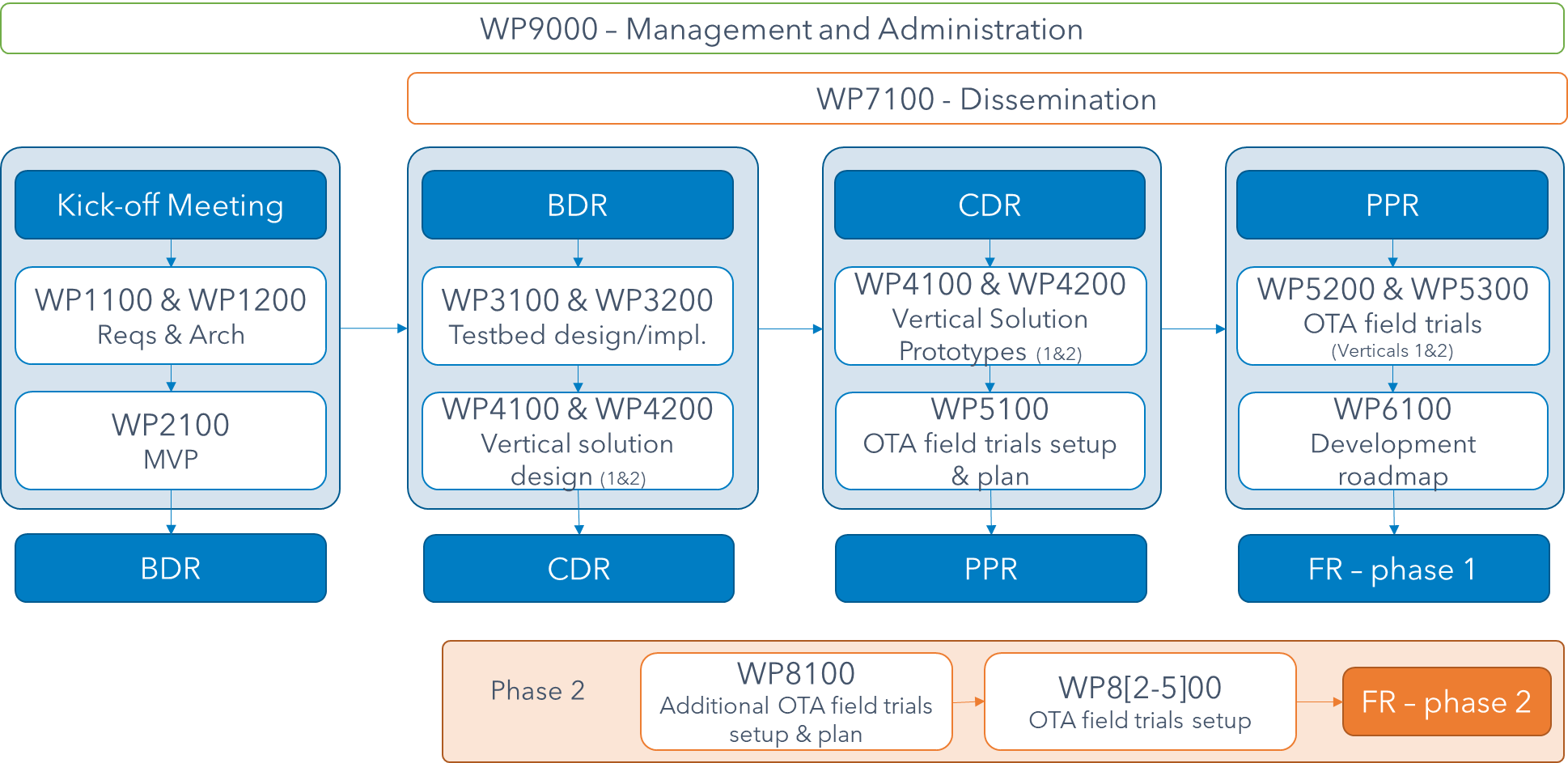
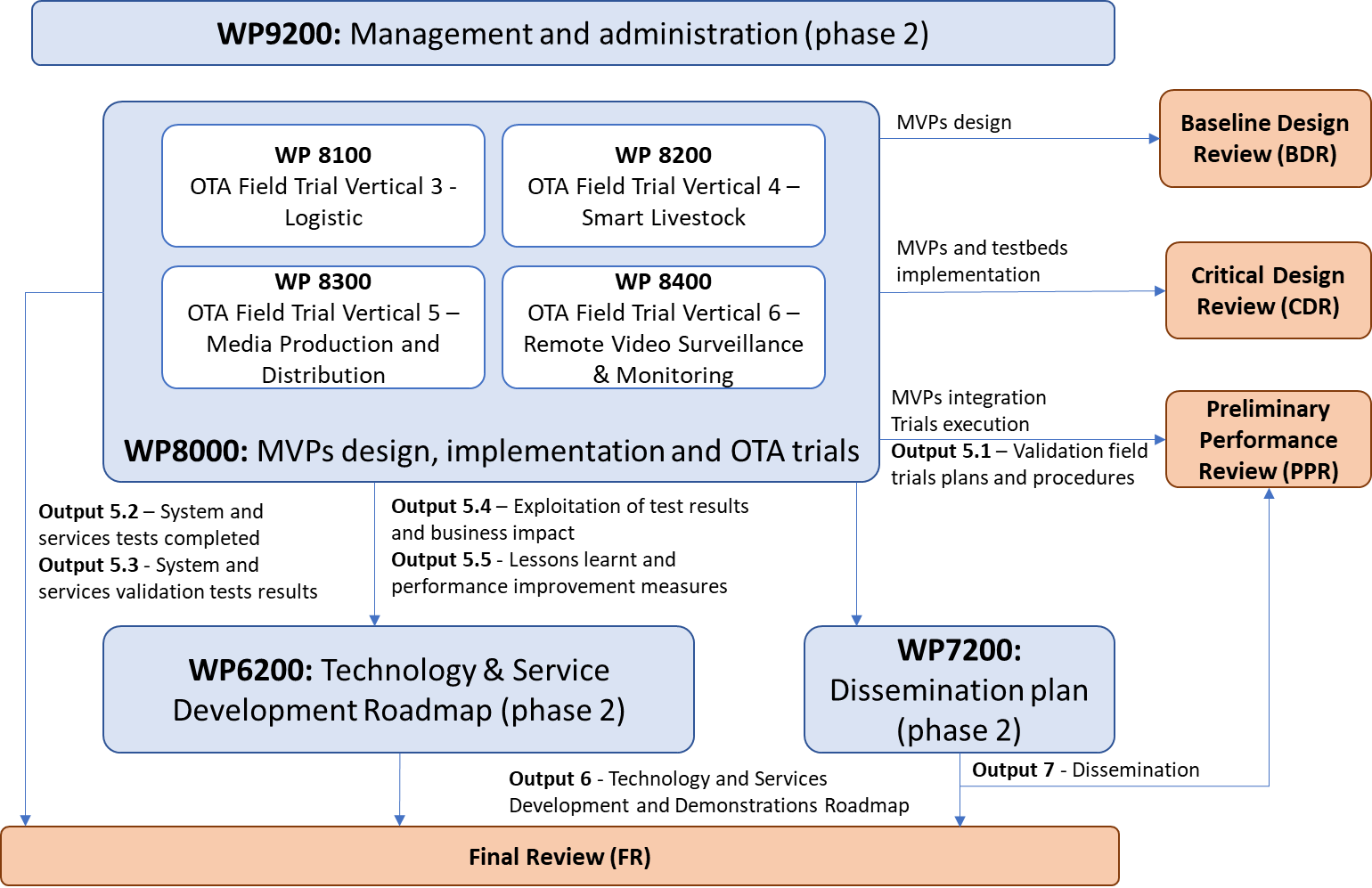
The second phase, started in February 2026, spans 18 months and addresses four additional trials. Each trial is organized in four main stages: MVP design for the BDR, MVP and testbed implementation for the CDR, integration and OTA trial execution for the PPR, and the final result analysis leading to the final review. The final stage is complemented by a business-oriented analysis of the trial outcomes to define technology and service roadmaps, while dissemination actions will continuously run during the entire project execution with publications and participation in training lessons or industrial events.
Current Status
The project has successfully concluded the first phase with the OTA trial execution and demonstration of PPDR and smart agriculture applications. The project is now at the beginning of the second phase, working on MVPs and system architecture for the four vertical trials in smart port, smart livestock, multimedia, and remote environment monitoring sectors.
Companies