
PAGE CONTENTS
Objectives
5G-LEO aims to accelerate the development of Open Air Interface (OAI) as an open-source tool allowing the exchange and comparison of 5G NTN results by the satellite communications community and facilitating the collaboration in R&D activities. The extended OAI software library is seen as an important instrument to develop early prototypes for validating key 5G NTN design aspects and providing prompt feedback to the 3GPP standardisation process. The main objectives of the 5G-LEO project are the following:
- Review the reference scenarios and use cases identified for NR-NTN system deployments by 3GPP and selection of a 5G LEO baseline scenario to be implemented and verified with the extended OAI library;
- Identification of the fundamental gaps and changes needed in the code base for properly extending OAI for the 5G LEO baseline scenario;
- Implementation of the required OAI code adaptations for the different layers of the 3GPP protocol stack to support 5G LEO and closely following the developments in 3GPP standardisation for 5G-NTN within Rel-17 and potentially in Rel-18;
- Set-up an end-to-end 5G LEO demonstrator in the lab for experimental validation of the OAI extension for the 5G-LEO baseline scenario.
Benefits
5G-LEO helps the prototyping of and experimentation with 5G LEO communication networks closely following the 3GPP Work Item on Non-Terrestrial-Networks (NTN) and thus supporting the evolution of the 5G New Radio standard regarding NTN.
The main outcome of this activity is a publicly available new, improved version of the open source OAI software library with new features to support 5G LEO satellite communication networks. After functional and real-time validation in lab, the risks to go over live satellite links is significantly reduced.
Features
The 5G-LEO solution is characterised by the following features:
- Firstly, an important concept of 5G-LEO is to evolve an existing open-source software implementation platform, the OpenAirInterface™, which has a very considerable supporting community. This approach is expected to support achieving a significant impact;
- The main feature of the 5G-LEO platform is that it enables end-to-end testing and performance verification of 5G direct access adapted to LEO satellite systems using an emulator environment;
- Further important features include the mitigation of satellite RF impairments of the 5G signal as part of the implementation, in combination with the handling of considerable Doppler shift and handover rates through the compensation at the different layers of the protocol stack at the 5G NR UE and gNB.
Challenges
The key challenge of 5G-LEO is the implementation of 5G NR g-NodeB (gNB) and User Equipment (UE) components adapted to LEO satellite systems while the standardisation of these NTN features is still ongoing within 3GPP. More specifically, mitigating satellite RF impairments and considerable Doppler shift of the 5G signal represent specific challenges for the implementation that need to be compensated at the different layers and at the 5G NR UE and gNB.
As LEO satellites have relatively small beams and are moving fast, 3GPP currently assumes beam steering to be available on the satellite, so the 5G cell is stable on the earth while the satellite is visible. When one satellite disappears, the next satellite already provides another beam/cell on the same spot and uses a different cell ID and the UE has to perform a satellite handover. This is managed by the higher layers.
System Architecture
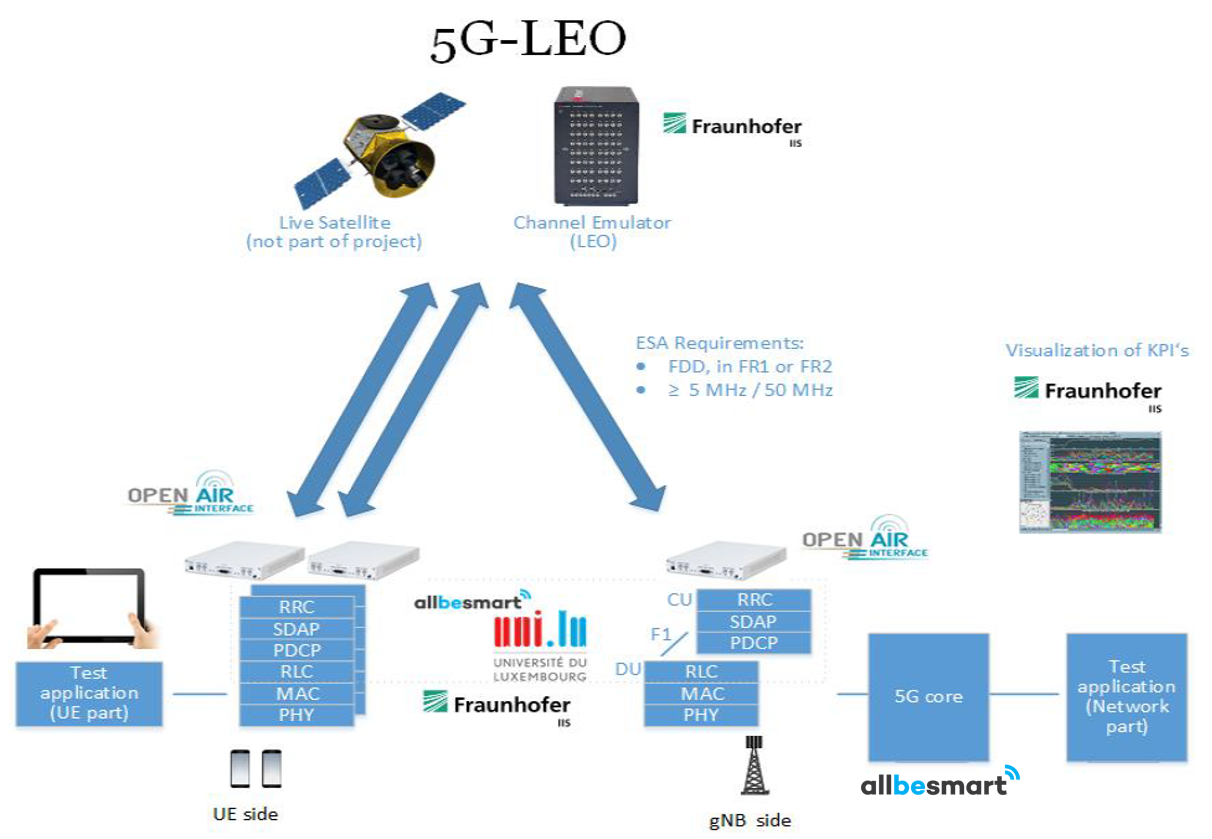
The base-band processing of the OpenAirInterface (OAI) open-source software stack for g-NodeB (gNB) and User Equipments (UEs) is performed on standard multi-core PCs, which are connected to commercial SDR transceivers, USRPs from National Instruments. On the network side the IF interface between 1 and 6 GHz is connected to the satellite-enabled channel emulator that is capable to emulate LEO satellites. On the UE side the IF interfaces are connected to the channel emulator as well. The functionalities are tested for real-time effects (timing relationships in radio layer, effects by hardware configuration, performance evaluation regarding RF effects like large Doppler shift, delay drifts etc.). The setup with gNB, UEs and 5G CN OAI is designed for later operation over real satellite links.
The figure below shows the architecture of the 5G-LEO end-to-end demonstrator with the 5G core of the network on the right hosting the demo applications and being able to visualise key performance indicators, and two end user devices/terminals on the left hand running the user part of the demo application.
Plan
The project consists of two phases. The first phase focuses on the reference scenario, identification of OAI software gaps and technical specifications and includes a Design Review. The first phase is planned to last for four months.
The second phase focuses on the implementation, software compliance and demonstration and includes a Final Review. The second phase is planned to last for ten months.
Current Status
The project completed its mission and extended OpenAirInterface™, the open-source software library for 5G wireless R&D, to support satellite systems in non-geostationary orbits. The extension included the implementation of the full 5G protocol stack (Release ≥16) for both the User Equipment (UE) and g-NodeB (gNB).
The activity identified the software gaps in the OAI library and the fundamental changes in the code base necessary to support non-geostationary orbit satellite systems according to the 3GPP specifications (Release ≥ 16) for the Non-Terrestrial Networks New Radio scenario. Based on a trade-off analysis of the most pressing features, the activity designed, developed and validated the missing functions in the UE and gNB protocol stacks to support bi-directional communication links in NGSO 5G satellite networks. One of the notable key functions implemented in 5G LEO included the implementation of the F1 based (intra CU) handover.
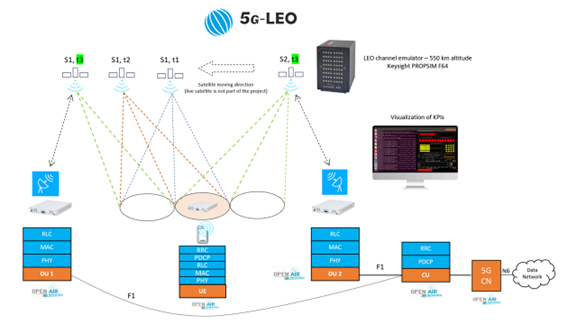
The validation consisted of an OAI-based software test bed implementing the selected LEO scenario.
Thanks to the 5G LEO activity satcom stakeholders are furnished with the same research and development tools used by the terrestrial wireless community for prototyping and testing 5G technologies. The publicly available developed software, an extended new version of the open source OAI software library with new features enables and serves to stimulate the consideration and inclusion of NTN NR communication links in various testing and proof-of-concept scenarios.
Very importantly, all features and functions developed and implemented in 5G LEO have been merged into the main develop branch of OAI and are available for the whole community thus giving the greatest impact.