


PAGE CONTENTS
Objectives

6G SmartSat provides a testbed and proof of concept demonstrator with the following goals:
-
To provide a suitable environment for rapid testing of routing, specifically semantic routing, solutions accounting for the physical characteristics of the multi-layer non-terrestrial network system;
-
To provide a suitable framework for running an extensive number of simulations aiming to discover side-effects and limit cases in the proposed routing system;
-
To provide an emulation environment in which hardware components can be embedded and tested, emulating realistic links to be able to determine the impact of different technologies on a single node.
Benefits
6G SmartSat provides a first of its kind toolset in the form of a testbed to investigate proof-of-concepts and solutions for beyond 5G/6G networking architectures for multi-layered non-terrestrial networks based on smart satellites.
Features
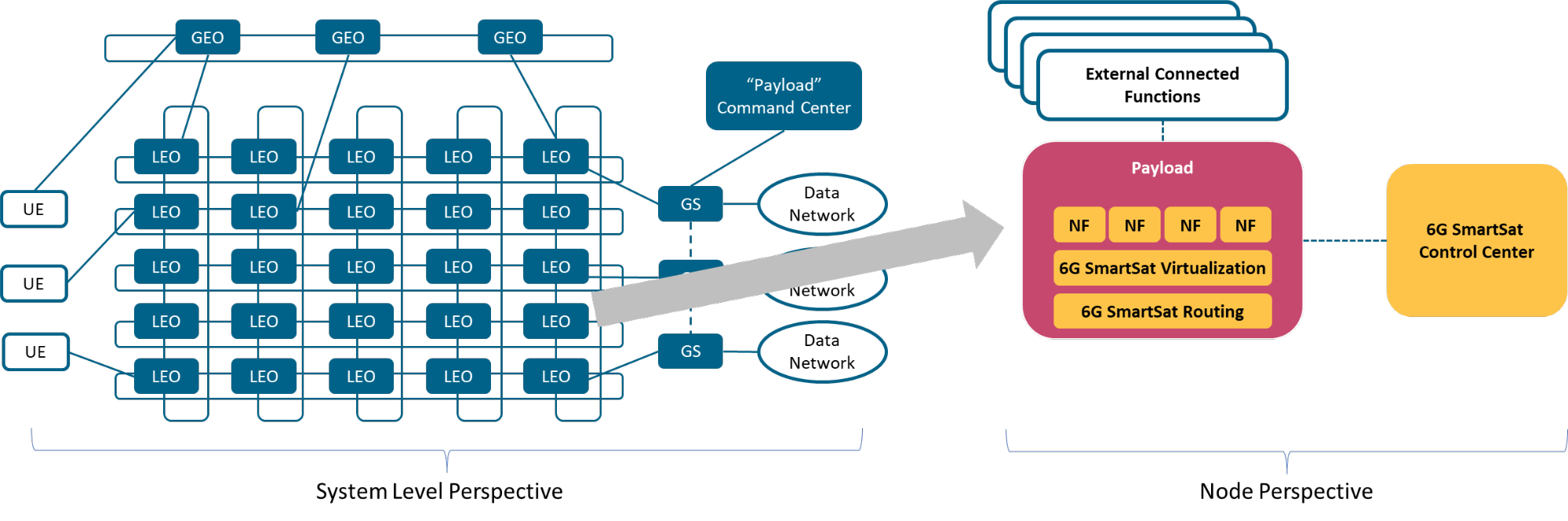
The 6G SmartSat concept and approach entails a dual view, including both a system level perspective and a perspective from the individual nodes as depicted in the figure below.
Challenges
The key technology related challenges for 6G SmartSat are as follows:
-
Due to the very large variation of parameters, a very large number of network architectures could be considered
-
The semantic routing concept is very broadly defined
-
An appropriate space routing solution is not yet defined
-
Integration of space and terrestrial networks
-
Network function placement and virtualization on space nodes
-
Routing impact on the space node resources
-
Network node management
-
Multi-layer routing solution
-
Relevance of the proposed testbed
-
System architecture description in the testbed should be appropriately defined
-
Appropriately reducing the complexity of the emulation environment
Finally, we anticipate the testbed software selection to be challenging as the complexity of the simulation needs to be kept under control while being able to provide relevant results.
System Architecture
The 6G SmartSat tesbed environment consists of three main components:
-
Initial abstract calculations determining link characteristics
-
A simulator environment to test semantic routing and forwarding protocol configurations, and finally
-
An end-to-end emulation environment

Plan
The 6G SmartSat high level work-plan is shown below.

The project plan calculates with three milestones. MS1 System requirements review, MS2 Testbed preliminary design review and MS3 Testbed validation readiness review.
Current Status
The project started in January 2024 and is currently at a stage of preparing the first version of a white paper, having completed the requirements definition for such a multi-layer satellite constellation and the initial technology review including the quantified comparison and trade-off analysis of technology options and the identification of critical technology elements.
Companies


