PAGE CONTENTS
Objectives
The ARA Mk4 new generation Solar Array development started out with a set of generic, qualitative goals that referred to the performance and properties of its ARA Mk3 and FRED predecessors:
- Cost reduction
- Risk reduction
- Performance increase (mass, deployed wing frequency)
- Readiness for growth capability
At completion of the ARTES 5.2 development and characterization phase it became apparent that a significant mass decrease would only be feasible by drastically reducing the versatility. The mass goal was therefore redirected to ‘mass neutral’.
For the ARTES 3-4 qualification phase, the objectives were:
- Qualify the ARA Mk4 technology on component level
- Solar panels of 3 different suppliers
- PVA comprising different solar cell technologies
- Yoke structure
- Root Hinge with extended harness capacity
- Panel hinges including partial deployment capability
- Qualify a flight representative wing model in accordance with the customer requirements for:
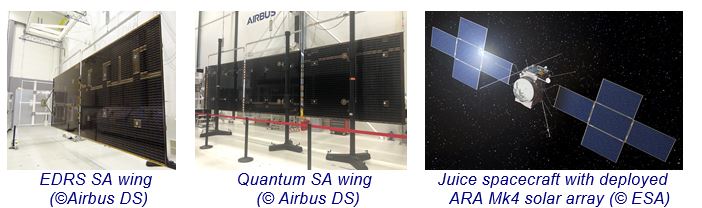
- EDRS-C solar array for OHB
- Quantum solar array for SSTL
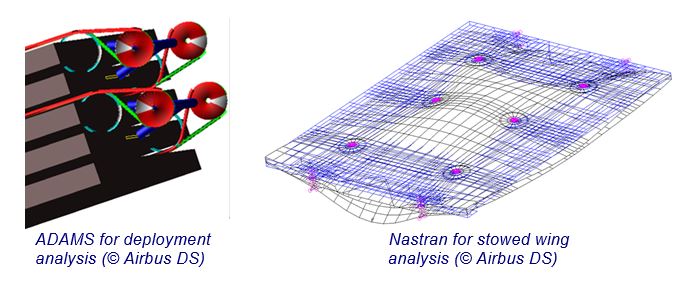
- Validate the mathematical models by correlation of the full wing test results with the predictions.
In conclusion, all of these goals have been met.
Benefits
The ARA Mk4 structural mechanical design stands on the shoulders of its predecessors with an extensive database of continuously refined and correlated tests and models. This allows spot-on predictions of stowed and deployed static/dynamic wing behaviour, fatigue resistance, interface loads and deployment shocks. This again leads to smaller uncertainty margins and risk budgets.
A key element in the test efforts for each project, is the qualification of the combination of panels and photovoltaics (e.g. requiring, in the case of LEO missions, thermal cycling programs of >70,000 thermal cycles). ARA Mk4 covers multiple combinations of various state-of-the-art solar cells, panel substrates and mission profiles, avoiding these time and cost consuming non-recurring thermal cycling tests.
Whether the end product comprises a single 1 m2 panel (fixed or deployable) or a 5-panel wing of 8.5 m2 panels with partial deployment capability in transfer orbit – the building blocks (hinges, holddowns, panel reinforcements, etc.) are the same throughout the complete range, covering EOL power needs up to 15 kW (based on standard, commercially available 3J GaAs cells).
Features
The panel substrate is a sandwich structure with high modulus CFRP skins and Aluminum honeycomb core and is locally reinforced at the hinges (edgemembers) and holddowns (plugs). All suppliers use a secondary bonding method for manufacturing; their substrates are interchangeable.
The V-shaped yoke uses a spring driven root hinge with latches, eddy current speed limiter and S/C interface connector. It is riveted to CFRP arms on which the electrical harness is routed and thermal protection (project specific) is applied.
All panel hinges are clock spring driven. Their latches, close tolerance journal bearing and bolted panel connections, give high stiffness and low hysteresis. A system of pulleys and Kevlar cables between adjacent hinges control the trajectory of the deploying wings.
Flexprints are applied between panels. These flat, double isolated flexible electrical circuits are connected to dedicated flexprint connector parts, which are bolted to the edge members of neighbouring panels.
The Photo-Voltaïc Assembly is specific for each application, due to strongly varying power subsystem demands. So far, compatibility has been demonstrated with:
- AZUR 3G30 150µm with integral diode 80x40mm²
- AZUR 3G30C LARS 150µm with integral diode 124x60mm²
- Spectrolab XTJ with external protection diode
SolAero ZTJ with integral and external diodes
Challenges
The process of deriving unit level requirements from the various solar array level specifications, while ensuring that the full future application range would be enveloped, was a major challenge.
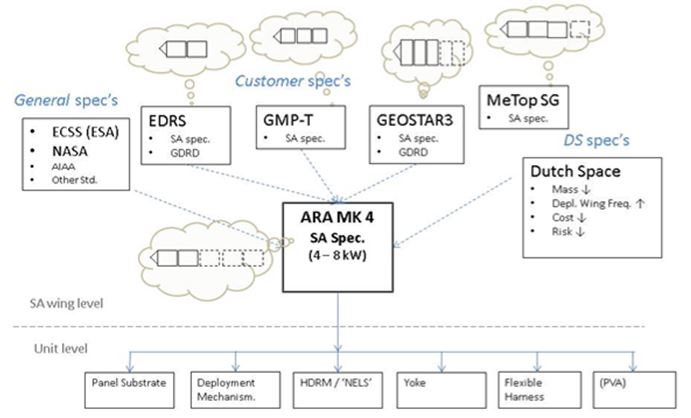
ARA Mk4 requirements flow down methodology
Allowing three substrate suppliers to define and qualify in parallel their own processes and materials to meet the product specifications, was an intensive effort.
Early in the project, the development of the holddown and release system (‘NELS’) proved to be more complex and time consuming than the other components.
System Architecture
The range of solar array applications was divided into two sets of configurations:
- Low-end applications (4 – 8 kW)
- High-end applications (6 – 15 kW)
The difference between high-end and low-end was mainly determined by the size of the spacecraft and the corresponding size of the panels, while the set of configurations could vary further from 2 to 5 panel solar array wings.
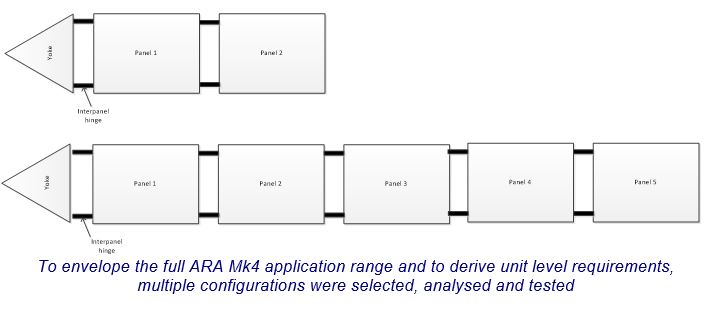
Each ARA Mk4 solar array wing can be divided into units, or building blocks, described under ‘Product Features’ that are combined to meet the customer’s requirements on interface, power, volume, etc.:
- Panel Substrate
- PVA (Photo Voltaic Assembly)
- HDRS (Hold Down & Release System)
- Yoke
- Root hinge
- Panel Hinge (including the Partial Deployment Mechanism)
- Synchronization system
Flexible Harness
Plan
The development ran largely in parallel with EDRS-C and later on also Quantum. To satisfy all needs, reviews were often divided into multiple stages.
Phase B1 was kicked off mid-2012 and the detailed design at unit and EDRS-C proto-qualification wing level was ready by mid-2014, after which production and testing finished in October 2015.
Since all formal ARTES qualification activities had not yet been completed, final stowage and packaging of the EDRS-C wings was only approved after the ARA Mk4 Qualification Review in February 2016.
To cover also LEO missions, PVA coupon thermal cycling continued until early 2017.
Current Status
The ARA Mk4 qualification program has been completed. In August 2019, the first ARA Mk4 solar array was launched on EDRS-C and is operating nominally in its GEO orbit.
Meanwhile, the Solar Array for the Quantum reconfigurable GEO telecom platform has been delivered, awaiting launch in 2020.
Under contract are
- MetOp SG A&B (6 LEO meteo platforms, launches starting 2021)
- MPCV-ESM 1&2 (powering the service module of the Orion-Artemis manned capsule, launch 2021)
- Juice (ESA’s mission to Jupiter, launch 2022)
- Biomass (ESA Earth Explorer 7, launch 2022)
Europa-Clipper (NASA’s mission to Jupiter moon Europa in 2022)