


PAGE CONTENTS
Objectives
The project aims to increase the availability of COTS GPS receivers by applying additional peripherals on the receiver board which immediately react on upcoming radiation effects (Single event Effects) and reduce the deadlock period. Furthermore, it aims to adapt the interfaces to meet typical small-scale spacecraft requirements.
The development of the following peripherals on the GPS receiver board is carried out within the project:
- Data interface (CAN2.0 and RS422)
- DC/DC conversion of the satellite‘s primary voltage (galvanically isolated) into receiver supply voltage
- Inrush current limitation (incl. galvanic isolation)
- Voltage and current monitoring
- Latch-up protection and recovery
Challenges
Deadlocks due to radiation effects that limit their availability are the main problem of COTS GPS receivers. The main challenge of the project is to limit the deadlock. Therefore, the deadlock has to be detected and countered as fast as possible. The development of the fast deadlock detection and fast automatic recovery system is the main challenge of the project.
System Architecture
The ARGO is a redundant COTS based GPS receiver unit for space applications. It can be either operated in hot or cold redundancy. The COTS based GPS receiver is equipped with additional peripheral electronics to counter radiation effects and to adapt them to typical small spacecraft interfaces. The redundancy is provided via two completely independent receiver and peripheral electronics PCBs in a single housing. The data interface and the antenna coupling are configurable. As data interfaces the customer can select either CAN2.0 or RS422 and antenna coupling can be done between a dedicated receiver/antenna pair or via a hybrid coupler which couples the signals of both antennas to one/both receiver(s) at the same time.
Furthermore, two different housing configurations have been implemented. The two configurations differ only in the attached covers.
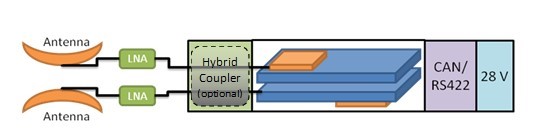
Electrical/data configurations
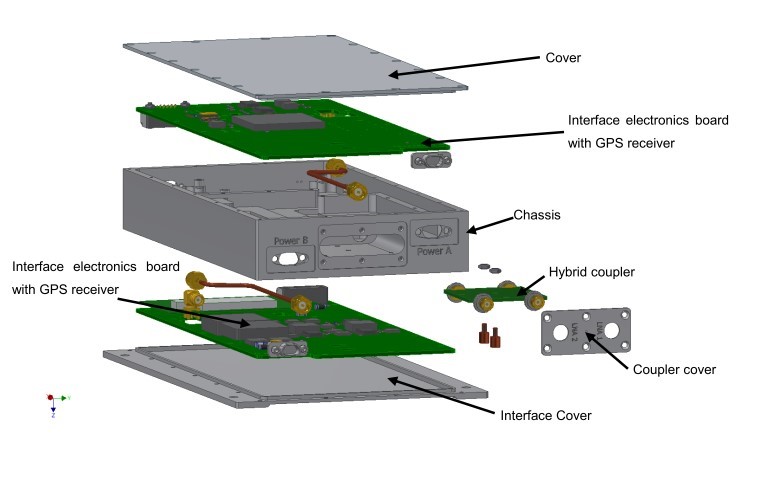
Exploded view
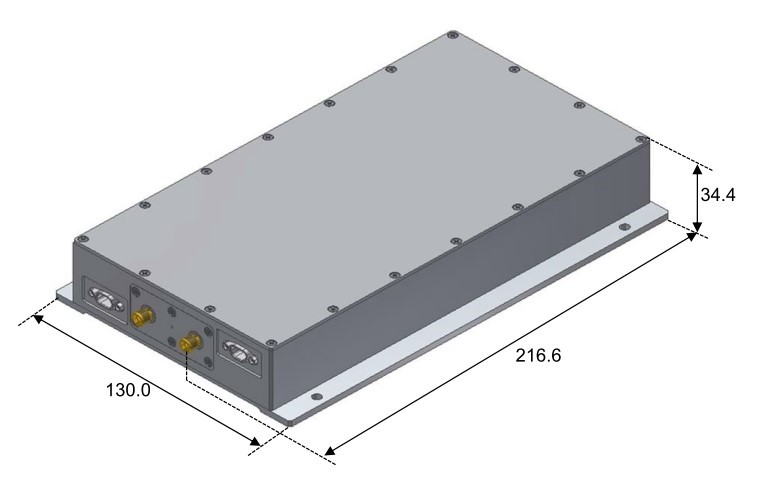


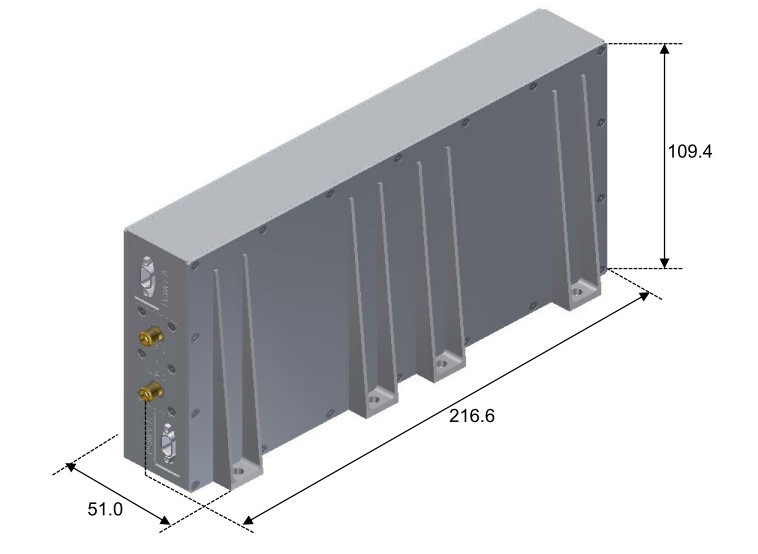
Housing configurations
Plan
The project covers the design, development and qualification of the ARGO-L1 GNSS receiver unit. At the beginning requirements are consolidated in a requirement review. The phase B is concluded with a PDR. Bread-boarding activities are carried out to support the phase B development. During phase C, an EQM is built-up and tested. The results support the development activities of phase C. The phase C and the project is concluded with a CDR.
Current Status
The project is finished. The EQM of the ARGO-L1 GNSS receiver unit has been successfully qualified.
