PAGE CONTENTS
Objectives
The primary goal of this project was to enhance our collective understanding of the advantages and challenges associated with employing generative AI in satellite communication design. It sought to pinpoint the most advanced tools and methods utilised in generative AI across various industries, determining their relevance to the satellite communications sector and the necessary modifications to tailor these tools for satellite communications applications.
The task delivered three proof-of-concepts, a generatively designed choke-ring antenna, a text-to-CAD tool and a fine-tuned stable diffusion model.
Finally, the project outlined a detailed plan for integrating these tools into SatCom design, including future development opportunities, and risks around the use of generative AI.
Benefits
The use of generative AI offers several benefits, in particular the discovery of novel solutions to design problems or other problems in the satcom industry. Compared to conventional AI, generative AI is capable of a type of ‘creativity’ and of exploring unconventional design spaces.
Generative AI also allows for the development of automated design processes, like LLM-driven 3D CAD modelling, which can reduce engineering burden and increase the speed of design iteration.
Features
The three proof-of-concept generative AI outcomes resulted from this project.
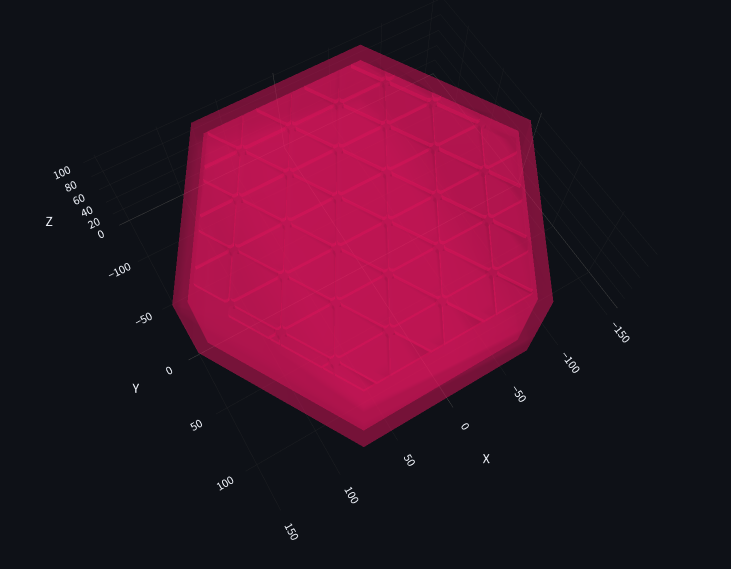
A choke ring antenna was designed with a Variational Autoencoder, which increased angular range in both transmission and reception over a human-designed base example.
A Text-to-CAD web-app was developed that used Large Language Models (LLMs) and OpenSCAD to create solid, parametric 3D models of satellite communication designs from text input. Retrieval Augmented Generation was demonstrated to increase the sophistication of models created by providing examples that could be leveraged in future designs.
A fine-tuned stable diffusion model was created using Stable Diffusion 3.5 and a dataset of approximately 80 satellite images. The model was able to learn and modify the outputs in response to the training, but the subjective quality of the outcome varied strongly depending on the assessor.
Challenges
The most significant challenge of this project was the integration of satellite communications domain knowledge with generative AI techniques. The effective application of generative AI demands domain-specific insight and, therefore, this project required the integration of expertise from both areas to identify potential applications.
Additionally, Generative AI applications are relatively novel, which means there are little precedent or previous examples within similar industries from which to draw. The satellite communications domain also demands precision solutions, which limits the effectiveness of existing generative AI tools.
Plan
This project spanned 9 months, starting from the 1st of July 2024.
The project tasks included:
- Survey and Assessment of Current Generative AI Techniques
- Identification of Potential SatCom Applications for Generative Design
- Development of Generative AI Models
- Hardware Assessment
- Programmatic Legal and Development Gaps
Milestone 1 was achieved upon the completion of tasks 1 and 2, followed by Milestone 2 with the completion of task 3. The final milestone was reached at the project’s conclusion.
Additionally, a workshop with industry experts took place at the end of Task 2.
Current Status
This project is now complete.
Related Links
Companies