


PAGE CONTENTS
Objectives
The objective of the programme of work is to develop an ad-hoc mesh radio network product which is integrated into a satellite system for the purpose of emergency services use, disaster recovery and Government security applications, as well as for commercial application in mineral extraction and oil and gas industries to improve safety, efficiency and to aid the rescue of personnel following incidents and accidents. The system can provide a resilient communications network which is independent of terrestrial infrastructure. The aim is to make the system compatible with a wide range of satellite systems and be modem agnostic, to maximise future sales potential. The programme includes trials using Ku and Ka-band satellites.
A key feature of the programme is consultation with the user community to ensure that their requirements and needs are captured and, as far as is technically feasible and commercially attractive, incorporated into the first generation system developed under this programme of work.
SYSTEM ARCHITECTURE
MANET handsets are ruggedised IP65 sealed handheld units. They use frequency hopping modulation in the 2.4GHz band. They are full Software-Defined Radios, with all functionality defined by code running on a DSP. They support full-duplex Push-To-Talk voice and AES encrypted data. Every radio rebroadcasts over multiple hops to make a mesh network. 64 groups of 28 users are supported. The software has been updated to provide features needed by CAMROSS, including IP data and an interface to a data terminal.
MANET repeater nodes are cut-down versions of the handsets, designed to be dropped and used as a network bridge, in scenarios where the team members are widely dispersed so the network could split.
Data terminals are COTS handheld computers, running Windows OS. Connected to the handsets they can access the MANET and ultimately the Internet via satcom. They provide users with a range of software functions, including user locations in a GIS and text messaging.
The IP gateway is a portable unit, with a rechargeable battery, that provides an interface to a satcom terminal. It contains two MANET radios nodes and a Linux OS computer which provides VoIP, web server and a MANET GUI.
A command data terminal is a laptop that connects to the IP gateway directly, providing additional MANET command and control features.
End-to-end voice, data and tracking is possible from the MANET over satcom to headquarters.
Benefits
Satellite telecommunications provide the only solution where existing terrestrial infrastructure either does not exist or is unavailable during an emergency. Its worldwide coverage, high bandwidth and robustness also make it an excellent choice for civil defence purposes.
CAMROSS is a new product that can provide an adhoc secure communications infrastructure supporting voice, data and user tracking to a distributed team in remote locations.
Through integration with satellite communications systems, connectivity is extended from the remote team back to their commanders at headquarters anywhere in the world.
It is easily portable, so can be used in the first hours and days after a natural or manmade disaster.
It even works in collapsed buildings, underground and other areas where the existing communication systems do not provide coverage.
Integration of several terrestrial ad-hoc networks via satellite is also possible, enabling co-ordination of operations in a number of areas, even where users are located in several groupings spread over a large geographical region.
CAMROSS is aimed at a significant niche market for security-critical applications, where end-users are institutional, government, non-governmental (NGO) and industrial customers, and key applications are:
- Blue light emergency services, plus other first responder teams,
- Humanitarian disaster relief,
- Homeland security and protection of the citizen,
- Petrochemical and mineral extraction – surveying, offshore oil platforms and mining,
- Boarding parties for coast guards,
Border surveillance to counter illegal immigration, piracy and drug smuggling.
Features
The CAMROSS system comprises a Mobile Adhoc NETwork (MANET) of handheld mesh radios operating in the license exempt 2.4GHz band and an interface to satellite communications via a custom highly portable IP gateway unit. The key function of the gateway is to provide an interface between MANET call groups and SIP-based Voice over IP (VoIP) software and systems. The gateway can be linked to a ruggedized laptop which runs custom applications software that enables monitoring and configuration of the radio network by the team commander. Additionally, team members can use handheld computer (‘data terminals’) which provide streamlined applications including text messaging. All handsets include GPS receivers, which share location data across the MANET, enabling team tracking on customised mapping software running on any computer attached to the network.
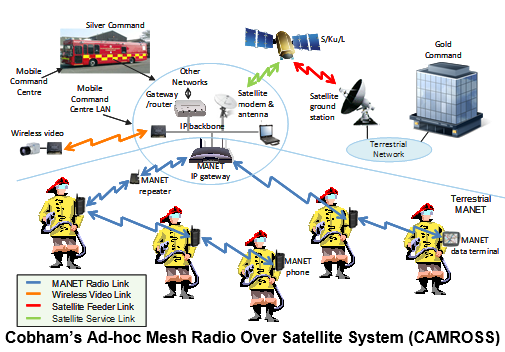
A key element of the system is the benefits of the inherent relay properties of the ad-hoc mesh radio system will ensure reliable communication in a local area including areas deep inside buildings and underground where satellite communications cannot normally provide coverage. This is possible because the handsets are not satellite phones, there only needs to be one satcom terminal, connected to the IP Gateway unit, that has line of site to the satellite. This arrangement also means that satellite bandwidth and satellite technology costs are minimised.
The system is compatible with existing Cobham products, including video transmission equipment, based on Co-Orthogonal Frequency Domain Modulation (COFDM), which can aid command centre co-ordination of operations.
Challenges
The overall challenge is to design a new system for adhoc voice and data capability with satellite backhaul, based on Cobham’s existing military soldier radio “Eagle Close Combat Radio” and Commercial-Off-The-Shelf (COTS) satellite communications equipment.
Key design challenges include:
- Affordability – system must be low cost
- Portability – equipment must be man portable, i.e. lightweight and small
- Ruggedisation – equipment must be able to withstand tough environmental conditions and usage
- IP connectivity – mesh network and satcom connectivity must use IP data, which is not supported by Eagle
- Ease of use – system should have a simple user interface and not require significant training
Integration – the product is composed of a wide range of hardware and software platforms which must work seamlessly as a single system.
Plan
The following tasks are covered by the project activities:
- Analyse the market, user requirements and competition
- Define the user requirements and business proposition
- Perform a proof of concept demonstration
- Define the system architecture
- Define the system specifications and development plan
- Define the radio hardware and software
- Define the IP gateway hardware and software
- Define software applications and video surveillance/ tracking system
- Develop ad-hoc radio embedded and application software
- Configure a 3rd party data terminal device to provide situational awareness
- Develop IP gateway prototype hardware and software
- Integrate and test prototype system
- Perform basic functionality over satellite tests
- Review and assess designs ready for productionisation
- Update ad-hoc radio and repeater node hardware
- Make custom IP gateway unit into a production build standard
- Certify the ad-hoc radio system for specific applications
Perform system user trial in representative scenarios
Current Status
The project successfully completed in March 2015. Cobham Technical Services has developed a custom MANET of handheld terrestrial radios and deployable nodes connected to a custom IP-based satellite gateway unit that interfaces to 3rd party satellite modems and antenna terminals. The system has been trialled over satcom.
Companies
