PAGE CONTENTS
Objectives
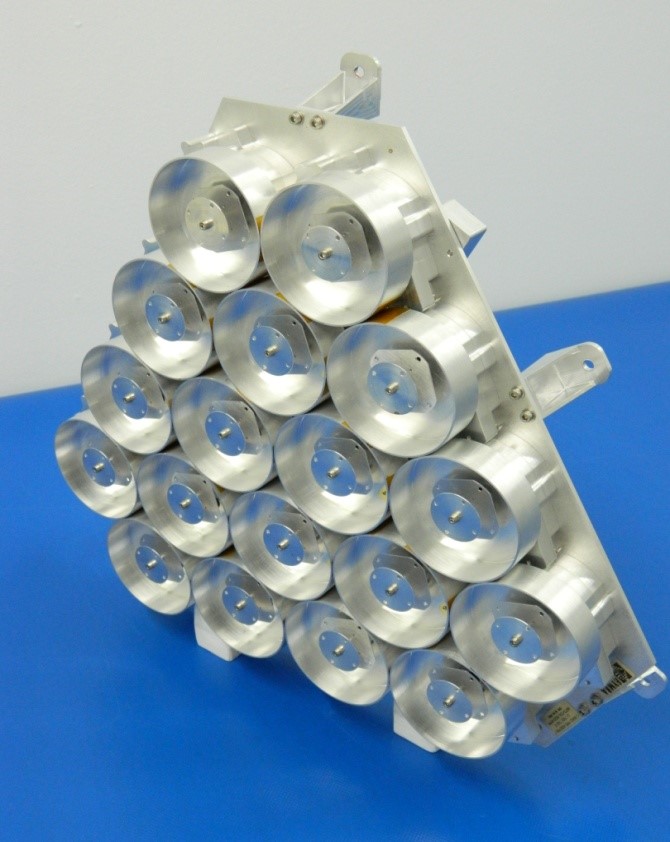
The double objective of the activity has been, on one hand, to design two compact C-band antennas addressing single and multiple feed per beam configurations and, on the other hand, to manufacture and test an engineering model (EM) of a C-band feed assembly producing one beam.The EM feed assembly includes all elementary components to validate RF performances at feed level. A special effort has been put on size and weight reduction, selection of materials, optimization of processes involved and robustness with regards to PIM.
The work logic has been as follows: two Multibeam Mission scenarios have been selected and their multibeam antenna-reflectors geometries, includingSFB and MFB configurations, have been defined. From those antennas, the feed design requirements have been derived.
A trade-off between both configurations, based on RF performance and accommodation aspects has been done and eventually the MFB configuration has been selected for further investigations. On a second stage, the EM that consists of representative focal components to generate a single spot beam have been manufactured and tested.
Benefits
The developed product is applicable for MFB at C-band. It is based on a novel periodic array structure which provides fully decoupled beam forming networks (BFN). Their implementation has been done in bar-line transmission line technology in combination with compact radiating elements (0.85λ) with high efficiency. The proposed solution and associated technology leads to a BFN on a single layer, resulting in a very compact feed system.
Currently, for the particular case of the MFB approach, there is no former reference for comparison at C-band.
Features
The performance measured of the Cband feed assembly is summarized below:
|
ELECTRICAL PARAMETER |
MEASURED VALUES (TX) |
|
Band |
3.625 – 4.2 GHz (Full band) |
|
Polarization |
H/V |
|
Directivity |
>15dBi |
|
X-Polar |
<-31dB |
|
Losses |
<0.5dB |
|
Isolation between beams ports |
<-40dB |
|
Interface |
TNC-H |
|
Power |
5 x 17.5 W per spot |
|
Return Loss |
<-20dB |
|
PIM (flux) |
-100dBm/m2 (RX band ) 2 x 50W |
|
Mass per beam |
<2.5 Kg |
system architecture
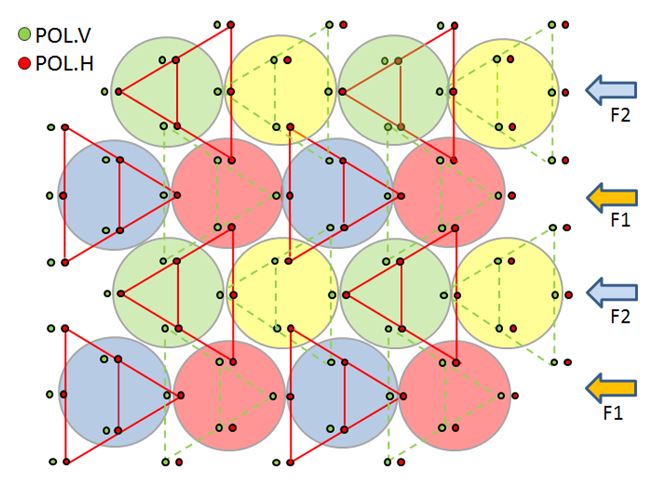
A novel feed array design for periodic MFB feed systems has been developed. This feed array uses 6 radiating elements per beam and each radiating element is shared with 6 surrounding arrays. The radiating elements are shared only in polarization leading to fully decoupled Beam Forming Networks (BFNs). Furthermore all BFNs have been constructed in a single layer without crossings. The proposed feed array is associated with a four colour re-use scheme different from the standard hexagonal one. The use of this feed array and associated re-use scheme in combination with square-rim or super-elliptical reflectors provides some improvement on the Carrier over Interferers ratio (C/I) when compared to standard circular-rim reflectors.
Challenges
A trade-off between single-feed-per-beam (SFB) and multiple-feed-per-beam (MFB) reflector antenna configurations has been performed on continental and sub-continental coverage. Considering the large reflector apertures required for proper gain and beam-to-beam isolation, the MFB configuration has been preferred as only two reflector antenna are required to produce the full coverage in transmit and receive.
The feasibility of the novel approach has been demonstrated by the manufacturing and testing of an MFB feed array leading to extreme feed system height reduction when compared to an equivalent feed array in an SFB configuration. This height reduction is obtained thanks to the use of bar-line technology and to the use of a small and efficient radiating element. The model was tested successfully for PIM. The array losses are better than 0.5dB in worst case.
Plan
The first group of tasks has included a state-of-the-art analysis and definition of candidate missions based on identified needs (Milestone 1) and associated antenna and feed requirements (Milestone 2). Preliminary RF design analyses have been focused on the two most relevant feed assembly solutions further detailed at RF level. Based on these detailed RF designs, one solution out of the two has been selected to proceed with the next Tasks (Milestone 3).
The second group of tasks has been related to the feed assembly detailed designs: mechanical and thermal analyses, as well as updated RF analyses (Milestone 4) and this has led to the manufacturing of an EM. For the environmental testing, typical telecommunication GEO satellite mission requirements were considered (Milestone 5). Finally, testing and analysis of results at feed assembly level were performed (Milestone 6).
Current Status
Project has been completed. All above mentioned tasks have been fulfilled : mission scenario definition, system, antenna and feed requirements derived. In addition, an engineering model of a compact Cband feed assembly (one spot) to prove the concept has been designed, manufactured and successfully tested.