


PAGE CONTENTS
Objectives
The dashAlpha project covers the delivery of a COTS-based, hardware-agnostic AI/ML-driven SD-WAN platform which is capable of bonding any combination of wireless and wired network bearers to create a single, secure, fault-tolerant and high-capacity network connection capable of supporting the uninterrupted use of real-time voice and video applications even during elective or non-elective degradation of network conditions.
The project also covers the employment of a high-level of automation to construct and repair individual bearer connections in the event of degradation non-availability, maximising the robustness of the bonded connection while minimising the administrative burden of the platform user. The project also employs machine learning to enhance the bonding behaviour of the platform by training the network using location-based telemetry.
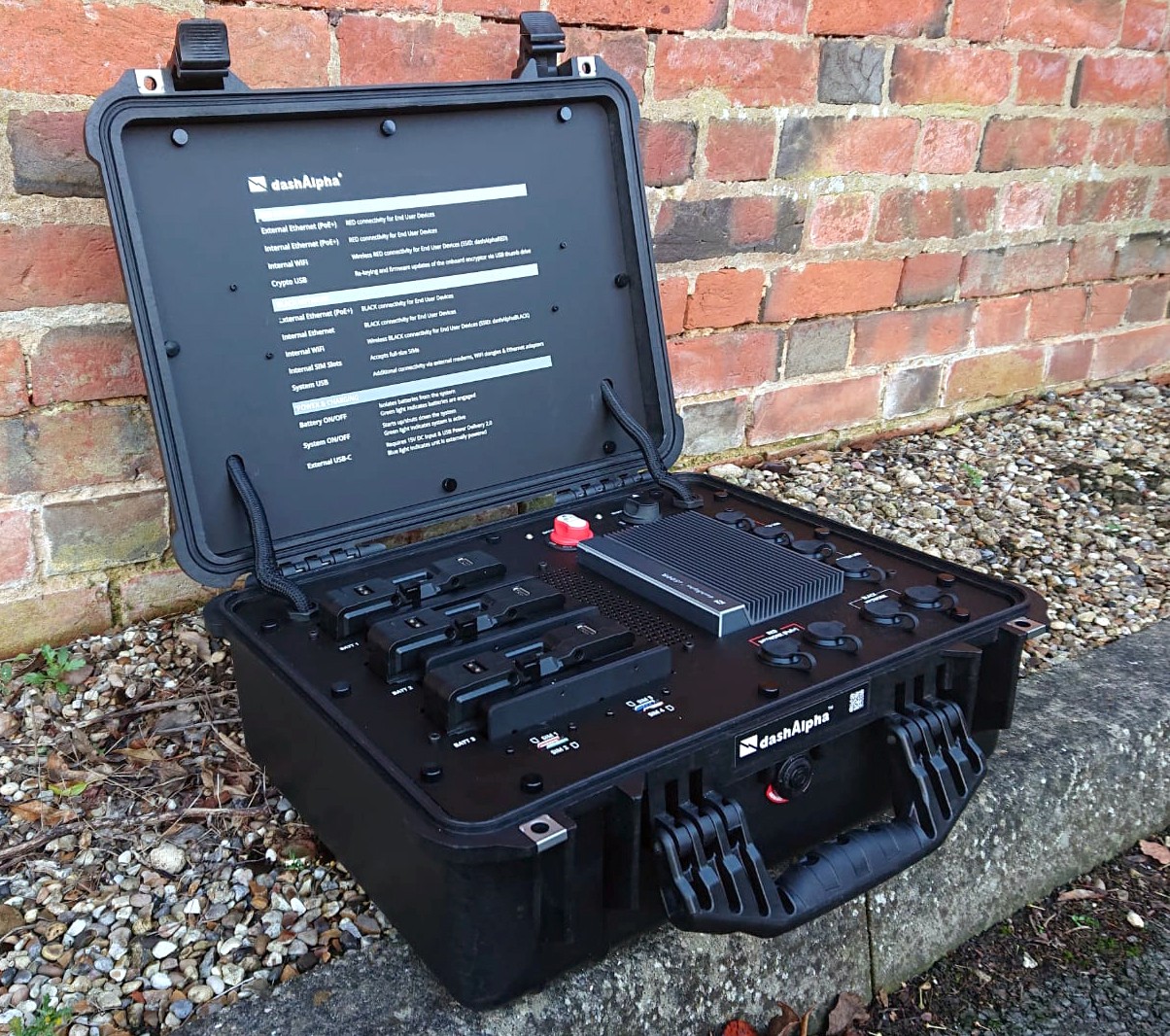
Benefits
dashAlpha has been designed and built with a philosophy of “software first, wireless first”.
“Software first” enables us to work more flexibly with customers to evaluate and select a hardware solution based on proven COTS/MOTS hardware and tailored to our customers’ needs. Additionally, by choosing to not produce first party hardware, we can better focus our engineering resources more tightly on the software aspect of our solutions.
“Wireless first” makes wireless networking technologies first class citizens on the dashAlpha platform, rather than simply being a backup for a primary fixed-line bearer. This gives dashAlpha an advantage in the marketplace over other SD-WAN vendors whose products are clearly designed to operate in a ‘fixed-line first” environment, where performance is rather more predictable, enabling us to enter market segments where other vendors are not present, or whose capabilities are weaker in comparison.
Finally, by building machine learning into our platform we can apply bearer management techniques to our networking solutions which are location-based, cognitive and pre-emptive. This will be especially useful for managing wireless “not-spots” in applications such as passenger transport.
Features
The dashAlpha platform implements techniques and mechanisms to stabilise Layer 1 networking across multiple and different network bearers, providing network resilience in challenging environments.
Network Monitoring
Bearers are continuously monitored for quality and deprioritised when quality levels fall below acceptable levels, with network packets reapportioned to better quality bearers.
Secure Tunnelling
User traffic is split across multiple secure VPN tunnels, maximising both throughput and security of data in flight.
Packet-Level Bonding
dashAlpha bonds both TCP and UDP traffic, supporting uninterrupted voice and video call sessions for applications such as Skype, Teams and WhatsApp.
REST API
dashAlpha offers REST APIs for each of its platform elements, supporting non-local management and automation.
Challenges
The development programme of dashAlpha focuses on three distinct challenges:
Satellite Communications Integration
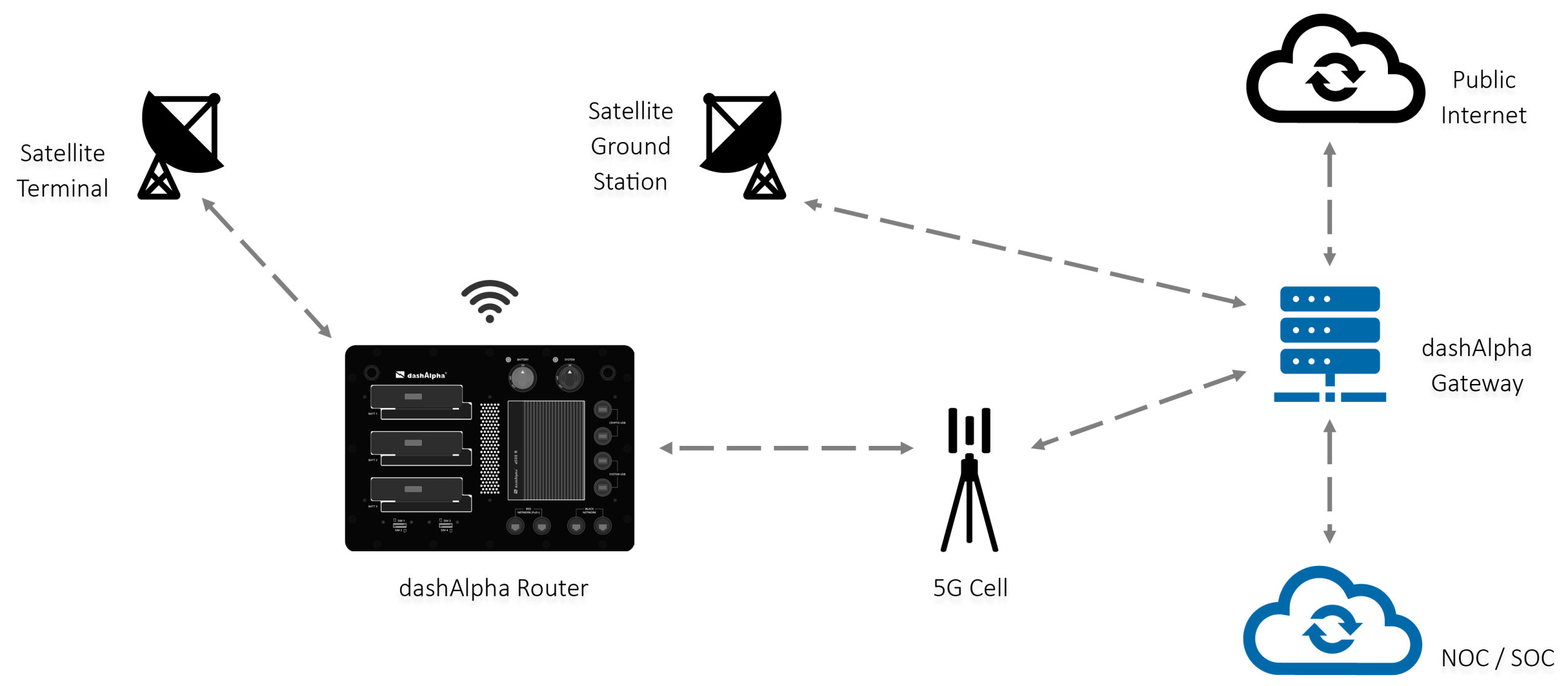
Capturing telemetry from a satellite communications terminal in order to make satellite signal quality part of the bonding algorithm, in line with the current mechanisms used for wireless bearers such as 5G and WiFi.
Machine Learning
Applying machine learning to the dashAlpha platform to support pre-emptive and location-based decision-making regarding target state of each network bearer at a given location.
Management
Focus on the management of the infrastructural elements of the dashAlpha platform, specifically management of the bonding gateways and the Network Operations Centre.
System Architecture
Plan
The dashAlpha development programme is planned to last 10 months and is structured in three phases.
Phase 1 covers the integration of a satellite terminal with the dashAlpha platform to facilitate telemetry capture, in order to feed the bonding algorithm.
Phase 2 covers the building and training of a machine learning model to teach the dashAlpha network about the wireless environments dashAlpha units are deployed in.
Phase 3 covers additional management capability for the dashAlpha platform through the development of a central network controller and a gateway controller.
Current Status
The project has completed.