


PAGE CONTENTS
Objectives
The automatic identification system (AIS) is essential to maritime traffic situation awareness. AIS tracks vessels’ movements and is invaluable for detecting and monitoring suspicious activity. However, AIS can be switched off accidentally or deliberately to hide suspicious activities. These ships put marine traffic safety at risk.
Detecting dark vessels is more than having no AIS messages or observing when an AIS message is not received beyond a specific time interval. The reason is that AIS message transmission is affected by many factors, such as distance from receivers or base stations, weather and environmental conditions, and proximity to ports. Furthermore, AIS data lack information about the vessels’ real-time environment and their reaction to adverse environments.
This project’s objective is to build a set of deep learning models supported by the integration of a diverse set of data sources which will allow maritime safety and security stakeholders to accurately:
1. Detect dark ships
2. Monitor the activities of the located dark ship
3. Locate the identified dark vessel
4. Support Search and Rescue activities
5. Detect and analyse ship to ship cargo transfer activities
6. Detect and analyse oil pollution and track down related vessel which caused emissions.
Benefits
The core product benefits and value relative to existing competing systems are:
1. Enhance the ability for reliable ship identification when AIS systems are turned off or disabled. The target is to detect at least 50% of dark vessels activities in selected regions of interest.
2. Enhance reliable ship location when AIS tracking not available. The target is to predict the track and location of the vessel correctly at least 80% of the time.
3. Enhance reliable ship identification. The target is to detect and identify at least 50% of dark ships activities in region of interest.
4. Compared to AIS-only, the target improvement in the detection is the one order of magnitude.
The CCN1 extension adds three additional benefits:
1. Reduce the per-tip operator workload from minutes to seconds by automating the cue collection step.
2. Provide an independent visual identity check that remains valid even when a vessel changes its MMSI or its name.
3. Deliver a per-portfolio risk analysis for underwriters and reinsurance broker.
Features
The key feature is to improve the current state-of-the-art in the domain of vessel detection and identification by fusing the data from multiple sources and through the implementation of ML models provide new ways of processing, fusing and analysing multiple data streams. This approach improves the quality of vessel detections and analytical capabilities for the maritime domain.
The key end user features and functions are:
- Provision of a SAAS application
- Applying the data mining and deep learning techniques to increase the accuracy of vessel detection
- Applying the data mining and deep learning techniques to increase the accuracy of vessel identification
- Provide a single application with multiple integrated datasets for vessel analysis
- Usage of both EO Visual and SAR trained EO models for analysis meaning analysis can be supported in bad weather/cloudy conditions.
- Ability for a user to define region of interest and time range/selection of products.
- Extraction of vessel details from Visual/SAR image.
- Correlation to AIS tracks.
- Determination of dark vessels.
- Present potential vessel candidates.
- Access to multiple supporting datasets.
- Provide OSINT related information for an vessel identified within the GSIN component through the RealWorld platform. Details such as current sanctions status, flag state, ownership structure and port state control audits performed on the vessel.
CCN1 features delivered for the CDR cycle:
- Automated Tip-and-Cue pipeline
- Three high-resolution providers
- Vessel Fingerprinting workbench
- Vessel and Fleet Risk Profiling
- Automated Evidence Reporting
Operations dashboard with per-pipeline KPIs
Challenges
The key challenges for the provision of the Maritime Awareness Service System are:
- Acquisition of suitable amounts of satellite data for machine learning model training purposes. The usage of multiple satellite vendors with different capabilities and external interfaces is required and post processing to have a baseline
- standard of imagery for training is required within the system.
- System using both EO visual and SAR sources for information generation.
- Availability of ground truth in relation to dark activity of vessels through the use of the Skytek RealWorld platform, in-house marine experts and simulation of dark activities.
- Availability of historical archive of global AIS data for ML training.
- Easy interface for region of interest requests and visualization of results for analysis.
- Integration with multiple supporting data sets providing additional details on marine vessels being monitored.
- Tailoring of the solution to be provided as a SAAS product for:
- Sanctions status
- Port State Control audits
- Track analysis
- Suspect vessel detections and dark vessel detections to initiate GSIN processing.
- Tailoring of the solution to be provided as a SAAS product for:
- Security organisations/Search and Rescue/Custom and Excise
- Insurance organisations
CCN1 introduces three additional engineering challenges:
-
- Achieving end-to-end tip and cue to evidence latency below 4 hours for Priority-1 events with three different high-resolution EO providers in parallel.
- Producing a ML vessel fingerprint database and automated lookup/verification/alerting against high-resolution EO providers.
- Provide sanctions compliance and AIS data overlays
System Architecture
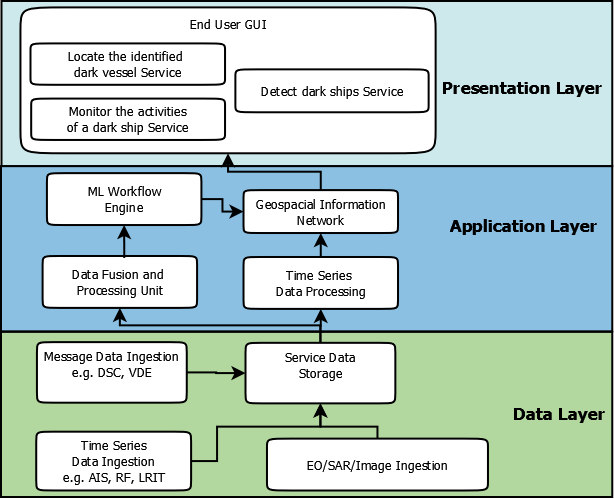
The following diagram provides a high-level overview of the three-layer architecture consisting of:
- Presentation Layer
- Application Layer
- Data Layer
which is the basis for the Maritime Awareness Service demonstrator system.
The key functional components are:
- Web portal
- Imagery serving
- Workflow coordinator
- Data storage
- Feed fetcher components:
- Copernicus fetcher for Sentinel-1 SAR and Sentinel-2 EO
- SAR tasker and fetcher
- EO tasker and fetcher
- AIS fetcher
- RF fetcher
- Vessel detection from imagery components:
- Sentinel-2 EO vessel detection component,
- Sentinel-1 SAR vessel detection component,
- Commercial EO vessel detection component,
- Commercial SAR vessel detection component
- Processors for tabular data sources:
- AIS processor,
- RF processor
- Vessel sanctions information
- Vessel PSC details
- Vessel ownership structure details
- Vessel flag state
- Matching engine
- CCN1 components added during the CDR cycle:
- Tip Scoring Engine + Sensor Selection + Tasking Manager.
- Vessel Fingerprint extraction
- Vessel / Fleet Risk Scoring service
- Evidence Workflow Generation
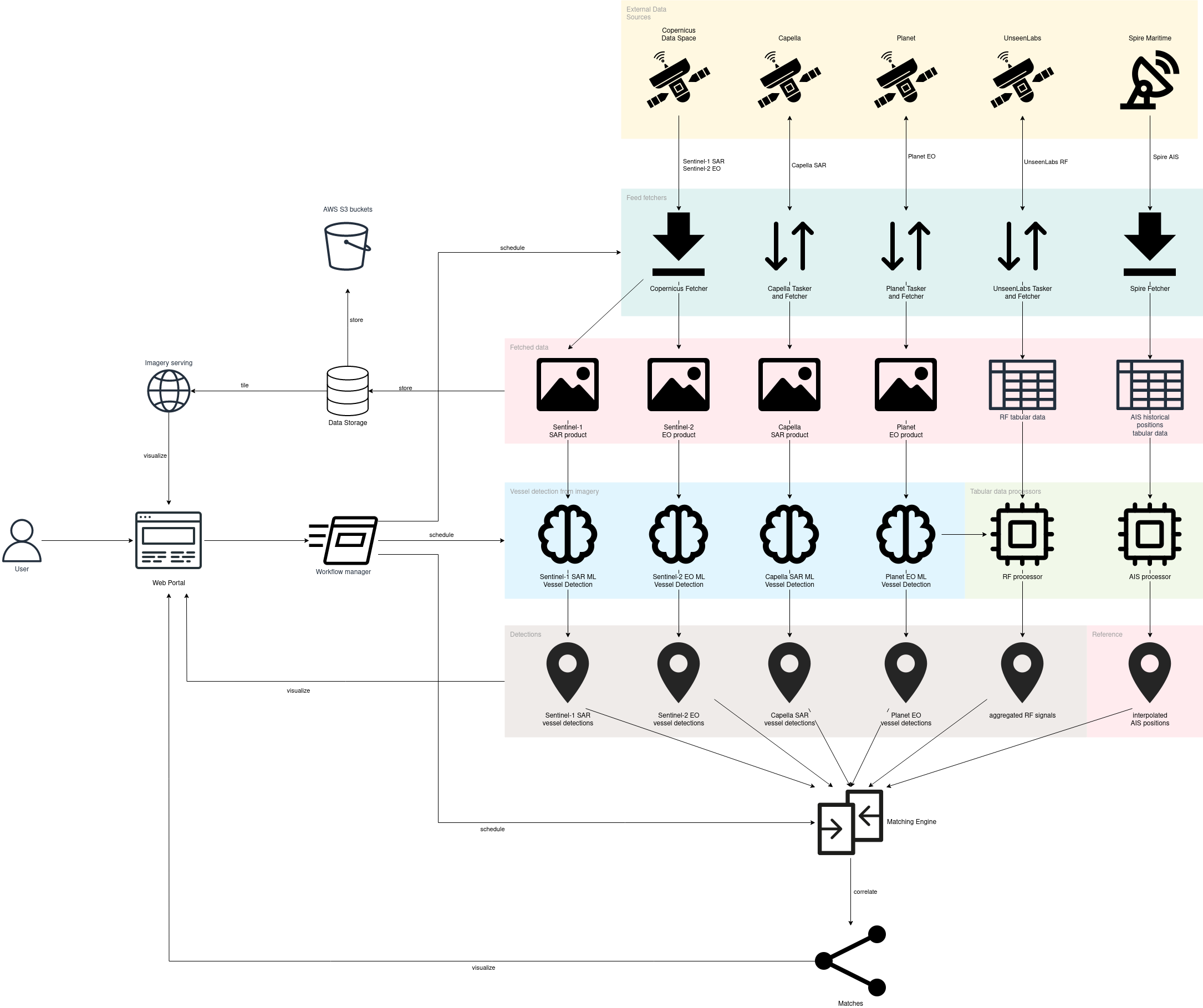
The system components and the workflow for processing is shown in the following diagram.
Plan
The base project was scheduled to be completed over a 28 month timeframe with the KO taking place on the 13th March 2023.
The primary milestones and phases for the project are as follows:
- KO – March 2023
- Preliminary Design Review (PDR) – February 2024
- Midterm Review (MTR) – July 2024
- Acceptance Review (AR) –Feb 2025
- Final Review (FR) – July 2025
- Final Presentation (FP) – Post Contract Closure
CCN1 extension milestones:
- CCN1 Kick-Off — September 2025.
- CCN1 Preliminary Design Review (PDR) — March 2026
- CCN1 Critical Design Review (CDR) —May 2026
- CCN1 Acceptance Review (AR) — TBD
- CCN1 Final Review (FR) — TBD
Current Status
The original project was successfully kicked off on the 13th March 2023 with the initial focus on selection of the high level use cases which form the basis for the system services.
To support the use case definition and refinement from the initially proposed selection within the project proposal, two workshops were held. The first workshop held at the Lloyds building London attended by key marine underwriters and compliance experts focused on the needs for dark vessel and identifying potential illegal activities. The second workshop was held in Maynooth University Ireland was attended by Naval Services, Coast Guards, Custom and offshore energy experts stakeholders.
The workshops clearly provided the core set of use cases and user requirements as the baseline for the Maritime Awareness Service. Based on end user needs, technical prototyping and the services technical baseline have been defined.
For the PDR milestone the detailed system requirements and system architecture for the Maritime Awareness Service where defined in addition to the external ICD and the approach for system testing and verification. The design detailed the components for the different data sources ingestion, covering the wide range of sources and types, to data fusion, application of ML, vessel detection and matching engines. The information is then visualised through a web application mapping interface GUI.
The AR involves the deployment of a complete demonstration system with the GSIN components fully integrated with multiple data sources and deployed on a cloud based infrastructure to provide a SAAS system.
Post AR, and up to the final review, a live trial of the demonstration system was available to which different categories of end users were invited. These end users were given live demonstrations of the functionality showing a range of sample use cases or trialled the system. They provided feedback to the development team, sales and marketing teams for further enhancement and any tailoring of the platform that would be required to provide a fully operational and commercial service.
The CCN1 contract extension was awarded in mid 2025 to deliver two new capability themes: automated tip-and-cue and vessel fingerprinting.
The CCN1 PDR was held on March 2026 and the CCN1 Critical Design Review (CDR) was held in May 2026.