


PAGE CONTENTS
Objectives
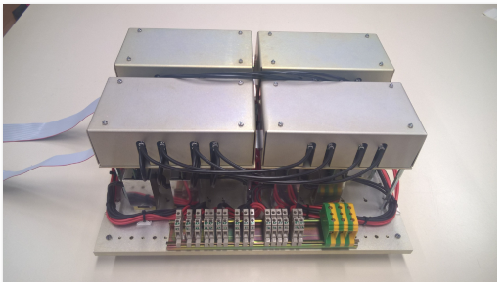
The objective of this project is to design and develop a modular universal high voltage switching matrix with solid-state components as a modular component for use with Power Processing Units (PPUs).
Targeted Improvements: Especially for telecom platforms with full-electric-propulsion systems the following improvements are targeted with respect to the PPU:
- Reduction of mass/volume/cost
- Improvement of reliability
- Reduction of production time and cost
- Flexibility by modular approach
- Reduction of PPU related components subject to ITAR
Benefits
At the end of this project, several output benefits can be extracted from this project.
The main goal of this project was to show the feasibility and functionalities of a high voltage switching matrix using solid state components. The outcome of this project is a practicable alternative to high voltage relays which are currently used in TAB products in the frame of the electrical propulsion. In addition, this switching matrix allows to connect several PPU’s to several thrusters and to implement on-ground or in-orbit configurability.
The proposed switching matrix is a hybrid solution using solid states components for the high voltage line and electromechanical relays for the low voltage lines. This way, the power dissipation inside de matrix is minimized by the use of electromechanical relays as far as possible and we provide a functional and available solution for the HV line. On top of that, the switching matrix is a standalone solution that is adaptable to various thruster types.
This project has lead TAS-B to acquire knowledge about various subjects. Namely the galvanic isolation of the high voltage line. The 2kV – galvanic isolation during re-pressurizing was successful up to 10Pa in a worst case situation ; the dedicated design is promising for TAS-B applications.
Features
The main product features are :
- Rated current of LV lines : 25A and 400V
- Rated current of HV lines : 20A and 2000V
- Galvanic isolation guarantee up to 10Pa
Challenges
The project focuses on a switching matrix concept connecting several PPU’s to several thrusters and implementing on-ground or in-orbit configurability in order to:
- adapt to the different operating modes during a typical telecom mission of full-electric spacecrafts
- guarantee electric propulsion system performances even after one or several failures.
The switching matrix should sustain high voltage up to 2000V in order to be usable with all kind of thrusters. Solid state components should be used to design high voltage switches.
System Architecture
The architecture is focused , for the breadboard, on a 2X2 switching matrix allowing to connect 2 PPU’s with 2 thrusters but this architecture is compatible to NxM switching matrix.
Considering limitations of solid state components, a high voltage line is switched by solid state components whereas low voltage lines are switched by electromechanical relays.
This 2×2 switching matrix without PPU in series feature is composed of:
- Switching matrix nodes including power lines (positive and return lines) as required in the specifications. They are divided in 2 different functions depending on voltage that must be managed:
- 1 high voltage (HV) switching node function whose voltage rating is 2000V. This function is made of solid state components.
- Medium high voltage (LV) switching node function whose voltage rating is 400V. This function is made of electromechanical relays.
- Status functions used to verify the presence of a voltage at each output of a PPU.
- Auxiliary Power Supply (APS) function used to supply switching node and control functions.
- Control functions used to manage TM/TC and control all switches of the matrix.
- Filter Units (FU).
Plan
This project has been divided in 5 tasks:
- Definition of Requirements
- Topology and Technology Trade-Off
The purpose is to highlight optimizations that decrease the number of switches required in a matrix.
The solid state component trade-off includes a market review of available components but also components that will be available in the near future.
- Architecture Design
- Detailed Design
- Detailed design of the blocs constituting the switching matrix
- Establishment of a list of the failures mode of the PPU and the thrusters
- Manufacturing, Verification and Test
Current Status
The project is now achieved at EBB level.
The goals of the contract have been reached.
This project highlighted some specific points that shall be taken into account for future development such as reliability of the high voltage lines and the matrix modularity ( its efficiency can be optimized for a specific thruster ).
This project has lead TAS-B to acquire knowledge about various subjects especially on galvanic isolation during repressuring at 2kV.
