
PAGE CONTENTS
Objectives
The project pursues the following technical objectives:
- Design a joint RF air interface enabling integrated communications and sensing on a common physical layer.
- Achieve improvement in detection and ranging accuracy compared to opportunistic sensing using conventional communication waveforms.
- Achieve improvement in throughput efficiency of the joint communication and sensing air interface relative to state-of-the-art solutions.
- Develop dedicated waveforms and protocols optimized for dual-purpose operation, including sensing-aware pilot structures and Doppler-sensitive designs.
- Define representative use cases and reference scenarios to derive user requirements and performance benchmarks.
- Specify verifiable technical requirements and maintain full traceability throughout the project.
- Select and assess three candidate technical baselines and downselect the most promising solution.
- Implement and validate a demonstrator of the selected joint air interface.
- Demonstrate the concept at Technology Readiness Level (TRL) 4 in a relevant environment.
Benefits
The J-CROSS air interface enables a unified physical layer for integrated communications and sensing, delivering significantly higher spectrum efficiency and sensing accuracy than conventional opportunistic approaches. Dedicated dual-purpose waveform and protocol design provides improvement in detection and ranging accuracy and improvement in communication throughput efficiency.
The solution reduces payload mass, volume, and power consumption by eliminating redundant subsystems, leading to lower manufacturing, launch, and operational costs. Continuous full-duplex operation enables real-time situational awareness and uninterrupted connectivity for safety-critical and autonomous applications. Compared to existing systems, J-CROSS offers superior performance, improved sustainability, and a clear migration path toward standardised multi-functional satellite payloads.
Features
The product comprises a full-duplex joint RF air interface, sensing-aware waveform structures, and a flexible protocol stack supporting dual-purpose operation. Key features include embedded pilot and reference signals optimised for time-of-arrival, phase, and direction-of-arrival estimation; adaptive frame structures balancing sensing and communication performance; and interference management mechanisms enabling simultaneous transmission and reception.
The system supports configurable bandwidths and modulation formats to address diverse mission scenarios. A demonstrator platform and performance evaluation framework validate sensing accuracy, ranging capability, and throughput efficiency. The design maintains compatibility with future standardisation activities.
Challenges
Conventional satellite systems treat communications and RF sensing as separate functions, leading to duplicated hardware, inefficient spectrum usage, and increased payload complexity. Opportunistic sensing using standard communication waveforms provides limited performance and constrains both sensing accuracy and data throughput. Achieving true full-duplex operation while maintaining isolation between transmit and receive paths represents a major technical challenge. Additional challenges include accurate extraction of sensing parameters under dynamic channel conditions, coexistence of sensing and communication functions without mutual degradation, and ensuring scalability toward future multi-mission satellite architectures.
System Architecture
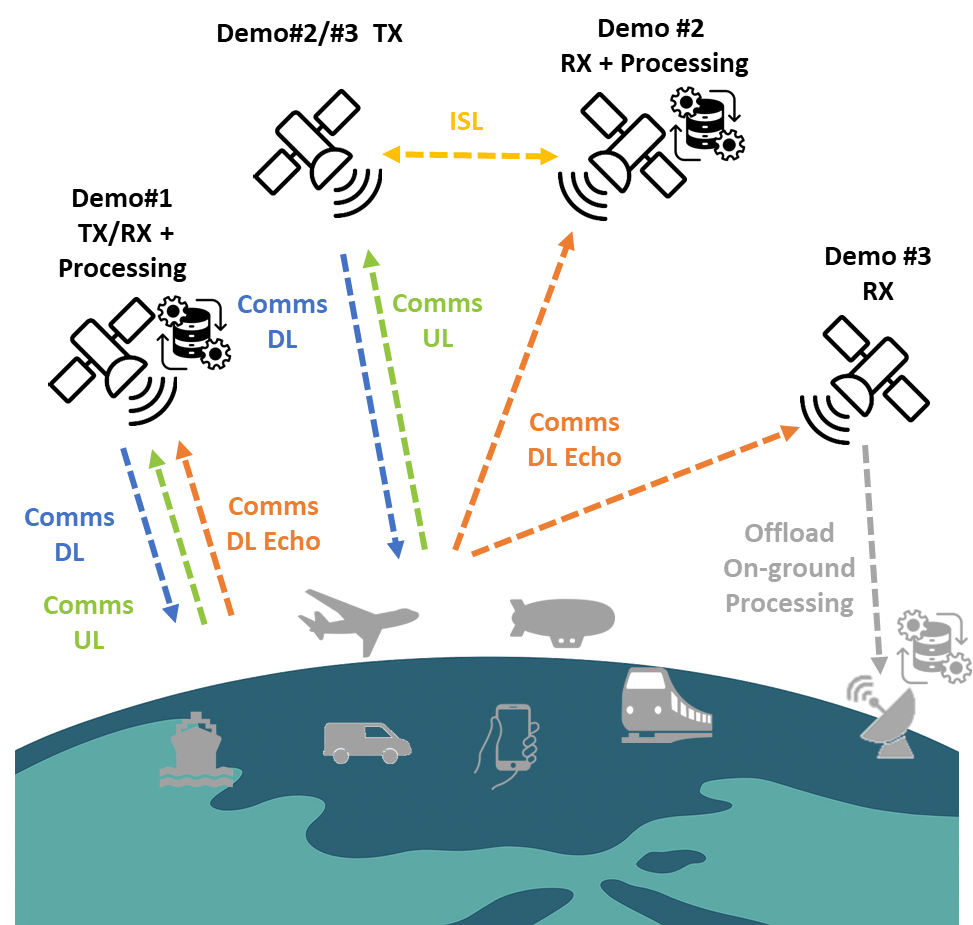
Integrating a JCAS framework into the architecture illustrated in Figure 1, transforms the satellites from simple data relays into dual-purpose nodes. In this framework, the same radio frequency signals used for the “Comms DL” and “Comms UL” are also employed to sense the environment.
As illustrated in figure 2, the system architecture is centered on an onboard digital processor integrating communication and sensing functions for 6G NTN operation. The processor hosts the 6G NTN RAN TX and RAN RX blocks for downlink and uplink processing, a joint communication and sensing (JCAS) receiver, and an onboard SAR processor. The transmit chain generates waveforms in the 6G NTN RAN TX and forwards them to the RF DL TX. The receive side includes RF UL RX for communication signals and RF DL RX for sensing echoes, both feeding shared digital baseband processing blocks.
The RF front-end comprises data converters, digital beamforming, frequency conversion, power amplification, and antenna arrays, enabling multi-beam operation. The processor supports onboard imaging, with optional imaging post-processing on the ground. The architecture interfaces with the 6G Core Network for control and user-plane connectivity. A control and management layer dynamically configures waveform parameters, resource allocation, and operating modes. The modular design supports scalability toward multi-antenna and multi-beam satellite payloads while tightly integrating sensing and communication functionalities.

Plan
The project covers use-case definition and requirements capture, technical specification, and selection of three candidate baselines. The most promising baseline undergoes detailed design and verification. An implementation and verification plan guides development of a demonstrator. A structured test campaign evaluates sensing accuracy and communication throughput against requirements. The activity concludes with performance assessment, documentation, and recommendations for standardisation and future development.
Current Status
The project, which kicked-off in January 2026, is at initial phase, with use-case definition and requirement analysis ongoing. System architecture trade-offs and candidate technical baselines are under assessment. No demonstrator has yet been implemented.