

PAGE CONTENTS
Objectives
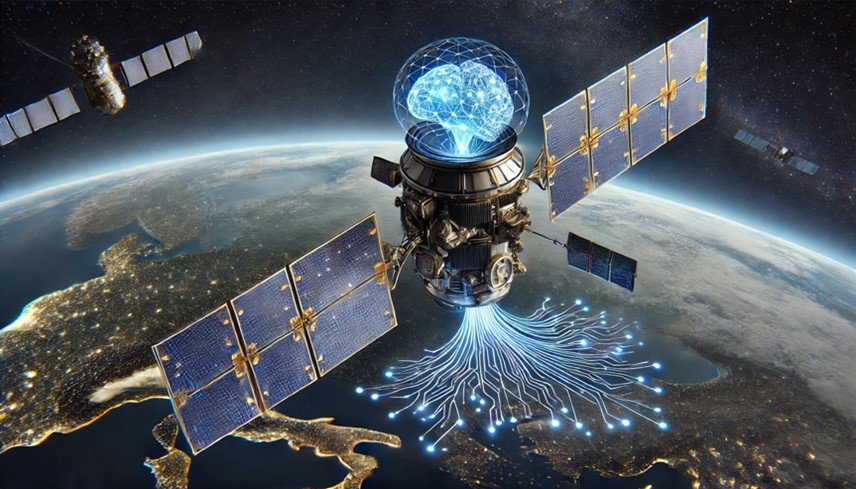
The ASCEND project develops a product family of On-Board Data Processing (OBDP) units that deliver edge cloud computing capabilities to satellite constellations. The Data Processing Units (DPUs) leverage commercial-off-the-shelf (COTS) GPU-accelerated computing technologies to enable onboard artificial intelligence in SmallSat and Microsatellite platforms.
The product family consists of two units:
• Sterna: a compact, stand-alone DPU for SWaP-constrained platforms (large CubeSats to Microsatellites), built around the NVIDIA Jetson Orin NX.
• Morus: a higher-performance successor for Minisatellites and Small Satellites, using a modular daughterboard architecture, targeting the NVIDIA Jetson AGX Orin and Jetson Thor platforms.
The DPUs position satellites as flexible space cloud servers by virtualising higher-level communication layers (L2/L3) onboard, enabling Software-Defined Payloads, cognitive payload functionalities through AI/ML, and the ability to repurpose satellites for secondary missions such as Earth observation.
Benefits
The Sterna and Morus DPUs offer satellite operators three transformative capabilities:
Flexible Payloads: The products enable virtualisation and cloudification of higher-level communication layers directly onboard the satellite. This transforms the satellite into a regenerative node in the network, improving link budgets, reducing ground segment dependency, and enabling dynamic reconfiguration via software (Software-Defined Payload).
Cognitive Payloads: The GPU-accelerated architecture enables cognitive functionalities through AI/ML, including real-time RF interference detection and mitigation, dynamic spectrum resource management via a RAN Intelligent Controller, and automated modulation recognition.
Repurposable Payloads: The processing power allows satellites to be retasked for secondary missions. A SatCom satellite can perform maritime surveillance, Earth observation target detection, or other analytics, creating new revenue opportunities from a single asset.
Compared to existing onboard processors, the ASCEND products offer 10–100× higher AI inference throughput while maintaining a compact SWaP envelope and a primarily European supply chain (≥90% BOM value from EU suppliers).
Features
Sterna delivers ≥100 TOPS (INT8) AI inference via the NVIDIA Jetson Orin NX, with PCIe Gen 4.0 x4 and 1 GbE data interfaces, in a stand-alone PC/104-compatible form factor weighing under 500 g.
Morus delivers ≥250 TOPS (goal ~1000 TFLOPS FP8) via the NVIDIA Jetson AGX Orin or Jetson Thor T5000, with PCIe Gen 5.0 x8 and up to 100 GbE, in a modular form factor. Multi-unit clustering enables Tb/s-level throughput.
Both products share a dual-domain architecture: a radiation-tolerant Supervisor Domain providing autonomous FDIR, power sequencing, health monitoring, and A/B boot redundancy; and a Processing Domain running Linux with a container-based software framework. Internal M.2 slots provide NVMe storage expansion. ECC memory on Morus extends the operational envelope to higher-LEO and MEO orbits.
Challenges
Key challenges include qualifying high-performance COTS computing modules for the space environment, particularly radiation tolerance and thermal management within conduction-cooled platforms. Virtualising 5G RAN components onboard introduces real-time processing constraints absent in terrestrial deployments. Integrating a RAN Intelligent Controller in a closed AI feedback loop for dynamic spectrum management requires low-latency inference alongside the communication stack. Achieving a primarily European supply chain (≥90% of BOM value) while maintaining performance competitiveness presents an additional strategic challenge.
System Architecture
Both Sterna and Morus follow a dual-domain architecture:
1. Supervisor Domain: A high-reliability foundation built on a radiation-tolerant microcontroller providing autonomous fault detection, isolation and recovery (FDIR), power sequencing with latch-up protection, health monitoring via housekeeping telemetry, and A/B partition recovery with golden image fallback.
2. Processing Domain: Built on NVIDIA Jetson System-on-Module technology, providing GPU-accelerated AI inference and general-purpose computing. Runs a Linux-based OS with container-based application deployment.
Sterna is a stand-alone carrier board (PCIe/104 form factor) hosting the Jetson Orin NX. Morus uses a motherboard-daughterboard architecture supporting the Jetson AGX Orin or Thor T5000, integrating into slottable backplane standards.
The software architecture aligns the DPUs with 5G gNodeB and MEC standards, enabling virtualisation of telecom functions. AI applications such as spectrum monitoring run within a near-RT RAN Intelligent Controller (RIC) to dynamically optimise resource allocation. Kubernetes orchestration enables multi-tenant workloads, extending the terrestrial MEC paradigm into orbit.
Plan
The project spans four development phases: Definition (completed), Technology (completed for Sterna), Product Phase for Sterna (in progress, targeting TRL 8 via Qualification Model manufacturing and environmental testing), and Extended Technology Phase for Morus (in progress, targeting TRL 6 via breadboard and Engineering Model development). Key milestones include PDR, CDR, TRR, and TRB for each track.
An In-Orbit Demonstration of Morus is planned for 2027. The current contract period runs from January 2026 to March 2028.
Current Status
The Definition Phase and initial Technology Phase for Sterna are completed. The Sterna Engineering Model has passed functional, thermal-vacuum, vibration, EMC, and radiation testing, achieving TRL 6.
A CCN was submitted in September 2025, expanding the project into a two-product family. Sterna enters the Product Phase for qualification (TRL 8), including 5G gNodeB and spectrum monitoring use case demonstrations. Morus enters an Extended Technology Phase from TRL 2 to TRL 6, with an in-orbit demonstration test plan under definition. Sterna is flying for the first time in an IOD mission in Q2 2026.

Related Links
Companies
