

PAGE CONTENTS
Objectives
The growing demand for flexible and secure satellite communications is challenged by fragmented systems that are often limited to single-orbit operations and lack interoperability between technical and commercial functions. Satellite operators, service providers, and institutional users require solutions that can efficiently manage multi-orbit connectivity while integrating network operations and business processes.
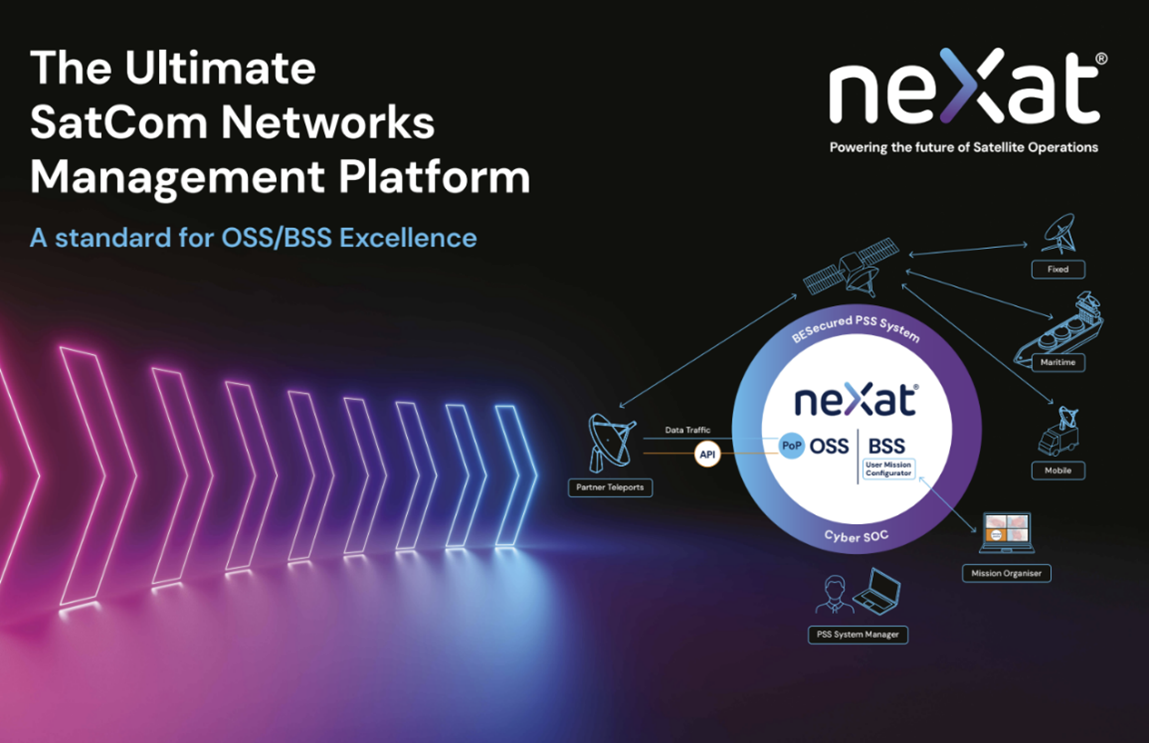
neXat addresses this need through the development of the Initial Capacity Readiness Platform, a modular Operations Support System and Business Support System solution. This platform enables users to monitor and manage satellite networks, control services, and handle customer, billing, and operational processes within a unified environment.
The service will be delivered either as cloud-based software or deployed directly within customer infrastructures, allowing flexibility depending on operational and security requirements. Its modular design allows users to select only the components they need and adapt the system to their specific context.
The objective of the project is to develop, integrate, and validate a pre-operational version of this platform, including enhanced multi-orbit capabilities, standardised interfaces, and strengthened cybersecurity features, enabling rapid deployment and demonstration to future customers.
Benefits
The solution relies on satellite communication systems, including Geostationary Earth Orbit (GEO), Medium Earth Orbit (MEO), and Low Earth Orbit (LEO) constellations, as well as their associated ground infrastructure (teleports and user terminals). It does not operate satellites directly but enables efficient use and coordination of multiple space-based assets.
The added value lies in the ability to combine different satellite orbits within a single operational and business management platform. Each orbit type offers distinct advantages (e.g. wide coverage, low latency, high throughput), but current solutions typically manage them separately, leading to inefficiencies and limited flexibility.
By integrating these assets, the platform allows users to dynamically select and optimise the use of satellite resources based on performance, availability, and service requirements. This enables improved service continuity, better quality of service, and more efficient use of capacity.
Compared to existing approaches, which are often fragmented or limited to single operators or technologies, the proposed solution provides a unified, technology-agnostic layer. This reduces operational complexity, supports new multi-orbit services, and allows users to adapt more quickly to evolving market and mission needs.
Features
The platform provides users with a unified view and control of their satellite communications services. It delivers real-time information on network performance, service status, and resource usage, while enabling users to configure services, manage customers, and monitor operations through a single interface.
Key functionalities include:
- Monitoring of satellite links and service quality
- Configuration and activation of communication services
- Management of users, subscriptions, and billing
- Allocation and optimisation of satellite resources
- Secure access to data based on user roles
When deployed, users can operate and supervise complex satellite networks more efficiently, reduce operational costs, and quickly adapt services to changing needs.
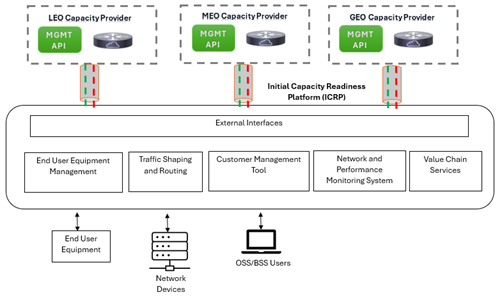
The system works as a central software platform connecting satellite infrastructure, service management tools, and user interfaces. It collects data from the network, processes it, and presents actionable information to users, while also allowing them to send commands back to the system.
At a high level, the architecture consists of modular components connected through standard interfaces: network management, business management, and external interfaces. These modules can be deployed either in the cloud or within the user’s own infrastructure, depending on security and operational requirements.
Challenges
The targeted user communities are satellite operators and (inter)governmental organisations, together with their system integrators. These users are located in Europe (e.g. Belgium, Spain, Greece, Poland), as well as in the Middle East, Africa, and Asia (e.g. Saudi Arabia, Turkey, Qatar, Azerbaijan, Pakistan, Japan).
Satellite operators require solutions to manage increasingly complex multi-orbit infrastructures and to offer competitive, value-added services to their customers. (Inter)governmental organisations need secure and modular systems to pool and share satellite resources across multiple users and missions.
Key user needs:
- Unified management of multi-orbit satellite networks and resources
- Flexible and modular solutions adaptable to different operational and procurement contexts
- Integration of operational (network) and business (customer, billing) functions
- Capability to support resource pooling and sharing across multiple stakeholders
- Secure handling of sensitive data and strict access control
- Scalable deployment models (cloud-based or on-premise) depending on security constraints
The main challenge is to deliver a solution that combines modularity, interoperability, and high security, while remaining efficient, scalable, and easy to integrate into diverse and complex infrastructures
System Architecture
Plan
Following contract signature on 22 December 2025, the project kicked off with an online meeting on 6 January 2026. User requirements were consolidated through multiple internal iterations involving both technical and commercial teams, incorporating feedback from ongoing exchanges with stakeholders such as satellite operators. This resulted in the finalisation of the User Requirements Document, requirement matrix, and associated use cases and user stories.
Based on these outputs, the system architecture was refined and an updated Service and System Architecture was produced. Development activities have been initiated, with the project environment set up in Jira and first work on the initial platform version underway.
The project lasts for a period of 3 years. The Platform will have 2 iterations ICPR 1 and 2.
Current Status
The Critical Design Review (CDR1) has been successfully passed on the 1 April 2026, formally closing WP2 (Architectural Design). The full CDR data package, comprising the Service & System Architecture, the User Requirements Document, the Requirements Matrix, the Use & Test Cases and the System Verification Document, has been delivered and accepted. The development phase WP3 has been formally launched, with the 71 user requirements fully translated into a traceable backlog.
The initial development effort focuses on the platform-level Modularity user requirement (UR-P-01) as the transversal foundation for the six product elements, with the architecture design completed and implementation on-going. The next contractual milestone is the Mid-Term Review 1 (MTR1), targeted for October-November 2026.
Related Links
Companies
