PAGE CONTENTS
Objectives
LEO constellations employ hundreds to thousands of small satellites resulting in several key characteristics including low latency, to enable real-time and mission-critical applications, and low RF power requirement of ground terminals. Typically, LEO satellites cover the area of interest with multiple independent spot beams using different polarizations and frequencies.
Each LEO satellite orbits at high speed and covers a certain area for only a limited time, thus requiring handover between satellites to ensure an uninterrupted connection. To maximize system capacity and ensure quality and reliability of coverage, the antenna on board the LEO satellite must have multibeam capability, to serve multiple users simultaneously, and beam steering capability, to move the entire cluster of spots within of an adequate angular range, covering populated areas and avoiding desert areas. The objective of the project is therefore the development of a passive, multibeam, high gain antenna with beam scanning capability, having compact dimensions for installation on board a LEO satellite platform.
The antenna uses two reflectors made of an all-metal artificial surface to refocus a cluster of high gain spotbeams within an adequate angular range without compromising the performances in the Ka band. Beams are steered by rotating the reflectors about two axes.
Benefits
With respect to the current solutions for multibeam antennas for LEO satellites, based on electronic reconfiguration, the REPAM antenna is a passive antenna, hence highly efficient, which allows to steer 37 high gain spot beams within an angular range of ±40° in the Ka band. The simplicity of the steering concept, together with the large number of beams steered within a wide angular range, render the product competitive and attractive for the next generation of LEO satellites. Indeed, to steer the beams, only the reflectors are rotated around two rotation axes while the cluster of feeds is fixed.
Features
The REPAM antenna comprises two separate Ka-band Tx/Rx reflectors (17.7-20.2 GHz and 27.5-30 GHz), 70cm in diameter, offering a large number of circularly polarised high-gain spot beams continuously steerable within an angular range tailored to the field-of-view requirements of LEO satellites. The antenna can handle dual circular polarisation.
A cluster of horns provides the beams which can be scanned within an angular range of ±40° rotating each reflector about two axes. Each spotbeam provides a gain larger than 40 dBi in reception and 36.5 dBi in transmission. While steering the beams, the cluster of horn is kept fixed, while the reflector surface is rotated, thus significantly simplifying the rotating mechanisms.
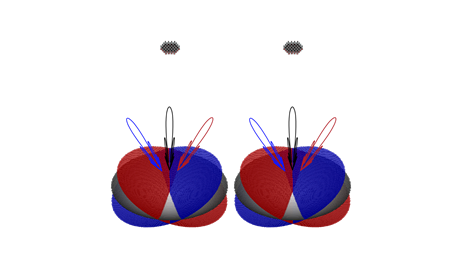
The main achievements are:
• Design of fully passive bifocal reflector antenna capable of steering within an angular range of ±40° a cluster of 37 high gain beams from a cluster of horns;
• High gain: >40dBi in Rx band, >36.5 dBi in Tx band;
• Ka band coverage;
• Dual, switchable, polarisation capabilities;
• Simplicity of the scanning mechanism: the reflectors are rotated while the cluster of horns is fixed;
• Fully metallic solution.
Challenges
Key challenges are related to the design of a metasurface able to handle and steer a high number of independent beams in the Ka band. Beams performances shall be stable within wide frequency range and a scanning range which is sufficiently wide for the target LEO satellite application. The antenna weight and size must also be limited so that it can be onboarded on a small satellite platform.
System Architecture
The antenna architecture consists of two all-metal metasurface-based reflectors (one for the Tx band, one for the Rx band), having the same physical dimensions, that are fed by a cluster of 169 horns to generate a cluster of 37 beams.
The entire beam cluster can be steered using a reflector rotation mechanism, while the horn cluster remains in a fixed position. The system utilises a multi-feed-per-beam scheme. The horns are grouped into subclusters of 7 elements. In this configuration, a main (central) horn is surrounded by six others that are shared among adjacent subclusters.
Plan
The project includes Kick-Off (KO), System Requirements Review (SRR), Preliminary Design Review (PDR), Detailed Design Review (DDR), and Final Review (FR). Final goal of the activity is the realisation and test of a reduced scale demonstrator. Tests include both electromagnetic and mechanical stress tests relevant to the envisaged operational environment.
Current Status
The activity was successfully completed.