


PAGE CONTENTS
Objectives
Today’s mobile satellite terminals use either traditional dish antennas with mechanical steering or electronic arrays with amplifiers for each antenna element. These solutions are either heavy, complex mechanically and have high power consumption (dish) or have high power consumption (conventional electronically steered array).
The Sofant solution uses low loss MEMS to enable an alternative architecture of electronically steerable array. This architecture shares one amplifier across several antenna elements. Sharing the amplifier improves the efficiency of the amplifier, significantly reducing power consumption and reducing the cost of the solution.
Sofant developed a series of 16 element sub-arrays that can be assembled into much larger arrays. The sub-array construction uses the same assembly processes and suppliers as today’s smart phones. This allows us to drive down cost of the solution by aggregating demand across the SatCom and mmWave 5G market.
Benefits
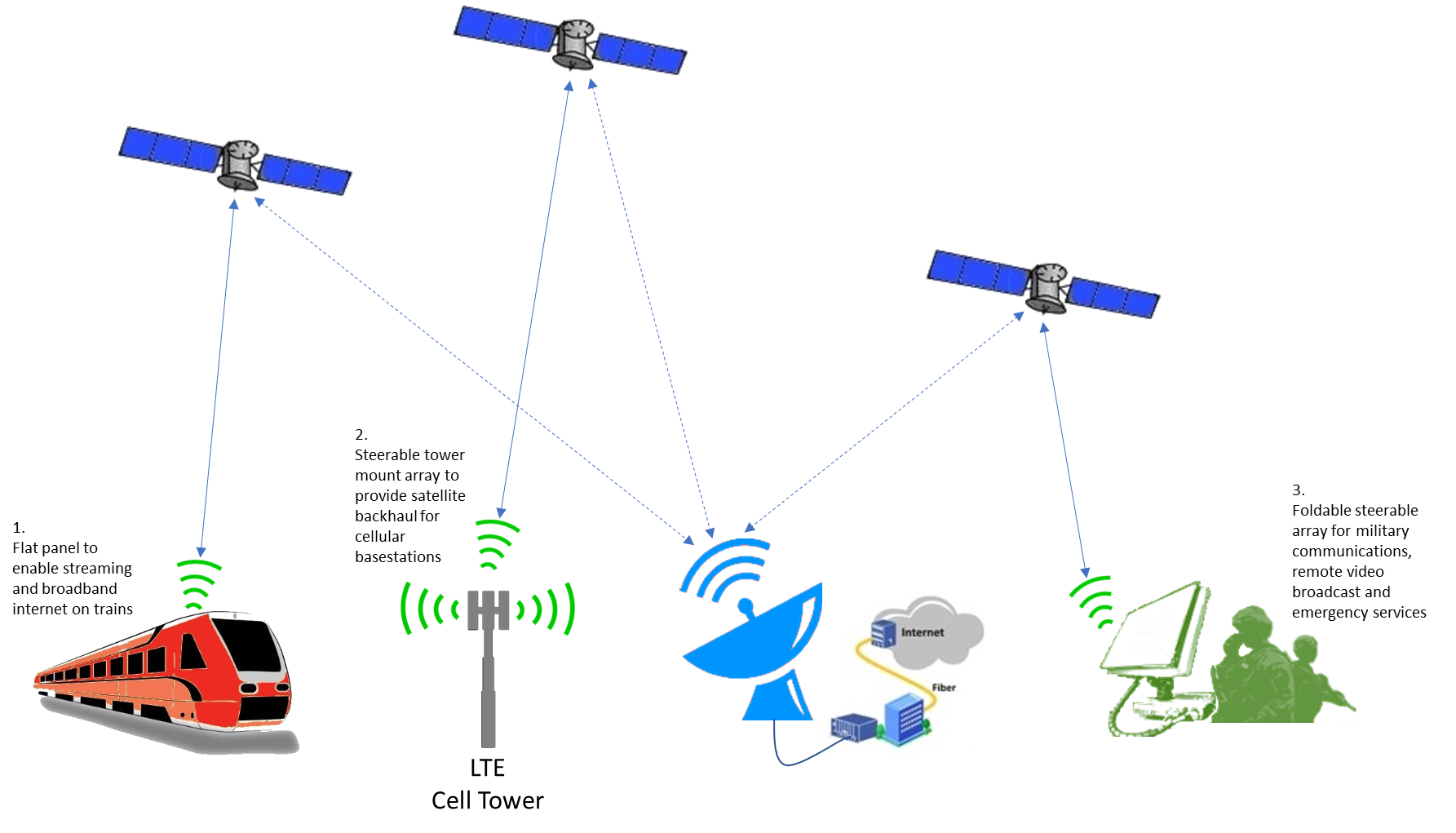
The Sofant sub-array is primarily targeted at Value Added Manufacturers (VAM’s) who would integrate many Sofant sub-arrays into their Satellite Terminal (several hundred per terminal). Sofant is also talking to multiple Satellite Operators and exploring additional opportunities for the technology.
The key needs we are addressing are:
- Low Power Consumption
- Compact size/low profile
- Low cost
- Wide scan angle range for some applications
- These requirements are balanced against the need to achieve G/T and EIRP requirements to ensure acceptable quality of service
The key operational challenge is guaranteeing the quality while minimising the size and profile of the antenna system. These requirements are in conflict and must be carefully balanced.
The solution is targeted at two of the major satellite operators, both whose satellites have a global reach, both are European headquartered. Target VAM partners are located in the UK, but the end customers will be worldwide.
Features
The core component of the Sofant solution is a passive antenna sub-array. Unlike alternative solutions we offer a Tx sub-array containing only antenna elements, phase shifters and feeding networks. This approach is enabled by the existing Sofant low loss RF MEMS phase shifter.
This architecture results in several performance benefits for the array including: reduced power consumption through use of single PA per sub-array; reduced power dissipation/heat; reduced production test and calibration.
The sub-array construction uses high volume production processes used in mobile phones. This will result in cost savings and simplified product ramp as volumes increase. Sofant are applying the same assembly approach to mmWave 5G to further aggregate volumes and reduce cost.
Challenges
The project overcame the challenges of developing a low loss, high bandwidth antenna and antenna feed network that is low cost to manufacture.
System Architecture
The Sofant Antenna Array Architecture consists of the following components: 4×4 antenna element Ka Band Tx sub-array; 4×4 antenna element Ka Band Rx sub-array; Tx Motherboard, Rx Motherboard.
The RF signal is connected to the Rx and Tx sub-arrays using connectors on the motherboard. The system demonstrates the core functionality of the RF chain and demonstrates the scalability of the overall assembly.
Plan
The project is split into 3 phases: Initial sub-array antenna prototypes; 2nd revision antenna array prototypes; Verification and validation of sub-arrays.
After the first phase an initial sub-array prototype was fabricated, along with basic measurement data.
After the second phase an improved antenna array prototype was fabricated and measured.
The final phase consisted of measurement, verification and validation of the 2nd revision antenna array prototype and motherboard assemblies.
Current Status
The project commenced on October 1st 2018, and has completed two months. The initial work is focused on substrate selection and the design of antenna elements and test structures using a new substrate technology
Companies
