

PAGE CONTENTS
Objectives
Backhauling service has been a considerable market for satellite communication systems, particularly to support areas that are too expensive to reach or too difficult to deploy conventional terrestrial networks. Therefore, given the promising role of IAB in 5G networks, it is of great interest to analyze and evaluate the potential benefits that IAB can bring to the non-terrestrial domain and/or as enabler for integration of NTN into 5G networks. While IAB could possibly bring efficiencies in the area of spectrum re-use between user and backhaul links, these possible benefits need to be put into a satellite regulatory context. Therefore, this activity will identify promising IAB architectures in future satellite-terrestrial integrated communications networks, and select the most promising ones to be further investigated via SW-simulations.
Benefits
This activity will propose different IAB NTN architectures, considering different satellite orbits and orbit combinations, all relevant frequencies, all relevant UE classes (be it on ground or in space), FDD/TDD modes, out-of-band and in-band backhauling, and combinations of above for which the use of IAB could add value. A simulation campaign will be carried out to assess the potential benefits of the shortlisted architecture(s).
Features
Integrated Access Backhaul (IAB) allows exploiting the same frequency resource used by an end device to access a base station and for the base station to access the backhaul network. Such deisgn opens the door to expanding coverage to challenging locations such as isolated areas and enables flexible deployment compared to the expensive fiber optic infrastructure.
Challenges
The significant global increases in network traffic brings one major challenge, which is to substantially improve the underlying backhaul infrastructure. Considering the large available bandwidth in mmWave band, the cellular operators can consider different spectrum sharing scenarios for the Radio Access Network (RAN) and the backhauling network. This technique is known as integrated access and backhaul (IAB), and has recently attracted a lot of attention both from academia and stakeholders. The key concept of IAB is to reuse the existing framework of 5G access link for the backhaul as well, by efficiently multiplexing access and backhaul in the time, frequency and/or space domain.
System Architecture
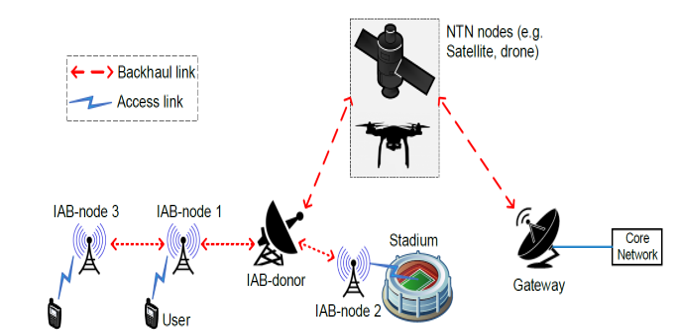
Fig. 1 illustrates an IAB-NT architecture for backhauling, where the IAB-donor installed on ground wirelessly communicates with the core network via NTN nodes (e.g. satellite, drone). This architecture aims to expand network coverage to remote areas over sea, land or disaster area where terrestrial networks coverage is not available. If the network capacity needs to be enlarged for a short time in particular areas (e.g. stadium, concert venue), IAB can provide fast time-to-market for access points to come on air. The IAB reduces the deployment and operational cost significantly without the need of the dedicated backhaul link.
Plan
Sat-IAB started in July 2022 and will last for 6 months.
The project is composed of four main tasks:
-
Task 1: Inventory of IAB related activities
-
Task 2: Exploring relevant IAB NTN Architectures
-
Task 3: Detailed definition and top-level simulation
-
Task 4: Dissemination and future developments roadmap
Current Status
Project started in July 2022.
Companies
