

PAGE CONTENTS
Objectives
The objective of the project is to develop a Software Defined Radio (SDR) Modem for addressing Telemetry, Tracking and Command (TT&C) functions in satellite testing Electrical Ground Support Equipment (EGSE) systems and simulation environments for telecom market and ground stations market.
The project is starting from the existing prototype work (from former GSTP activity), which is for the implemented features mainly on Technology Readiness Level (TRL) 5, with the Technology Phase to add missing modem functionality and enhance the existing prototype to bring all features to TRL 5/6.
In the next step, the Product Phase shall productise the SDR Modem (all features shall be fully implemented, all admin functions shall be available, all features shall be verified and validated on module and system level up until TRL 8).
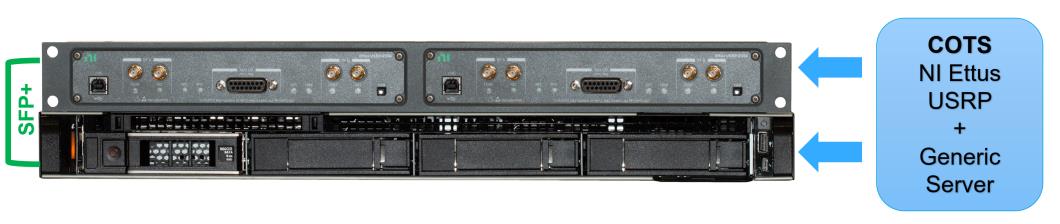
The figure below shows the main components of Terma SPECTRA SDR Modem. Terma SPECTRA SDR Modem is a distributed system that consists of a generic hardware backend (server) connected to an RF frontend (digitizer) via SFP+ cables. The RF frontend can be positioned close to the antenna to reduce signal loss, while the backend can be located in a server room.
Benefits
Terma SPECTRA uses a distributed SDR system, where the generic HW acts as the backend of the SDR connected to an RF frontend for maximum flexibility.
- Distributed Architecture for Optimal Performance: Separate RF frontend and baseband processing enables antenna-proximity deployment while maintaining centralized control, reducing cable losses and achieving up to 50% rack space savings compared to traditional integrated modems.
Complete CCSDS Protocol Stack: Full frame-level TM/TC processing with comprehensive support for various modulation and coding schemes. - Software-Defined Reconfigurability: Adapt to evolving mission requirements through software updates without hardware modifications – switch between modulation schemes, update protocols, or add capabilities post-deployment.
- 4-Channel Simultaneous Operation: Support up to 4 independent uplink/downlink channels from a single 2U unit, enabling full duplex capability and backup carrier monitoring while dramatically reducing system complexity.
- Rapid Deployment and Integration: Standards-based compliance (CCSDS) enables seamless integration with existing RF SCOE systems, EGSE setups, and satellite networks, reducing integration effort and accelerating time-to-operation.
- Hardware-Agnostic and Virtualizable: Built to run independent of specific hardware platforms, supporting physical, containerized, and virtualized deployments across on-premises, cloud, or hybrid architectures for maximum deployment flexibility.
- Scalable Growth Path: Future-proof architecture scales with mission needs – upgrade processing power, add channels, or expand ground segment capacity without replacing RF infrastructure or increasing physical footprint.
- Security by Design: End-to-end encryption with TLS, hardened OS (CIS benchmarks), role-based access control, …
- Native L- and S-Band Operation: Direct L- and S-band support without external converters or intermediate frequencies, simplifying RF chain design and improving signal integrity.
Mission-Proven Reliability: Dual modem redundancy with parallelization support ensures mission continuity in high-reliability ground systems and satellite operations.
Features
Terma SPECTRA Overview
- CCSDS compliant TT&C modem
- Satellite ground station
- EGSE
- Distributed system operating on COTS hardware → scalable, potential for virtualization
- Backend PC with Linux OS (Debian 12)
- RF frontend (USRP X310) connected with 10 Gb optical cable (SFP+)
- Frequency Range: 10 MHz – 6 GHz
- Bandwidth: 160 MHz (TX), 84 – 160 MHz (RX)
- Conversion: 14-bit ADC (200 MS/s), 16-bit DAC (800 MS/s)
- 2U form factor → up to 8 channels with 2 FEs (4 TX/RX pairs)
- Multicore, multithreaded processing
- Monitoring and Control Interfaces
- Terma SPECTRA Remote Interface (JSON-based, SSL-secured)
- Terma SPECTRA GUI (remote & local)
- Data Interfaces (TM/TC)
- TCP/IP
- RS422
- File
Modulation Schemes
- Remnant Carrier – PCM/PM, PCM/BPSK/PM
- Suppressed Carrier – (D)BPSK, (D)QPSK, OQPSK, GMSK (Coherent), GMSK (Non-Coherent)
- Subcarrier Waveform – Sine
- Line Coding (PCM Formats) – NRZ-L/M, SP-L
Symbol Rates
- Telecommand: 64 sps up to 2.048 Msps
- Telemetry: 60 sps up to 16 Msps
Channel Coding Schemes
- BCH Encoder & Decoder (CCSDS BCH(63,54))
- Reed Solomon Encoder & Decoder (RS(255,223), RS(255,239) with Interleaving I = 1,2,3,4,5,8)
- Convolutional Coding & Viterbi Decoding (Rates: 1/2, 2/3, 3/4, 5/6, 7/8)
- Turbo Encoder & Decoder (Rates: 1/2, 1/3, 1/4, 1/6)
- Concatenated (Reed Solomon + Convolutional)
Framing / Deframing
- CADU – CCSDS ASMs or Custom
- CLTU – CCSDS Start/Tails or Custom
Randomisation
- Scrambler / Descrambler – CCSDS Polynomials or Custom
Pulse Shaping / Filtering
- Pulse Shaping Filters – Rectangular, RC, RRC, Gaussian
- FIR Filters
- IIR Filters
Sweeper
- 1-leg linear
- 2-leg linear
- 3-leg positive/negative
Doppler
- Doppler pre-steering based on TLE
- Doppler correction/compensation (automatic)
Carrier Sequence Operation
- CCSDS PLOP – 1
- CCSDS PLOP – 2
Ranging
- ESA Tone/Code Ranging (ECSS-E-50-02C, ECSS-E-50-05C)
Signal Analysis
- Eb/N0, CNR, C/N0 Estimation
- Spectrum, Waveform and Constellation Display
- BER/FER Tester
Signal Generator
- CW
- Noise Source (AWGN)
- Custom
Challenges
The main challenges were found in the SDR technology, implementation of the required capabilities, modulation types, Turbo coding, Doppler correction and impairments correction, ranging as well as the related performances.
Another challenge was the selection of the baseline solution (HW and SW COTS platform). The main criteria were the processing performance, cost and the portability of the implementation, as the SDR modem is desired to be as much as possible HW independent.
System Architecture
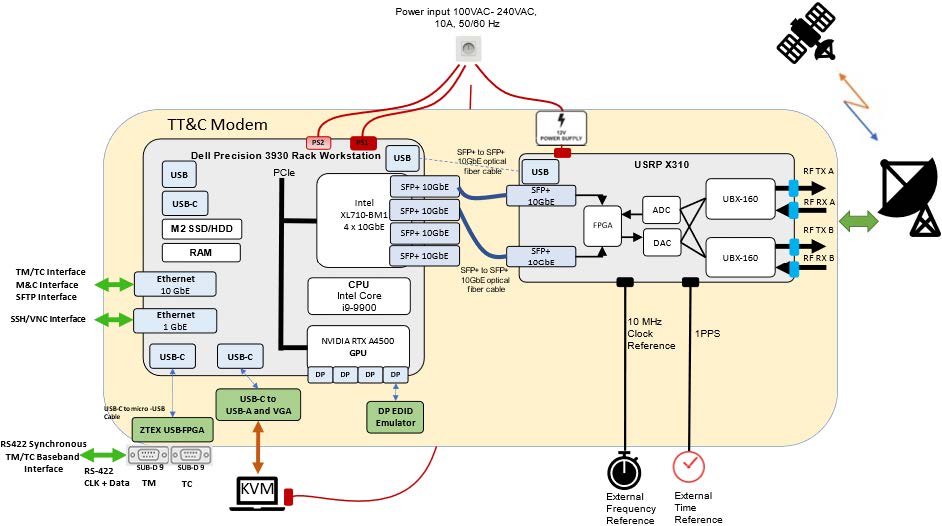
Terma SPECTRA follows a distributed architecture, where the SDR backend, powered by the generic hardware (server), communicates with the RF frontend (digitizer) via high-speed SFP+ cables (200 MS/s). This setup allows for a separation of the SDR processing from the RF front-end, enabling the possibility of placing the RF hardware close to the antenna and the backend in a more centralised or remote location, such as a server or workstation room. This approach maximizes operational flexibility, enabling easy integration into different environments while maintaining high performance and signal integrity. The following figure presents the hardware architecture together with internal and external based on a rack server and USRP X310 digitizer:
Plan
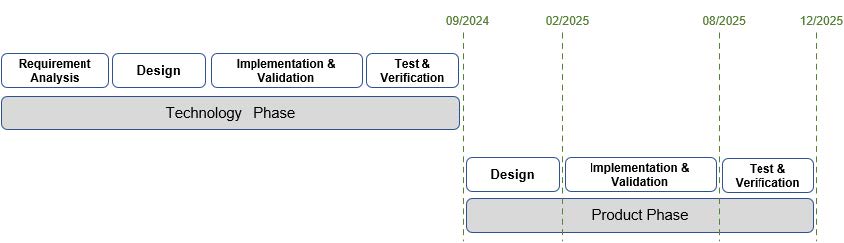
Technology Phase was used to de-risk the SDR modem functionality and to enhance the existing prototype to bring all features to TRL 5/6. Technology Phase was completed in September 2024.
The Product Phase which then starts shall productise the SDR modem. All features shall be fully implemented, all admin functions shall be available, all features shall be verified and validated on module and system level up until TRL 8.
Current Status
Currently test and verification of the SDR modem product phase are ongoing. We expect the project to be completed by the end of 2025 / beginning of 2026.

