PAGE CONTENTS
Objectives
The major objectives of this activity are
- to investigate in detail new architectures and technologies for the design of a wideband, highly flexible front-end as part of user terminals for next generation broadband and broadcasting services
- targeting consumer grade products, to demonstrate the feasibility of a cost-effective solution with the capability to appropriately process
- a single wideband carrier with a bandwidth of up to 500 MHz within a input frequency range of 1 GHz to about 2.2 GHz
- multiple carriers, from one or multiple input sources with an aggregate bandwidth of up to 500 MHz, which may exhibit individually different bandwidths.
The activity also aims at the investigation and demonstration of additional front-end processing to perform apart from
- highly flexible digital front-end channelization/ digital filtering and carrier selection
- signal level control and mitigation of front-end imperfections (I/Q imbalance, DC offset)
in particular,
- digital beam forming and interference mitigation
Challenges
The development of the targeted wideband front end faces as major challenges the
- Design of down-conversion of a 500 MHz band out of a wide IF input bandwidth (1 – 5 GHz) with subsequent A/D conversion and handling of resulting sample rate of several Gsamples per second
- Design and implementation of additional processing for
- extraction of a varying number of carriers with flexible bandwidth for the single or multi-carrier wideband scenario
- digital beam forming, in particular, definition of robust methods
- to determine the individual weights for the input signals to generate the desired beam forming
- to remove all differential frequency offsets and sustain a constant differential carrier phase offset between all input signals received by the different antenna elements
System Architecture
The wideband channeliser can extract up to 32 independent channels from an instantaneous bandwidth of about 2 GHz (200 – 2200 MHz)
Each of these channels is independently configurable at run-time allowing
- a bandwidth between 1 MHz up to about 500 MHz (in steps of 1 MHz),
- any centre frequency within the input bandwidth with a tuning resolution of ≤ 1 Hz,
- selected channel bandwidths, which may overlap in frequency,
- low-pass or root-raised cosine (RRC) output filtering with a 35% roll-off factor to minimise amplitude and group delay variations,
- performance of the channelization process with a variation from an ideal down-conversion process of less than a 0.4 dB,
- an output sample rate of either 2x bandwidth or 4x bandwidth,
- channels programmed with identical bandwidth and filtering having guaranteed coherent phase relationship.
The Digital Beamforming has been designed for a typical DTH reception scenario, i.e. a stationary user terminal receiving signals from a GEO satellite. The developed solution is based on a considerably extended MPDR beamforming algorithm. The extensions have been introduced, in order to increase robustness and adaptability against anticipated constant and time varying residual errors.
The novel DBF approach
- can be employed by reception terminals using an antenna system with a moderate number N of feeds /LNBs
- does not require specific knowledge of the received signal
- does not rely on permanent feedback from the demodulator/decoder unit, in particular, recovered signal samples for reference
- is capable to efficiently mitigate
- residual errors concerning the assumed antenna manifold
- antenna mispointing within a certain, selectable range
- potential residual static or time varying frequency offsets and amplitude variations between the baseband channeliser output signals being received via the different antenna feeds/LNBs
- can automatically determine the number of interfering signals
- ensures smooth phase transition in case of a weight update,
Plan
Phase 1:
- Identification of potential front-end application scenarios including required digital signal processing and derivation of corresponding requirements
- Review of existing terminal architectures and identification of front-end technology gaps, in particular, with respect to receiver front-end
- Trade-off analysis and selection of front-end architecture based on survey of relevant technologies, feasibility assessment, performance, and cost analysis
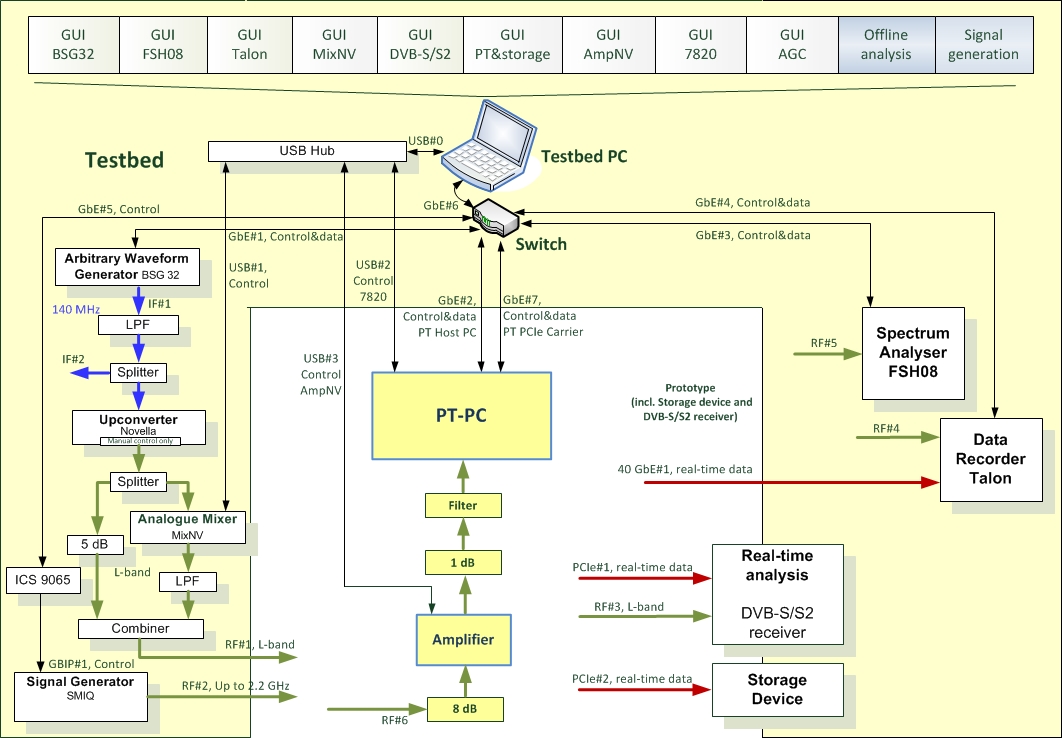
- Definition of a front-end prototype (including test-bed) for demonstrating selected features of the new design
- Generation of preliminary development / implementation / test plans and specifications for front-end prototype and test-bed
Phase 2:
- Detailed design of prototype and test-bed
- Development, implementation, and integration of prototype and test-bed
- Validation and test campaign
Current Status
Completed in January 2017.