MONAMI

Miniaturised VHF/UHF Omnidirectional Antenna for M2M/IoT Applications

STATUS | Completed
STATUS DATE | 31/03/2025
ACTIVITY CODE | 7B.047

Objectives

Nanosatellite constellations are becoming an increasingly popular means of deploying IoT services worldwide.  Startup Kinéis, based in Toulouse, France, is now giving some of its IoT devices hybrid terrestrial (868 MHz LORA) and satellite radio (in the 400 MHz band) connectivity. This kind of low-frequency telecommunication uses less power for extended device battery life. But the lower the telecommunication frequency, the larger the antenna. This creates serious challenges for smaller devices.

CEA-Leti, which boasts a strong track record designing and integrating miniature antennas, has worked on this project with Kinéis to shrink the antennas size by a factor of 7.5 to reach 5 x 5 x 3 cm dimensions (that is λ/15 x λ/15 x λ/25 where λ is the wavelength at 400 MHz). Distributed RF loading techniques has been used on the antenna low cost structure. Another strong constraint that has not been dealt with so far is that the antenna has omnidirectional type radiation but with circular polarization.

The breadboard miniature antenna has been measured in the large anechoic chamber of CEA Leti and on the field with Kinéis satellites link.


Challenges

Main technical challenge concerns the ultra miniaturization on the 400 MHz antenna while maintaining circular polarization and bandwidth (Impedance, Axial ratio). The antenna performance sensitivity to its close context has also been evaluated. A second band at 868 MHz (Terrestrial IoT) is also supported by the developed antenna.

Plan

The MONAMI project has started from the miniature antenna SotA and market review (early 2021) and ends with the field test of Terr./Sat. IoT  links with the breadboard antenna (2023).

Current Status

Preliminaries studies have allowed to identify most promising antenna technologies and to embrace the trade-off between performance and miniaturization effort. The first breadboard miniaturized circular polarized antenna has been characterized in CEA Leti anechoic chamber and expected performance has been achieved. Final breadboarding of a miniature antenna integrated on a metallic context to emulate container scenario, has been characterized in anechoic chamber and validated during a Kinéis Satellites system-level campaign (Fall 2023). The project is now closed.


MLDR

Machine Learning Technique for Data Rate Reduction

STATUS | Ongoing
STATUS DATE |
ACTIVITY CODE | 7B.079
MLDR

Objectives

The goal of the activity is to develop an intelligent AI model that improves useful data rate by enabling less complex and less power consuming coding scheme with respect to current implementations. The developed algorithms can compress data using AI by reducing data replicas that are intrinsically present in the information to be transferred and mitigate possible reception errors by exploiting this intrinsic redundancy.

The applications are tested using a demonstrator testbed, showing the benefit of AI-supported data compression, comparing the obtained results with a state-of-the-art communication standard.

The testbed is composed by a Software Defined Radio (SDR) that simulates the CCSDS 131.2-B data link layer. The SDR takes input from the application layer, which is represented by the AI algorithms.

Such structure allows to test the end-to-end transmission chain, evaluating also the benefit of AI smart data compression models against different channel conditions and different use-cases or data types.

Finally, IngeniArs performs a feasibility study for deploying the AI-compressor into the GPU@SAT hardware accelerator.

GPU@SAT is a technology independent GPU soft-core developed by Ingeniars that can be embedded in space-qualified FPGA and used for space applications, including high-reliability space missions (class 1).

Challenges

The biggest challenges for the MLDR project are:

  • AI-compressors: develop an AI model that is able to compress and decompress data while maintaining the best quality possible is a very challenging task. In fact, such AI models deal with different data types and noise conditions requiring a peculiar training phase that create a well-formed and quantised latent space.
  • End-to-end communication simulator: build an end-to-end communication chain based on CCSDS 131.2B could require more than 1 year. IngeniArs has a long experience with such type of communication systems and already disposes of a complete CCSDS 131.2-B SDR, limiting the risks related to the simulation environment.

System Architecture

System architecture

IngeniArs adopts the CCSDS 131.2-B simulator supported by GPU, which represents a fully functional end-to-end communication system.

Supporting the simulator with the AI-compression algorithm, IngeniArs can easily derive the metrics while computing the error correction rate. The errors are due to channel impairments (AWGN, doppler error, frequency error, timing error, etc.) introduced by the CCSDS 131.2-B simulator.

The two algorithms run on a dedicated computer with GPUs, which can accelerate both the CCSDS 131.2-B data link and VAE model.

Plan

N/A

Current Status

The project has already passed the SRR, and now IngeniArs is working on the preparation of the datasets as well as a preliminary selection of possible models to be adopted as reference for the final implementation. Concurrently, IngeniArs is preliminary developing the testbed. The latter is composed by three different steps:

  1. Encoding phase: executed by one of the AI models developed selected with respect to the type of data involved in the use-case
  2. CCSDS 131.2-B end-to-end simulator
  3. Decoding phase: executed by the decoder of the AI models used for generating the latent space.

To speed up the testing of the AI models, IngeniArs is adopting a CI/CD strategy, which allows to integrate and develop different models in short time.

PDR is forecasted for Q2 2025.

ESA supports digital transformation and interoperability in satellite ground segments

Publication date

05 Nov 2024

Digitalisation and interoperability in satellite ground segments is crucial to growing a more competitive and flexible satcom sector. ESA came together with nine companies during the Digital Intermediate Frequency Interoperability (DIFI) European Plugfest event on Harwell Science and Innovation Campus, UK.

Hosted at Satellite Applications Catapult facilities, the event showcased the wide plethora of interoperable products and capabilities that are developed within the DIFI consortium and of which boasts over 60 different companies that work together through regular working groups.

The drive for interoperability stems from the DIFI standard, which is focused on establishing a standardised digital interface for the exchange of intermediate frequency signals between equipment and systems from different vendors.

Through these standards, various platforms will be compatible and interoperable with each other, working towards a more efficient and flexible ecosystem for satellite ground segment operations. By developing standardised interfaces, it reduces integration complexities and enables the ground segment to scale up faster, while supporting innovative applications – from commercial broadcasting to critical governmental communications.

ESA is supporting the development of future-facing software defined modems and virtual networks, and collaborated with organisations at the event, exchanging with industry leaders and experts on how it can best support a growing collaborative ground segment ecosystem promoting digitalisation and interoperability.

Over the course of the three-day event, the participating teams integrated and tested products across 178 test cases (93% were partially compliant and 75% were fully compliant with DIFI standards), showcasing the importance of the higher benchmarks.

“All [engineers] agree that failed tests might’ve been the most important takeaway, highlighting ESA’s role in encouraging, driving and de-risking innovative technological progress,” said Sanna Sandberg, Ground Segment Engineer for cloud and AI solutions at ESA.

ESA worked with the DIFI consortium through the co-funded activity, “Digital IF for satellite ground segment”, which is primed by ETL Systems, as part of ESA’s Advanced Research in Telecommunications Systems (ARTES) Core Competitiveness programme.

A keynote from ESA’s Acting Head of Ground Segment, Ilias Panagiotopoulos, showcased ESA’s role in enabling the disruptive evolution of ground segment technologies, through such events as PlugFest. The event provided a platform on specification validation, a range of product types, and showcase of integrated industry.

“The adoption of DIFI standards is not merely a technical enhancement; it is a strategic move towards achieving greater efficiency and interoperability in our satellite ground operations undergoing fast paced digital transformation,” said Panagiotopoulos.

The ground segment team forms part of ESA’s ARTES’ Core Competitiveness programme, which provides funding and multi-disciplinary expertise to enhance competitiveness in satellite communications.

GaN Ka-band HPA for VSAT

2W- and 4W-Class Ka-band HPAs in QFN plastic package for VSAT applications

STATUS | Completed
STATUS DATE | 27/08/2024
ACTIVITY CODE | 7A.061
GaN Ka-band HPA for VSAT

Objectives

The final objective of the project is to design, manufacture and test a set of MMIC High Power Amplifiers, in SMT package and European GaN technologies, capable to deliver a saturated output power of 2 and 4 Watts over the frequency range [27 – 31] GHz. Furthermore, the target is also to enable a European Source of Ka-band 2W and 4W HPAs.

The solution in low-cost QFN plastic package makes this solution very attractive for cost and assembly simplification. 

This component is intended to be used for new generation of Very Small Aperture Terminals (VSAT), covering both MSS (Mobile Satellite Service) and FSS (Fixed Satellite Service) uplink frequency ranges.

Challenges

The main challenges addressed by the project are:

  • To obtain these classes of power amplifier in very small MMICs from available European GaN technologies.

  • To identify the right packaging solution both low-cost and high-frequency.

  • To define the right trade-off among power, efficiency and linearity, for the optimization of both RF and thermal performance.

System Architecture

The architecture of the amplifier is optimized for the best trade-off among power and thermal performances and dimensions.

Plan

The project is developed on the basis of the following tasks:

  • Task 1: Analysis of the technology, identification of best architectures for the MMICs and definition of the Baseline Specifications; Identification of optimum package option.

  • Task 2: Design of first iteration MMICs and relevant test structures; manufacturing and test of components;

  • Task 3: Detailed design of the MMICs;

  • Task 4: Manufacturing & Test of the final components.

and through the following Milestones:

  • Requirements Review

  • Preliminary Design Review

  • Bread-Board Test Review

  • Detailed Design Review

  • Test Review Meeting

  • Final Review

Current Status

The project is in the final phase (Task 4).

AI-DEM

Demodulator supported by Artificial Neural Networks

STATUS | Ongoing
STATUS DATE | 18/07/2024
ACTIVITY CODE |
AI-DEM

Objectives

The project “Demodulator supported by Artificial Neural Networks” aims to evaluate the benefit of an AI-enhanced demodulator compared to a traditional implementation. Our primary objectives include designing and testing an AI model for physical layer processing tasks, such as symbol soft de-mapping and channel decoding, taking as reference the CCSDS 131.2-B-2 standard. This involves a critical assessment of the state of the art and the definition of a new suitable topology for an AI model, as well as adequate training and validation strategies. The performance is then compared with a standard demodulator in terms of cost, computational complexity, power consumption, and bit error rate. The ultimate goal is porting the model into an FPGA-based architecture platform developed by IngeniArs S.r.l., namely GPU@SAT, to demonstrate the capabilities for onboard satellite applications.

Challenges

The following are the key challenges to be addressed:

  • designing and fine-tuning an AI model for physical layer processing tasks like symbol soft de-mapping and channel decoding;
  • generating a large and diverse dataset that accurately represents the possible different conditions of the communication channel to effectively train the AI model;
  • integrating the AI model into GPU@SAT ecosystem, an FPGA-based soft-GPU platform through model optimization and quantization;
  • measuring the performance and comparing it to a traditional demodulator while considering various metrics (cost, power consumption, BER, etc.).

System Architecture

The last phase of the project involves setting up and testing a hardware demonstrator based on the GPU@SAT IP core developed by IngeniArs. For this purpose, a software implementation of a CCSDS 131.2-B-2 transmitter and a channel noise emulator are used to generate the input signal. The receiver, on the other hand, is divided into two parts: the first, which addresses synchronization, is implemented in software; the second, addressing symbol soft de-mapping and decoding, is the AI model running on the soft-GPU platform.

Plan

The project starts with the definition of requirements and preliminary AI model topology, leading to the System Requirements Review. Next, the AI model design and dataset generation are planned, followed by the Preliminary Design Review. The project then proceeds with AI model implementation, performance assessment, and Critical Design Review. Upon achieving the required performance, the project then focuses on porting the model to the GPU@SAT platform, with associated testing and validation, leading to the Test Readiness Review. The final phase involves the critical assessment of the collected results and outlining a roadmap to the utilization of this technology in space applications, concluding with the Final Review.

Current Status

The project is on-going.

The generation of the dataset and its validation has been completed successfully. Some model architectures representing the CCSDS 131.2 de-mapper and decoder are under training.

INWAVE

Integrated Q/V/W-Band Passive RF Hardware for Ground Segment Network Equipment

STATUS | Ongoing
STATUS DATE | 15/07/2024
ACTIVITY CODE | 6A.077

Objectives

The main objectives of the activity are the following:

a) RF: the main RF goal is to design and produce three different feed chain designs, corresponding to the following frequency plans:

  • Case 1: From 37.5GHz to 51.4 GHz

  • Case 2: From 37.5GHz to 86.0 GHz

  • Case 3: From 71.0GHz to 86.0 GHz

The results are the first W-band monolithic diplexer-polarizer-antenna and the first multiband Q/V/W feed for ground applications in the market.

b) AM objective:

Laser powder bed fusion (LPBF) has proven to be the most suitable AM technology for RF components providing high resolution, design freedom and complexity, good mechanical properties, and reasonable surface finish that can be further improved by post-processing. 

However, there is a significant room for improvement which directly impacts the RF performances. First, via process optimization for a specific design feature and secondly, with new generation of LPBF machines that improve features and contour resolution using pulsed-wave mode of laser as opposed to conventional continuous wave laser. In addition, new materials specifically designed for LPBF manufacturing have entered the AM market, thus providing improved material performance.

This activity aims at developing new AM end-to-end manufacturing route for Q/V/W-band passive RF hardware using advanced LPBF manufacturing with fine detailed resolution (FDR).

Challenges

The main challenges for this activity are the following: 

  • Increase the precision of Laser powder bed fusion (LPBF) AM processes to be able to meet the RF specifications of Q/V/W band components.

  • Implement RF designs that are compatible for AM and also robust enough to ensure high production yield for large volumes.

  • Design for Case 2 (37.5 to 86.0 GHz) is very broadband and requires a coaxial feed with complicated architecture. Such a solution doesn’t seem to exist in the market and is more challenging that cases 1 and 3.

System Architecture

Case 1 (from 37.5GHz to 51.4GHz): a monolithic feed chain including: 1) diplexers or triplexers; 2) OMT and polarizer; 3) feed horn is baselined.

Case 2 (from 37.5GHz to 86.0GHz): a coaxial feed component, where the TX band is  placed inside the inner coaxial. The TX path consists of a single-band septum polarizer with two bandpass filters connected to the ports. The RX path can consist in 1) a coaxial turnstile OMT with bandpass filters (with rejection in the TX band) and a hybrid coupler, or 2) a coaxial polarizer, and coaxial turnstile OMT with bandpass filters (with rejection in the TX band). The feed horn is to be integrated monolithically with the feed chain.

Case 3 (from 71.0GHz to 86.0GHz): a monolithic feed chain and reflector including: 1) diplexers; 2) septum polarizer (circular or linear); 3) feed horn, 4) integrated reflector is baselined.

Plan

The activity starts with a detailed state-of-the-art survey on both RF feed chains in Q/V/W bands and of manufacturing technologies used for such components (WP1). Based on the survey, a finalised technical specification is derived before the Requirements Review meeting.

Then starts the WP2 on technology selection and feasibility, led by CSEM. Different AM technologies are compared based on some benchmark RF geometries. This WP ends with a Technology Baseline Review. In parallel, prior to the completion of WP2, the detailed design and implementation plan (WP3 – led by SWISSto12) is starting, using the first inputs from WP2. WP3 ends with a Manufacturing Readiness Review / Critical Design Review of the feed chains. After the MRR, WP4 focuses on manufacturing up to the Test Readiness Review. WP5 includes all the testing and analyses of the results and is closing with a Test Review Board. After the TRB, a short WP6 is dedicated to the technology assessment and the development roadmap, leading to the Final Review of the activity.

Current Status

Currently, the requirements review meeting (MS1) has been successfully completed and the technology selection and feasibility WP (WP2) is ongoing.

NOTES

System Demonstrator of Non-Orthogonal Multiple Access over Satellite

STATUS | Ongoing
STATUS DATE | 22/04/2024
ACTIVITY CODE | 3C.024

Objectives

  • NOMA Techniques Development: The main purpose is the development and evaluation of NOMA (Non-Orthogonal Multiple Access) techniques for satellite return links, comparing performance with classical orthogonal access techniques.
  • Software Defined NOMA techniques Testing by means of a test bed which includes software-defined NOMA transmitter and receiver (SDR)
  • Throughput improvement: increasing the aggregate system return link throughput using NOMA over OMA
  • Latency reduction: reduction in overall system latency with respect to OMA
  • TRL up-scale: raising the Technology Readiness Level from current value TRL3 to TRL5

Challenges

  • Implementation and testing of Successive Interference Cancellation (SIC) at the gateway for High Order Modulations (HOM).
  • Characterisation of the different impairments that could impact the effectiveness of NOMA methodologies and identification of corresponding realistic and accurate models
  • Analysis and tuning of several algorithms (e.g., estimation algorithms) in order to deal with the different characteristics of the received signals
  • Identification of scheduling strategies at system level for a commercial solution, trying to minimise the impact in terms of complexity compared to existing OMA solutions

System Architecture

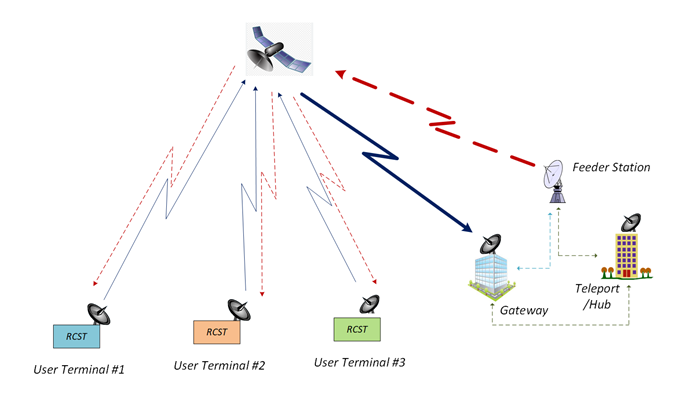
At architecture level, the system involves a number of terminals, a gateway to receive information from the terminals, a feeder link to send information to the terminals, and a HUB to manage communication, as shown in the following figure.

User terminals

The following figure shows in detail the channels allocated on the forward link and return link, both for the DAMA initial procedure and for transmission with PD-NOMA.

Terminal & Gateway

The developed NOMA techniques will be implemented in a software-defined NOMA transmitter and receiver (SDR), resulting in performance testing. A logical diagram of the air interface is shown below.

Sequence

The digital section foresees a turbo encoding of the incoming data with a certain rate and a subsequent modulation, then the burst is created according to a pre-established configuration in terms of preamble sequence, TFI and pilot, finally a digital SRRC filter is applied to the digital signal.

The following figure shows a high-level diagram of the receiver.

Receiver

In this stage the signal with the highest SNR is first acquired and demodulated, then this is cancelled to allow processing of the following one and so on until the last signal component to be demodulated.

Plan

The project plan foresees a unique phase which includes the following milestones after the KO meeting (T0):

  • System Requirement Review (T0+3M)
  • Critical Design Review (T0+8M)
  • Test Readiness Review (T0+15M)
  • Final Review (T0+18M)

The total duration of the project is 18 months.

Current Status

Conclusion of activities related to WP0100, WP0200, WP1100, WP1200, regarding survey and critical assessment of the state-of-the-art of NOMA technologies, definition of System scenarios, use cases, technical requirements and preliminary verification plan. After the successful conclusion of SRR milestone, the activities related to WP2100, WP2200 and WP3100, which deals with the technology trade-off and detailed design of the baseline solution, are going to start.

QVW

Integrated Q/V/W-Band Passive RF Hardware for Ground Segment Network Equipment

STATUS | Completed
STATUS DATE | 25/03/2024
ACTIVITY CODE | 6A.077
QVW

Objectives

Very High Throughput Satellite systems are shifting towards Q/V/W-band for the feeder link due to rapidly increasing traffic demand. These new bands provide larger usable spectrum while freeing Ka-band for the increasingly demanding user connectivity. However, the manufacturing of waveguide feeders at these bands become increasingly complex due to the shrinking feature size. Conventional milling techniques require tool access, so the components must be machined out of multiple piece-parts that are connected using flanges and screws. This results in bulky assemblies, which impacts on insertion losses and eventually system performance. 
This activity addresses this challenge by applying high-precision 3D printing techniques to produce monolithic components with much reduced interfacing and assembly. The project also explores the full design flexibility afforded by 3D printing. 
The University of Birmingham partners with Airbus, who has heritage Q/V-band development, and Filtronic, who has commercial production experience with V/W band components. This activity develops and validates three breadboards of fully integrated passive waveguide feeders at Q, V and W-band, respectively. 

technology

Challenges

The technical specifications for the hardware are stringent in terms of the requirement for dual circular-polarisation separation over either a wide band or two widely distanced frequency bands. There are significant trade-offs among bandwidth, polarisation isolation and frequency multiplexing.   
The other challenge area is the manufacture. Polarisers, orthomode transducers and multiplexers are known to be hard to manufacture and sensitive to imperfections in both manufacture and assembly. This activity explores the use of additive manufacture (AM) techniques. Design-for-manufacture is an important consideration to take advantage of the free-forming capability of AM without sacrificing the RF performance. 

System Architecture

The activity develops hardware components for three different band combinations. The architecture for each depends on the specific polarisation and multiplexing requirements. The hardware contains polarisers, orthomode transducers, filters, diplexers or multiplexer.

Plan

The project has six technical work packages: 

WP1000: Finalised Technical Specification
WP2000: Technology Selection
WP3000: Detailed Design of Prototypes
WP4000: Implementation and Verification Plan
WP5000: Verified Deliverable Items and Compliance Statement
WP6000: Technology Assessment and Development Plan

The Q/V band hardware development is in parallel with the Q/W and V/W band development. 

There are four milestones:
 
MS1: Finalised technical specification and technology selection
MS2: Detailed design and implementation & verification plan
MS3: Test results and assessment
MS4: Final report  
 

Current Status

The KO meeting of the project took place in December 2023. 

NOMA

System demonstrator of non-orthogonal multiple access over satellite

STATUS | Ongoing
STATUS DATE | 22/03/2024
ACTIVITY CODE | 3C.024

Objectives

The objective of the activity is to work on non-orthogonal multiple access (NOMA) techniques for 2 different use cases: 

  1. HEO use case

    • Bent-pipe satellite

    • IoT SS-CDMA system sharing transponder frequency band with VSATs

  2. LEO use case

    • IoT SS-CDMA system using WRC-27 new IoT candidate frequencies within the 1.4-2.1 GHz range

    • On-board processing or IoT gateway on the ground

    • Using Successive Interference Cancellation to improve throughput and availability, especially for IoT terminals at the edge of the coverage

The main target for the HEO use case is to remove the need to allocate dedicated return link bandwidth for the IoT SS-CDMA system and be able to coexists with regular VSAT traffic in a common frequency band. The main target for the LEO use case is to increase the throughput and probability for successful transmission for IoT terminals using Successive Interference Cancellation techniques. The work in this activity is based on using the IoT SS-CDMA air interface and the testbed that was developed in the ALISA ARTES AT activity as a starting point.

Challenges

The main challenges in the project are:

  • High Doppler variations from satellites in non-geostationary orbits are difficult to track by the demodulator in the presence of phase for low symbol rates at very low signal-to-noise ratios.

  • Estimation of channel state parameters.

  • Processing constraints in the satellites.

  • Pre-compensation of Doppler from satellites in non-geostationary orbits cannot be done for systems where messages are received by multiple satellites.

  • Complexity of NOMA algorithms.

  • Battery/power constraints of IoT terminal.

System Architecture

The architecture of the verification platform used for development and verification in this project is shown in the block diagram below

diagram


Plan

The duration of the project is 28 months. The following review meetings are planned in the project:

  • Output 0 Review (O0R) in January 2024

  • Output 1 Review (O1R) in April 2024

  • Output 2 Review (O2R) in August 2024

  • Output 3+4 Review (O3+4R) in January 2025

  • Final Review (FR) in March 2026

Current Status

Kick-off date for the project was October 18, 2023. Ongoing work is defining the system scenario, analysing the system benefits, and defining draft system requirements. In addition, the test plans and procedures are being drafted. The next milestone is the Output 1 Review (O1R), which is also the first milestone, the PDR.

CREAMPET

Autonomous Collision Avoidance Systems for Ground Control Centres with Data Privacy Protection

STATUS | Ongoing
STATUS DATE | 22/02/2024
ACTIVITY CODE | 6B.116

Objectives

The objective of this activity is to develop and test a prototype of an autonomous collision avoidance system for ground control centres that guarantees data privacy to satisfy satellite operators’ data privacy requirements. In other words, a prototype should be created which performs collision assessment between objects by using privacy-protected (i.e. encrypted, obfuscated…) shared data of different satellite operators.

The kind of computations covered in this autonomous collision avoidance context includes:

  1. Collision Probability

  2. State uncertainty prediction

  3. Conjunction data fusion from multiple data sources

  4. Collision avoidance manoeuvre decisions

In order to provide these functionalities, some private data such as state-vectors, covariance or object characteristics shall be shared, either to improve the training of the models or to execute the trained models. This kind of data is usually sensible to be shared by some of the satellite operators, and therefore also the one that will require the application of these privacy preserving techniques. In that sense, the developed prototype including the privacy preserving layer will consider the functionalities implemented on the activities S2P-S1-CR-01 (CREAM#1), using machine learning methodologies for the prediction of the above-mentioned parameters (AutoCA), and S2P-S1-CR-03 (CREAM#3), considering a centralised collision avoidance coordination system (AutoSTM).

Challenges

When working with data there is always a trade-off between the functionality provided by your service and the privacy of the data you are using to provide that service. The balance between what you want to do and what you can do (or what you are allowed to do) is not straightforward and for some advanced functionalities you must pay the price of the privacy and vice versa.


System Architecture

An initial draft diagram of the data and dataflow of a system that combines Collision Assessment tools with Coordination Platform and Service Platform Provider obtaining a complex and complete structure that offers all the information required for a satellite operator, increasing todays operational cost and accuracy.

The diagram presents different types of systems, such as standalone ones – e.g. Support software – as well as centralised services – e.g. Coordination Platform or Service Platform Provider. Depending on the type of system, different strategies might be required to be applied. In case of a support system (standalone version installed at the operators’ premises) the exchange data and models are shared directly between the Satellite Operators. In order to ensure the correct data has been exchanged, within the direct sharing the operators need to select and filter the required data by themselves, before ensuring the privacy and providing it to other users.

Plan

CREAMPET is a project initially scheduled for 18 months and consists of the following milestones:

  • Kick Off Meeting (KOM) – milestone marking the start of the project.

  • Software Requirements Review (SRR) – milestone marking the acceptance of the target software requirements 

  • Preliminary Design Review (PDR) – milestone marking the initial design of the software

  • Detailed Design Review (DDR) – milestone marking the design process completion 

  • Qualifying Review (QR) – milestone marking the success of the testing campaign

  • Acceptance Review (AR) – milestone marking the acceptance of the project.

Current Status

The activity has just started, the Kick-off meeting planned for the 15th of February 2024.