PAGE CONTENTS
Objectives
Tisalabs is an IoT company focused on the management challenges of the IoT industry. As the IoT industry matures the focus is moving from acquiring sensor data to providing security for the sensor network, geo-location of the sensors and the transmission of IoT data to secured repositories.
Tisalabs provides this essential IoT management infrastructure for enterprise customers through a cloud system linked with satellite communication for geographically dispersed IoT devices. The SecureSat project enhances our current system by improving the end-to-end security with a web solution managing the IoT devices and communications.
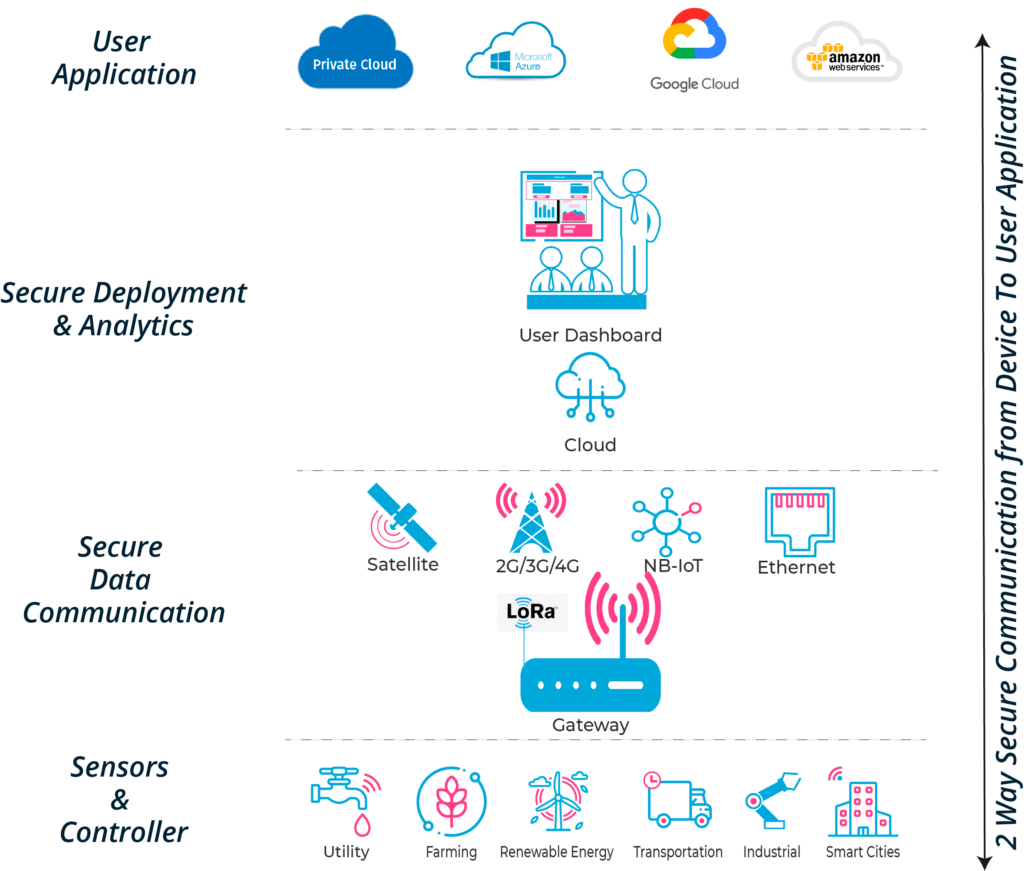
The objectives of the proposed activity are to develop and test a software solution enabling very secure communications between the IoT-enabled devices, gateway and the cloud data centre using a security framework with encrypted communications. This software will cover 4 main objectives:
-
Develop a solution with secure device identification with a secured identity key to identify each device.
-
Develop a solution that offers secure communication between IoT end node device, gateway and cloud data centre
-
Develop a solution with Signed firmware to improve the firmware integrity during the installation and upgrade in the devices
-
Develop a web application to facilitate the management of IoT devices and messages storage.
Challenges
The purpose of the project is to develop a turnkey solution for customers to deploy Satellite enabled IoT Solutions with LoRa/LoRaWAN and strong Security using hardware keys. The following are the main challenges to building such a solution:
-
LoRa/LoRaWAN traffic to be available to customer even without an internet connection
-
Maintaining a unique identity for devices and their corresponding H/W keys securely.
-
Maintaining data consistency over the whole chain from device all the way to the user application, assuming a high latency connection.
-
Maintaining data custody over different cloud providers and hardwares.
System Architecture
The system allows for the easy and secure implementation of LoRa and LoRaWAN sensor data to be routed from end-devices to edge gateways all the way to the tisalabs Tisa-Cloud infrastructure, the data is received either from Satellite operator when using short burst messages which are limited in size providing the same Quality of Service with different communication technologies. as it stands the solution is built to provide the following key user features:
-
A secure space edge gateway that allows LoRa traffic to be routed through Satellite Short Burst Modems i.e IDP modems.
-
A secure process that allows IoT devices to be identified with a secured identity key to its gateway device, thereby providing secure encrypted communications between device and gateway.
-
Manage at-scale large number of IoT devices over a very wide geographical spread with differing communications infrastructure such as urban, rural and isolated.
-
A Secure encrypted communication between IoT end node device, gateway and cloud data centre even when using Satellite communications.
-
A signed firmware to improve the firmware integrity during the installation and upgrade in the gateway and end devices with minimal data exchange.
-
A web application to facilitate the management of IoT devices and storage of messages as well as maintaining a consistent and automatic firmware and software upgrades.
-
A web application to monitor device security and vulnerabilities whilst providing devices status information.
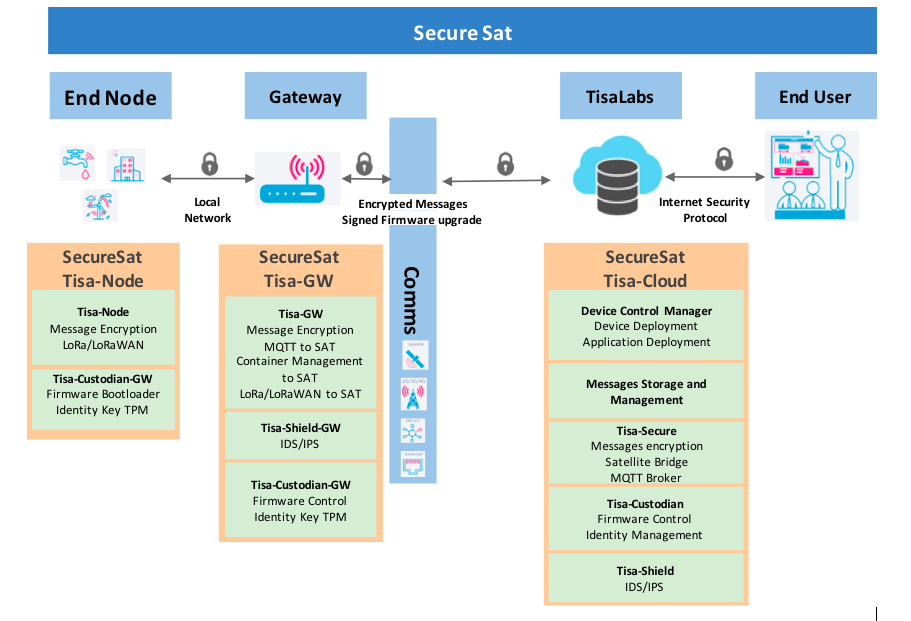
The functional diagram in the figure below shows the main system functionalities in each of the main system components involved
Plan
The project plan includes 5 work packages divided in 3 phases and 6 milestones.
-
Phase 1: Requirements and Design. In this phase a concise user needs and requirements assessment is performed before defining the system requirements and a comprehensive system design. The outputs are reviewed in the PDR-CDR milestone.
-
Phase 2: Development, Integration and Testing. This phase includes the Development of the system, integration of the components and functional testing (Factory Acceptance Test).
-
Phase 3: System Validation and Project Closure. In this phase full system validation is performed.
Further to the ESA project completion the system will be made available to a select beta customers for customer validation and feedback.
Current Status
The project is at the first phase of design specifications. We have completed all the technology choices and have reviewed and completed all of the technical challenges with the project.
We are now engaging in the product development phase which is starting now and will run for the next 6 month which allows us to develop the product as discussed and reviewed with qualified customers.
Companies