New platform for reliable connectivity developed in partnership with ESA’s 5G/6G Hub

Publication date

03 Sep 2025

The demonstration took place at European Space Agency’s (ESA) European Centre for Space Applications and Telecommunications (ECSAT)’s 5G/6G Hub on the Harwell Science and Innovation Campus in the United Kingdom. Image credit: ESA

From the European Space Agency’s (ESA) European Centre for Space Applications and Telecommunications (ECSAT)’s 5G/6G Hub, British company UniVirtua has successfully demonstrated a new product called dashAlpha – a connectivity-enhancing software platform that offers a step forward in reliable connectivity for self-driving cars, transport as well as vehicles crucial for disaster relief.

The dashAlpha d500R platform is designed to establish connection with several different sources – the so-called wireless bearers – such as satellites, cellular towers, Wi-Fi, Mobile Ad-hoc Networks (MANETs) and bond these together to increase broadband and decrease latency for the end user, by making use of a machine-learning algorithm used to predict satellite bandwidth performance. The technology is funded under the Space for 5G/6G & Sustainable Connectivity programme, within ESA’s Advanced Research in Telecommunications Systems (ARTES) and with support from the UK Space Agency.

During the live demonstration, the platform was used to bond multiple Starlink and Vodafone’s 5G Mobile Private Network (MPN) cellular connections to deliver resilient, high-bandwidth video calls. It was discovered that, despite one of the connections being deliberately severed, a stable connection was maintained – thus unaffecting the quality of the call.

UniVirtua’s dashAlpha is a connectivity-enhancing software platform that offers a step forward in reliable connectivity for self-driving cars, transport as well as vehicles crucial for disaster relief. Image credit: ESA

By aggregating multiple sources of connectivity, dashAlpha eliminates a single point of failure and creates a fault tolerant connection which can survive degradation, jamming or removal of one or more wireless bearers. Additionally, the software-defined nature of dashAlpha enables it to run on a variety of Commercial-off-the-Shelf (COTS) hardware, delivering a more cost effective and future-proofed solution than over existing proprietary communications solutions physically tied to their hardware.

“This project aligns with the 5G/6G Hub’s ambition of becoming one of Europe’s centres for excellence and innovation in 5G and 6G connectivity, and my team and I are proud to have added our expertise to this endeavour. Thanks to the cooperation between UniVirtua, ESA and the UK Space Agency, we have worked to advance dashAlpha, opening the platform’s potential to deliver resilient, high-bandwidth communications to remote and underserved areas,” said Antonio Franchi, the Head of ESA’s Space for 5G/6G & Sustainable Connectivity programme.

“UniVirtua has developed and successfully demonstrated a hybrid connectivity software solution at the ESA 5G/6G Hub, unifying terrestrial 5G and non-terrestrial communication bearers. This achievement showcases seamless integration across domains and highlights the potential of hybrid architectures to deliver resilient, high-performance connectivity,” Angelos Goulianos, 5G/6G Systems Engineer who is responsible for the ESA 5G/6G Hub implementation.

“We are thrilled to have taken part in the Advanced Research in Telecommunications (ARTES) Space for 5G/6G & Sustainable Connectivity,” said Joseph Poole, CEO of UniVirtua. “This opportunity allowed us to enhance the capabilities of our dashAlpha platform to create transformative solutions that can significantly benefit the wider community in the provision of secure and seamless connectivity.”

RIA RAN NTN

ML-based Dense Area RF Resource Management for Open source 5G-NTN systems

STATUS | Ongoing
STATUS DATE | 10/06/2025
ACTIVITY CODE | 3F.047
RIA RAN NTN

Objectives

3F.047 aims to enhance radio resource management in densely populated areas through machine learning applied to open-source 5G-Non-Terrestrial Network (NTN) systems. The objective is to produce a software solution for high performance and efficient resource allocation, for resources such as channels, modulations, and beams, within low size, weight, and power (SWaP) base stations. This project will produce technology that enables robust, secure, and high-capacity connections in previously unreachable locations and will be demonstrated on a prototype hardware system using commercial-off-the-shelf components. The project sets the stage for high-performance regenerative gNodeB’s as part of future NTN networks.

Challenges

The key challenges of the project involve building an inference subsystem that can handle large volumes of IQ data with very low latency in a very resource constrained package.

System Architecture

The system gNodeB consists of a Commercial Off-The-Shelf (COTS) Universal Software Radio Peripheral (USRP) on a low size, weight and power processor (ARM or x86-based) which runs all software to run a RAN, including a modified version of srsRAN, an open5GS 5G core, and the Qoherent Radio Inference Engine.

Plan

The project is split into 6 milestones:

  • Requirements Analysis, Alignment and Design
  • RIARAN-NTN GnodeB & Network Development
  • ML Workflow & Model Development
  • Integration and Lab Testing
  • Field Testing and Validation
  • Project reporting and closure

Current Status

Qoherent has done preliminary design work, hardware target benchmarking and performed field testing to inform testbed requirements. Development activities within the project such as development of the scheduler and construction of the project testbed is underway.

ESA, Telesat and RAL Space successfully demonstrate Q-Band satellite link over low Earth orbit

Publication date

03 Jun 2025

A group of people posing for a photograph
The Telesat and RAL Space team, with Technical Contributor for ESA Antonio Martellucci (right). Image credit: ESA

ESA, Telesat and the Science and Technology Facilities Council’s (STFC) RAL Space have reported a groundbreaking milestone in telecommunications technology, successfully establishing a Q-Band (38-39 GHz) link over LEO, between the RAL Space Chilbolton Observatory and the Telesat LEO 3 demonstration satellite.

The achievement was performed under a Memorandum of Understanding signed in early 2024 between Telesat and ESA, and showcases the newest milestone in the partnership, building on the world-first 5G NTN demonstration in December 2024.  

This project was funded as an ARTES Advanced Technology activity under the Space for 5G/6G and Sustainable Connectivity programme line, supported by the UK Space Agency. The resulting achievement represents a significant leap forward in satellite communication technologies, validating the performance of millimetre-wave Q-Band communications in LEO. 

The team, brought together experts from the ESA Connectivity and Secure Communications, and Technology, Engineering and Quality directorates, and also marked the first mission for ESA Technology’s mobile laboratory van which will support future campaigns, and leveraged expertise from the Technology directorate’s Wave Interaction and Propagation section. 

A Q-Band receiver developed by RAL Space was mounted on Chilbolton Observatory’s large 25m dish, which is normally used as a LEO satellite tracking radar. The team at the observatory used this radar tracking capability to monitor the state of the satellite and its orbit effectively during each pass. The team established a stable link with a collocated Ka-Band uplink antenna to the Telesat LEO 3 satellite, and maintained connectivity from approximately 15° elevation to a maximum of 80°.  The Telesat LEO 3 satellite also provided frequency up-conversion to Q-Band, amplification and retransmission to ground. The Telesat satellite station transmitted a DVBs signal with fixed QPSK ¼ modulation and fixed power, with the ESA modem locked with a margin of up to 13 dB and Es/N0 of up to 10.66 dB. 

In addition, thanks to a Software Defined Radio (SDR) available at the receiver, the RAL scientists and engineers collected critical wave propagation data for the entire satellite visibility periods. This allows us to evaluate the characteristics of atmospheric Q-Band propagation channel,. including in-excess attenuation, total attenuation and its components, scintillation and Doppler effect. Such propagation experiments are carried out in collaboration with Joanneum Research, Austria, for their experience with LEO measurements gained in the ESA ARTES W-Cube project. 

By studying Q-band and higher frequency communications, ESA is driving a fundamental shift in how satellite communication systems are conceived. This follows on from the legacy of Alphasat TDP5 and the Aldo Paraboni experiment, where ESA and a Thales Alenia Space-led Italian consortium, conducted a similar technological demonstration in geostationary (GEO) orbit. As the satellite communications market moves further into leveraging LEO capabilities, this latest demonstration showcases ESA’s commitment to driving European industry capabilities in an increasingly competitive global market. 

Demonstrations like this support a potential, more intensive use of Q-Band by LEO constellations, which, in turn, brings several critical advantages such as considerably smaller antennas, making it particularly attractive for aerial and land-mobile satellite communications. The Q-Band over LEO is also attractive for aerial (drone/HAPS) relay backhaul using the 5G New Radio (NR) standard, which is a novel approach for 5G networks. Additionally, Q-Band may be an attractive option for downlinking LEO traffic to gateways, freeing up Ku- and Ka-Band spectrum for additional user traffic. 

The most significant implication is the potential for consumers and business to access a much wider frequency spectrum. Satellite and terrestrial networks convergence is unlocking new innovations which will help connect communities, support emergency response systems, and enabling new possibilities for 5G and future 6G communications across the economy and society. 

Fabrizio De Paolis, ESA’s 5G/6G Implementation Manager, said: “We’re proud to be building truly world-leading connectivity capabilities in Europe and Canada, demonstrations like this showcase how ESA is working hand-in-hand with our industry partners. driving our competitiveness on the global scale.” 

Antonio Franchi, ESA’s Head of Space for 5G/6G and Sustainable Connectivity programme line, said: “We are proud to see our collaboration with Telesat – and now RAL Space – continue to grow, unlocking new opportunities through higher frequency communications. This latest demonstration, supported by the dedicated teams from ESA, is a key step toward enabling new 5G and 6G NTN capabilities. It highlights how our Member States are driving innovation to meet both market needs and societal challenges. Congratulations once again to the entire team!” 

Alberto Ginesi, Head of the Telecom Systems and Techniques Section of the Directorate of Technology, Engineering, and Quality, said: “The quest for higher frequency has always been at the centre of ESA R&D investigations over the last half century. This achievement represents yet another important milestone in that direction and reaffirms the role that the Agency wants to play in helping its member/supporting state industry in exploring innovative systems and technologies.” 

Antonio Martellucci, propagation engineer and Nicolas Floury Head of Wave Interaction and Propagation Directorate of Technology, Engineering, and Quality, said, “The experimental assessment of the satellite radio channel and atmospheric propagation effects at high frequencies is an essential step for the design and operation of efficient and reliable satellite services and provides the foundation for radio regulatory studies. This is made possible by the commitment to develop propagation instruments and experimental techniques in ESA programmes.” 

Mario Neri, Telesat’s Director of Spectrum Strategy, Innovation and Space Sustainability said “Telesat applauds this cooperation with ESA and RAL space. Telesat has been continuously innovating to meet the connectivity demands of the future, and the data collected from this demonstration is invaluable as we consider higher frequency bands for future expansion of the Telesat Lightspeed LEO constellation. I’d personally like to recognise and thank Telesat’s engineering professionals who supported this programme.” 

Dr Emal Rumi, Principal Research and Development Engineer at STFC RAL Space said: “We’re witnessing a shift in satellite communications as many operators move from targeting distant geostationary orbits only to increasingly including low earth orbits. This Q-band breakthrough addresses two crucial challenges – the increasing demand for high-speed data, and the rapid growth of LEO telecommunication satellites. Chilbolton Observatory has been driving telecommunication research since the 1980s, and this milestone demonstrates that our expertise in RF design and signal propagation studies is just as relevant today to support partners delivering new research, technologies, and services.”

MARLIN

MARitime LEO Insight Network (MARLIN)

STATUS | Ongoing
STATUS DATE |
ACTIVITY CODE | 3F.029
MARLIN

Objectives

MARLIN provides:

  • a means for regulators and certification bodies to effectively and efficiently monitor responsible fishing at scale,
  • a solution for fishermen seeking to simply and efficiently report fishing activity to regulators.

Challenges

The following challenges could affect MARLIN’s technical success or end users’ adoption of the MARLIN system:

  • Availability of cellular 5G terrestrial network coverage in coastal regions
  • Complications integrating the MARLN sub-assembly with legacy Insight360 hardware
  • Electronic component availability
  • Ingress protection failing to achieve the necessary level of protection for marine environments
  • Incompatibility with existing legal constraints on data management and/or on-vessel hardware installation
  • Legislation does not mandate electronic monitoring of fishing vessels.

System Architecture

MARLIN’s on-vessel hardware is a sub-assembly to the underlying architecture of Arribada’s current Insight360 monitoring system, which autonomously records video and audio data. The MARLIN sub-assembly adds a range of cellular 5G modems and satellite Machine-to-Machine (M2M) transmitters and develops the software subsystems to drive and manage data transfer, exploring intelligent switching and optimisation of our hybrid comms solution.

The current design of the on-vessel hardware includes a waterproof IP68 enclosure, power regulation, Power-over-Ethernet (PoE), USB3, HDMI, mPCIe storage, hybrid cellular 5G and satellite M2M connectivity, Global Navigation Satellite System (GNSS), a 4 channel directional microphone for audio capture, IP CCTV cameras and an LCD diagnostic screen.

Plan

The MARLIN project spans ESA’s Definition and Technology Phases with four milestones.

Definition Phase

Purpose: Gather user requirements, define the system architecture, investigate compliance constraints, and create a product business model.

  • Milestone 1: Systems Requirements Review

Technology Phase

Purpose: Build and perform on-vessel tests of the MARLIN prototype hardware, build and test the dashboard software, and assess user experiences.

  • Milestone 2: Mid-term Review
  • Milestone 3: Preliminary Design Review
  • Milestone 4: Critical Design Review

Current Status

The MARLIN project began on December 2, 2024. The following covers work in February 2025.

Work in progress:

  • Interviewing stakeholders to understand what MARLIN will require to be successful for different end-user groups
  • Analysing the responses from stakeholder interviews
  • Creating a business plan centred on conducting market research, identifying key trends, estimating market size, and analysing competitors
  • Created an initial MARLIN hardware block diagram
  • Began testing software platforms for MARLIN

Next activities:

  • We will continue to do all of the above activities for the next two months

How ESA is enabling AI adoption in telecommunications

Publication date

12 May 2025

Connectivity lines on a globe of Earth over Europe
The research detailed in the document, outlines how governments, telecommunications operators, and technology developers can integrate AI across terrestrial networks and non-terrestrial networks to enhance global connectivity and reduce latency. Image credit: Shutterstock

A strategic vision for the future of telecommunications, where artificial intelligence (AI) serves as the cornerstone of next-generation networks, has been presented in a new white paper released by the European Space Agency’s (ESA) Space for 5G/6G and Sustainable Connectivity programme. The research detailed in the document, outlines how governments, telecommunications operators, and technology developers can integrate AI across terrestrial networks and non-terrestrial networks to enhance global connectivity and reduce latency.

The white paper demonstrates how AI is revolutionising network architecture from radio access networks to core infrastructure. The integration of advanced technologies such as federated learning, generative AI and network data analytics functions are proving instrumental in optimising network performance whilst maintaining robust data privacy standards.

Looking towards the horizon of 6G networks, the white paper positions AI as a fundamental building block rather than a mere enhancement. The research explores cutting-edge hardware developments, including quantum advancements and CubeSats, which will serve as crucial enablers for AI-native 6G networks. The concept of AI for the cyber-physical world introduces revolutionary applications such as digital twins and physics-aware AI, promising to reshape network infrastructure management.

ESA is supporting a competitive connectivity industry with interoperable and adopted standards being crucial for this. The research examines AI standardisation through the lens of 3rd Generational Partnership Project (3GPP) efforts, which enables industry-wide alignment. This standardisation framework proves crucial for ensuring seamless connectivity across diverse network environments, a key consideration for policymakers working to foster technological innovation whilst maintaining system compatibility.

For decision-makers, the white paper emphasises the importance of strategic investment in AI technologies and advocates for collaborative frameworks to ensure secure and efficient transition to 6G systems. The research underscores the necessity for proactive policy development to support this evolution whilst addressing critical considerations around data privacy, security, and ethical AI deployment.

“AI is transforming lives and businesses across the world. It is crucial that ESA enables and encourages responsible industry-wide adoption to ensure the competitiveness on the global market. The early adoption and strategic alignment with AI-driven telecommunications will be crucial for maintaining competitive advantage in the global digital economy. ESA is already driving this AI-driven 6G non-terrestrial networks through its 6G Satellite Precursor initiative, supporting European industry to foster positive change for the lives of citizens and enable new opportunities across the economy,” said Antonio Franchi, Head of ESA’s Space for 5G/6G and Sustainable Connectivity programme.

“AI is redefining how networks are designed, operated and optimised, from Radio Access Networks (RANs) and core automation to edge intelligence and user device adaptability. This white paper outlines how AI’s convergence with terrestrial and non-terrestrial network technologies, guided by evolving 3GPP standards, is laying the groundwork for truly intelligent, self-optimising 6G networks. Explainability and transparency will be critical to building AI-native networks that are trustworthy, resilient, scalable, and ready for 6G,” said Ana Stroescu, Internal Research Fellow at ESA’s Space for 5G/6G and Sustainable Connectivity programme, part of the Connectivity and Secure Communications directorate.

Read the white paper in full.

ESA drives European and Japanese Partnerships for 5G/6G technological collaboration

Publication date

05 May 2025

The European Space Agency (ESA) and the National Institute of Information and Communications Technology (NICT) of Japan met at the NICT Innovation Center in Tokyo on 31 March. The meeting discussed the key results of trials resulting from the ESA-NICT collaboration on 5G/6G and satellite, the lessons learned, and technical areas of interest for an extension of the collaboration, funded under ESA’s Space for 5G/6G and Sustainable Connectivity.

ESA and NICT first signed a Letter of Intent in 2018 on joint efforts for cooperation in the field of 5G satellite communications. The agreement has been organised in phased activities, designed to enable long-term success and benefit both European and Japanese industry.

ESA and NICT support their own Industries to investigate technology path finders for global satellite communication networks convergence, integration in 5G and validate use cases of interest, such as natural disaster prevention and mitigation, global maritime transportation, and Internet of Things (IoT) to cover oceans and airspaces.

The project brought together a European industrial team, primed by Eurescom GmBH with Fraunhofer FOKUS as technical manager. The Japanese industrial team was led by Japan Radio Co., Ltd, with SKY Perfect JSAT Corporation and the University of Tokyo as partners.

Under the first phase, industry partners worked on the interconnection of local 5G systems via satellite, as well as the management of long-distance networks between Europe and Japan. The teams achieved a network quality evaluation of satellite and 5G connection, working to understand the feasibility of satellite 5G networks via international long-distance communications, as well as the successful transmission of 4K Video and IoT Data.

The second phase investigated and validated multi-orbit (geostationary (GEO) / low Earth orbit (LEO)) 5G transport solutions and the multi-5G-Core enhancements, which are typical for international communications. These topics were introduced and are now being discussed in 3GPP Rel 19/20.

Under this phase, the European team concentrated on links performance monitoring; dynamic path selection between GEO-LEO-Terrestrial networks; and data path management. Meanwhile, the Japanese team concentrated on network slicing, Quality of Service, active bandwidth control and application detection in switching GEO-LEO-Terrestrial link scenarios.

Technical achievements from European partners included: experimenting and validating services in Public Protection and Disaster Relief (PPDR) fire-fighting scenarios with 5G temporary local networks interconnected via satellite, including User Equipped UAVs for video monitoring, with experimentation taking place in Berlin, Brandenburg area in Germany.

Additionally, the Japanese team showcased their experimentation and validation of PPDR use cases utilising Non-Public 5G networks over satellite, such as 4K video footage viewed through Virtual Reality lenses, remote control of field-deployed robot via video transmission, and various applications for remote areas.

Overall, the European and Japanese Phase 2 trials confirmed the feasibility of real-time switching of multi-orbit satellite links, and the associated network components and applications sessions. Additionally, the Over the Air validation trials demonstrated the feasibility of the seamless path switching.

Looking forward, the collaboration between European and Japanese partners will continue, focusing on extending the collaboration towards Beyond 5G, and 6G Non-Terrestrial Networks (NTN). ESA and NICT are exchanging with their own Industry to identify their areas of interests and capabilities.

“Expanding our international partnerships in close collaboration with industry is essential to securing the long-term competitiveness of the space sector. ESA is proud to be playing a central role in enabling and advancing these collaborations. We will continue our bilateral exchanges with NICT to explore opportunities for extending our cooperation beyond Phase 2,” said Antonio Franchi, ESA’s Head of the Space for 5G/6G and Sustainable Connectivity programme.

“Intercontinental communications are a key differentiator for 5G/6G NTN,” said Maria Guta, Senior 5G/6G Satellite Solutions Architect at ESA. “Globally connected regions served by private 5G/6G networks and linked through NTN represent a vital use case. Investigating key challenges across multiple use cases and vertical sectors, alongside global scale experimentation, is essential to accelerate developments, deployment and ecosystem growth. The collaboration between European and Japanese industries has proven very valuable, laying the groundwork for continued cooperation and helping to align ecosystems and support the path toward viable NTN deployments.”

Hiroaki Harai, Director General of the Network Research Institute at NICT, said: “We are proud to have been part of this Japan-Europe international collaboration, successfully completing the joint experiment on satellite-5G interconnection and the multi-backhaul demonstration through these two phases of the project. This project has strengthened the collaboration between NICT and ESA, as well as among Japanese and European stakeholders in the field of NTNs. We will continue our efforts to advance NTNs through ongoing research and further international collaboration.”

Software Test Bench

Software System Test Bench for Narrow-Band IoT over Non-Terrestrial Networks

STATUS | Ongoing
STATUS DATE |
ACTIVITY CODE | 3A.143

Objectives

The NTN NB-IoT test-bench project delivers:

  • NTN NB-IoT base-station (eNB)
    • remotely configurable: frequency band, cell-ID, power level
  • a corresponding NTN NB-IoT User Equipment (UE) using a customised Access Stratum (AS), Non-Access Stratum (NAS) and Physical layer (PHY)
  • ability to run multiple-instances of UE (up to 48)
  • UEs will have parameterised characteristics, to represent different use cases
  • eNB selection and re-selection
  • operates in HD-FDD (Half-Duplex Frequency Division Duplex) mode
  • uses standard NTN Radio Frequency (RF) bands 255, 256
  • test scripts to control satellite channel emulator to vary: noise, Doppler, signal attenuation, delay for uplink and downlink
  • UDP (User Datagram Protocol) and ping test applications
  • tests Low Earth Orbit transparent and regenerative, and Geostationary Orbit operation

Challenges

One of the challenges of this project is that the 3GPP® specifications are frequently refined and updated. CCww keeps a close watch for new versions of approved specifications and output from 3GPP® working groups, and updates its code as necessary.

Another challenge has been limitations of hardware performance. This has been mitigated by moving the upper PHY (Physical Layer) functionality to the fast PC, and configuring real-time priority for the most demanding processes (e.g. PHY-H and Medium access control (MAC) layers).

The exact synchronisation of timing and frequency of the sub-systems proved to be a challenge in the early stages of the project. These issues were resolved by adding external clock references to the eNB and channel emulator, and using Network Time Protocol (NTP) to align the time of day of the sub-systems.

System Architecture

The test bench system consists of 5 sub-systems; an NTN NB-IoT eNodeB (base station), multiple NTN NB-IoT UEs (user terminals), a minimal Core Network (CN), a satellite channel emulator, and a system manager/ diagnostics viewer.

The eNB is implemented on a PC and an NI/ Ettus SDR.

The lower physical layer (PHY-L) of the UE is implemented on a standard AMD/ Xilinx FPGA dev board under embedded Linux, and the upper physical layer (PHY-H), and protocol stack of the UE are executed on a high specification Intel i9 PC under a Ubuntu Linux OS, with a Gigabit Ethernet interface between the 2 platforms. A multiplexing functionality is provided to allow multiple instances of UE to be instantiated, so creating a more realistic test environment.

The channel emulator is implemented on a fast PC and NI/ Ettus SDRs (one for downlink and one for uplink path). This allows typical satellite weather impairments, Doppler shifts, and delays to be simulated.

Plan

The project consists of 2 initial parallel development phases for updates to the protocol stack and PHY, and creation of the test environment. These are followed by several stages of testing, adding different modes and more complex scenarios at each stage.

Current Status

The Test Bench development is based on CCww’s and Lekha’s existing embedded software IP for terrestrial cellular Narrow-Band IoT.

All necessary development hardware has been sourced and configured in both CCww’s and Lekha’s labs.

The protocol stack and PHY for the UE have been updated to support 3GPP® NTN NB-IoT requirements, and multiplexing functionality has been added to the UE to allow multiple instancing.

A satellite channel emulator has been developed to implement GEO round trip delay, and the real-time orbital paths of LEO satellites with dynamically changing delay and Doppler shift, as well as the capability to inject impairments.

The integration of the various sub-systems has been completed and a suite of test sequences has been developed to exercise the various modes of operation; GEO, LEO transparent and regenerative.

ESA and GSMA to support three 5G/6G-NTN innovation challenges for global seamless connectivity

Publication date

07 Mar 2025

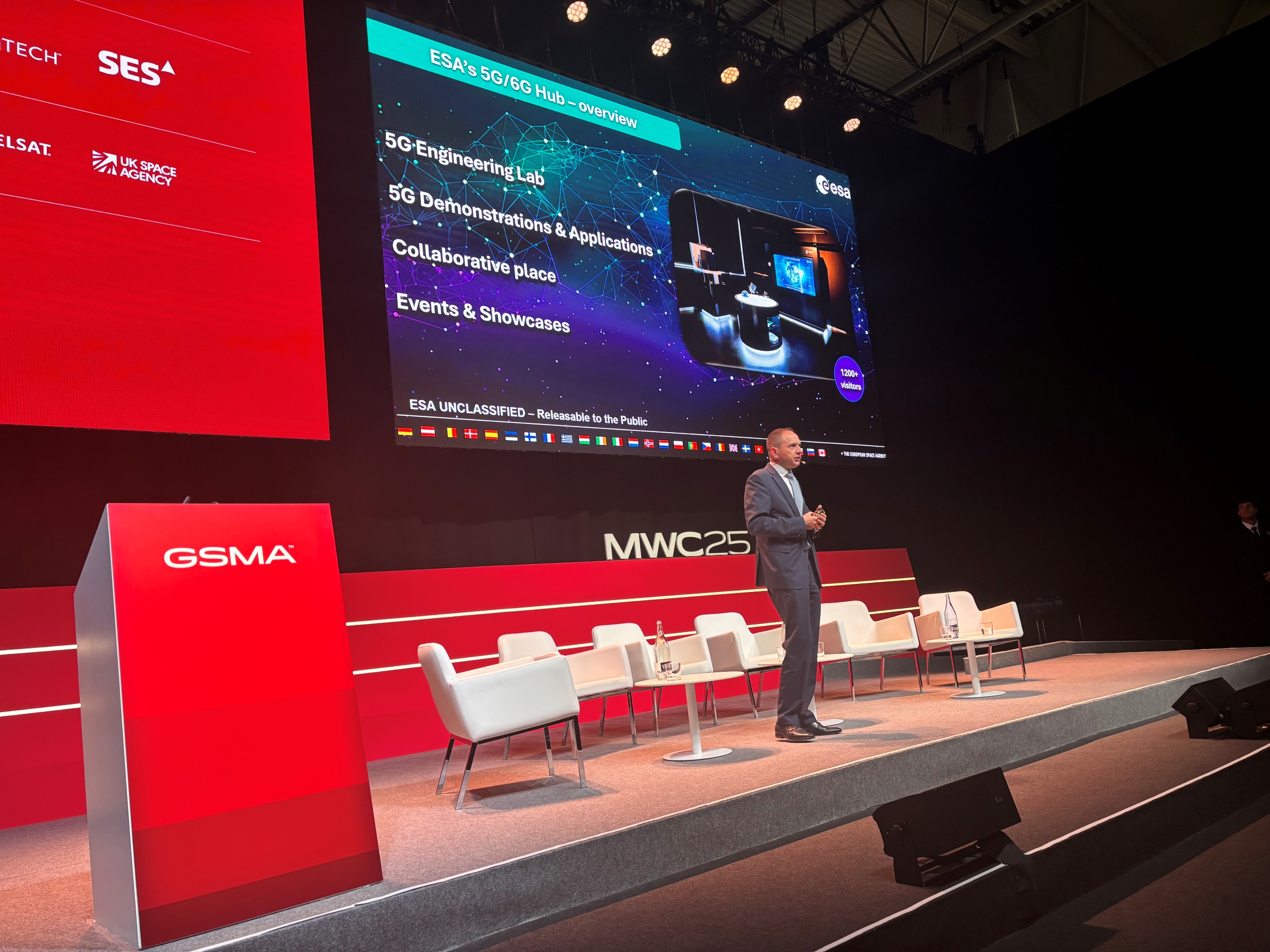
The European Space Agency (ESA) and Global System for Mobile Communications Association (GSMA) Foundry announced at MWC25 Barcelona, Spain, an ESA-funding round to support three innovation challenges.

Each innovation challenge targets critical aspects of future connectivity. The first centres on direct-to-device communications, aiming to revolutionise how mobile devices interact with satellites. This breakthrough technology promises to extend connectivity to the world’s most remote regions, supporting emergency services and bridging the digital divide for underserved communities.

The second challenge ventures into 6G innovation, where satellite-terrestrial convergence will play a pivotal role. The challenge will use the standardisation recommendations from the 3rd Generation Partnership Project (3GPP), with the aim to maximise benefits across industrial partners and users and focus on ultra-low latency applications, advanced IoT, and edge intelligence.

The third challenge focuses on creating pioneering 5G/6G hubs, following the successful model established at ESA’s European Centre for Space Applications and Telecommunications (ECSAT), located at Harwell Science and Innovation Campus in the UK. These hubs, integrating satellite technology into 5G/6G networks, enable testing of use cases ranging from autonomous vehicles to next-generation logistics, smart cities, and public safety networks.

Interested companies and organisations are invited to submit their proposals until 30 June 2025. Successful applicants will receive funding as well as opportunities to collaborate with leading organisations in the telecommunications and space sectors. Selected innovators will also have the opportunity to showcase their achievements at MWC26 and other GSMA Foundry events.

Antonio Franchi, ESA’s Head of the 5G/6G NTN Programme Office, said: “We are proud to partner with GSMA Foundry on these new industry challenges and we are pleased to expand our investment in the industry. Our goal is to support the satellite and mobile industries to connect everyone, everywhere, and at any time, and this collaboration is a major step towards achieving that vision.”

“By working together, we can unlock the full potential of satellite and terrestrial telecommunications networks, paving the way for groundbreaking solutions that deliver significant benefits to both society and industry,” said Richard Cockle, Head of GSMA Foundry.

Visit here to apply: ESA and GSMA Foundry Challenges 2025

ESA and the Mobile Satellite Services Association forge partnership to drive space-based 5G/6G networks

Publication date

05 Mar 2025

The European Space Agency (ESA) has signed a Memorandum of Intent (MoI) with the Mobile Satellite Services Association (MSSA), taking a further step towards transforming the future of global connectivity. The MoI will see ESA and MSSA spearhead efforts to create seamless mobile connectivity that extends from the busiest urban centres to the most remote rural areas.

Under ESA’s Advanced Research in Telecommunications Systems (ARTES ) strategic programme line – Space for 5G/6G and Sustainable Connectivity – the partnership will build a strong cooperation in innovative areas of 5G/6G networks, with an emphasis on the integration of satellite (non-terrestrial networks, or NTN) and terrestrial networks and continuing momentum for an open-architecture standards-based approach. This also includes accompanying and emerging technologies such as Direct-to-Device (D2D). The collaboration also looks to address crucial policy and standardisation considerations. By aligning with 3rd Generation Partnership Project (3GPP) standards, terrestrial mobile coverage for telecommunications operators and over-the-top (OTT) firms will be extended, reaching and connecting businesses and communities.

The collaboration leverages ESA’s extensive expertise in space technology and MSSA’s comprehensive understanding of mobile satellite services. A global non-profit industry group that represents leaders across the D2D ecosystem (satellite operators, Mobile Network Operators, phone manufacturers, chip venders, Original Equipment Manufacturers, etc), the MSSA brings specialist knowledge on how to optimise the use of L- and S-Band Mobile Satellite Spectrum.

The MoI showcases ESA’s commitment to bringing space to Earth, providing tangible benefits for businesses and impacting the day-to-day lives of citizens. With D2D technologies growing in importance within the connectivity ecosystem, collaboration with international and industry partners ensures that ESA Member States remain competitive in an increasingly competitive sector.

“This partnership reflects our commitment to ensuring that space technology serves society’s connectivity needs,” said Antonio Franchi, Head of ESA’s 5G/6G NTN Programme Office. “By working together with MSSA’s leading satellite operators, we can accelerate the development of space-based 5G/6G and ensure everyone, everywhere has access to reliable connectivity.”

“MSSA and ESA are joining forces to safely and securely integrate satellite and terrestrial communication networks for the benefit of consumers,” said Mark Dankberg, Chairman of MSSA and Chief Executive Officer of Viasat. “Our combined efforts will further benefit the development and deployment of standards-based D2D services to support Europe. Furthermore, ESA’s participation underscores the significant momentum for supporting business models leveraging licensed MSS satellite spectrum and open interoperable architectures based on 3GPP standards.”

ESA white paper to optimise performance and operations for 6G Non-Terrestrial Networks

Publication date

28 Feb 2025

The European Space Agency (ESA), together with a consortium of European satellite industry, terrestrial technology providers and terrestrial mobile network operators, have released a study to investigate and optimise routing protocols enabling efficient operation of 6G Multi-orbit Non-Terrestrial Networks (NTN).

The project is led and funded by ESA’s Connectivity and Secure Communications’ Space for 5G/6G and Sustainable Connectivity programme line. The study was primed by Eurescom, in collaboration with Fraunhofer FOKUSAirbus Defence and Space and D-Telekom.

Developed through ESA’s 6G SmartSat project, the study proposes novel routing solutions to seamlessly integrate space-based networks with terrestrial communication systems in the most efficient and adaptable manner. It aims to contribute to the goal of offering advanced connectivity for citizens and industries across ESA Member States and the globe, wherever the location.

With the widespread adoption of 5G as a communications standard, satellite constellations have emerged as viable alternatives and complement terrestrial networks. They offer extensive and reliable communications across a broad spectrum of users and applications, providing commercial, business and government connectivity services, as outlined in ESA’s 5G-IS white paper.

These constellations are already equipped with inter-satellite links and smart payloads capable of supporting Radio Access Network (RAN), core network functionalities and edge computing to form complex space-based networks. The satellite networks are characterised by overlapping layers of multi-orbit, grid-like topologies (how nodes in a network are connected) that undergo frequent, yet predictable, changes. It is viewed that challenges that come with these technologies will be addressed by 3GPP 5G Release 20/6G Release 21 standards.

The NTN networks are further impaired by weather effects that impact service and/or feeder links. These characteristics cause such networks to significantly differ from Terrestrial Networks, requiring new routing strategies.

To cope with these challenges, the study introduces a novel topology semantic routing protocol for multi-orbit NTN networks. The proposed architecture adheres to the principles of 3GPP services requirements, while accommodating the unique topological infrastructure constrains of multi-orbit NTN. It mitigates the continuous changes impacting the links quality or the neighbour satellite nodes status. To further increase the efficiency, the proposed solution can be used in combination with existing low-footprint routing solutions, such as pre-defined centralised routing for regular topologies, segment or geographical routing protocols.

“ESA is proud to be working with our industry partners to evolve and develop key 6G NTN technologies, which have the potential to enhance lives and businesses across our Member States,” said Antonio Franchi, Head of ESA’s Space for 5G/6G and Sustainable Connectivity programme. “This study showcases the real impact that we can have, with evolving business cases to be made across the various sectors, we look forward to realising the potential of 6G NTNs and their complementing role with existing TNs.”

“6G SmartSat activity holistically addresses the design of 6G multi-orbit NTN networking architectures. The study follows a co-design approach involving representatives of satellite and terrestrial sectors to identify, categorise, and prioritise the use cases better served by satellite constellations under technical and market fit criteria. The activity provides a first-in-kind contribution to the NTN sector detailing technology roadmap and tools necessary for validation of future 6G multi-orbit NTN networks,” said ESA’s Maria Guta, Senior 5G/6G Satellite Solutions Architect.

Read the white paper in full.