MFS

Multifunctional Structure Elements

STATUS | Completed
STATUS DATE | 14/05/2021
ACTIVITY CODE | 4A.061

Objectives

There is a push for smaller and cheaper satellites, especially with the commercialisation (r)evolution currently going on within the space industry. Cheaper and smaller means a higher level of integration, i.e. increase the efficiency of each component by combining functions.
One such an example is storing propellants inside the satellite structure rather than in a separate propellant tank.
The current project aims at identifying and demonstrating technologies for storing propellants in the (primary) structure of the satellite. This includes propellants for chemical as well as electric propulsion systems in the liquid as well as the gaseous state.
The project on one hand investigates which combination of propellant, propellant carrier and structure benefit most from integration. On the other hand, the influence on the mechanical behaviour, primarily the response of the structure to vibrations, is assessed. This is done experimentally as well as numerically.

Challenges

The main challenge is to combine the, often contradictory, requirements for propellant storage, expulsion and load carrying elements in a complete and sufficient set of requirements for one (sub-)structure/component fulfilling multiple functions. At the same time, provided solutions should be such that industry may adopt the technology. This requires the solutions to be adaptations of existing designs, rather than revolutionary new approaches to satellite layout and manufacturing.

System Architecture

Propellant is stored in the side panels of a satellite. To this end the side panel forms a gas-tight storage container with specially manufactured inner structure to withstand the pressure inside the panel. These inner structures can be best thought of as struts that resemble a three-legged tree on both sides. They are designed in such a way that the maximum load can be transferred with the minimum amount of mass. Hollow glass microspheres (HGMs) are used to limit the pressure the panel is experiencing, while still providing sufficient pressure for the propulsion system. HGMs are tiny spheres (mean diameter of 16 µm) that can be pressurised well over 900 bar. For effective use, pressurisation of up to about 750 bar is sufficient, leaving enough margin. Pressure release is controlled by adjusting the temperature.

Plan

The project consists of two phases. In the first phase a detailed analysis is made of possible combinations of propellant, propellant carrier and structure. The approach will be to start from an existing design and investigate possible changes.

A trade-off will be made and the most promising combination will be experimentally investigated in the second phase of the project. Two types of experiments will be conducted: immersion and expulsion tests will verify the principles of the proposed technology. Vibration testing will shed light on the influence on the satellite structure.

Current Status

Phase 1 of the project is completed. An analysis of potential mission scenarios, suited propellants and structures as well as the structural design was completed. Preliminary charging and discharging tests with HGMs and different gases was performed.
It was concluded that the current state of the art technology is not developed far enough to enable the proposed technology with reasonable financial means. The resulting mass saving is 2% at most. Currently available HGMs do not satisfy degassing requirements that would suit the typical satellite lifetime. For this reason, the project was ended.

Demisable High Pressure Tanks for LEO Satcoms

Demisable High Pressure Tanks for LEO Satcoms

STATUS | Ongoing
STATUS DATE | 25/03/2024
ACTIVITY CODE | 4B.139
Demisable High Pressure Tanks for LEO Satcoms

Objectives

The primary objective of this project was to investigate options to improve the demise behaviour of a composite overwrapped pressure vessel (COPV). Those are ranging from basic material properties, material configurations, the influence of the aspect ratio, and shape options to possible add-ons or modifiers. The thermogravimetric characterization of typical COPV materials shall provide a solid ground for a baseline re-entry simulation which is also the benchmark for later improvements. Specific demise parameters for the most promising improvement solution shall be gathered in a plasma wind tunnel test campaign. The demise model of the simulation environment shall be extended to integrate these parameters and allow for a re-entry simulation of a demise-improved tank system. Furthermore, the influence of these improvements or modifications to the COPV shall be studied with regards to cost, complexity, performance, and safety implications.

options to improve the demise behaviour of a composite overwrapped pressure vessel (COPV)


Challenges

The consolidated project requirements dictate a metallic liner and an overwrap from high strength fibers to be able to meet the leakage and mass criteria. Since titanium as a liner material and aramidic/kevlar fibers for the overwrap would make matters even worse, the only option are an aluminium liner and carbon-fiber reinforcement. As a safety and fracture critical item, any modification to a COPV requires extensive investigation and testing to become validated.

Plan

The project spans over three project phases. The first phase includes a standard material characterization and the baseline re-entry simulation. In the second phase, demise improvement modifications shall be investigated and tested for their demise behaviour. In the third phase, the selected improvement modifications shall be evaluated for impact on product properties and compared to the baseline in an improved re-entry simulation.

Current Status

The development project has shown that unexpected setbacks can lead to a rethink of the plan and a return to the basic investigations. It also highlighted, that more investigations are necessary to bring the D4D strategy for COPVs to the next level. However, it is believed that with the gained knowhow in matrix systems in combination with the innovative strip tape concept, there is an optimistic way forward in developing a demisable tank in the near future

LoCo

- Low-cost GNSS Receiver for Geostationary Telecom Satellites

STATUS | Completed
STATUS DATE | 03/02/2021
ACTIVITY CODE | 4A.057
LoCo

Objectives

The availability of an autonomous mean of positioning in a geostationary platform is essential in reducing the dependence on the ground control, especially when low-thrust electrical propulsion is used to transfer the satellites to the GEO orbit, a manoeuvre that lasts several months. In this case, the on-board GNSS function can autonomously feed the avionic systems in charge of controlling the trajectory and the attitude, and schedule in this way the requested thrusters actuations and attitude variations.

Nowadays the use of GNSS Receivers in GEO satellites is a reality, although their cost is quite high. The first part of the project has been focused on the cost-wise analysis of the architecture of a GNSS receiver to identify the potential areas where a significant reduction of the recurring cost can be achieved.

In the second part, a novel architecture of the RF-IF section of the receiver has been designed and manufactured using a highly integrated solution based on a hybrid RF-digital MMIC developed for this purpose in the frame of the project.

Finally an elegant breadboard incorporating both the RF-IF section and an AGGA-4-based digital board has been assembled and tested to verify the overall performance of the GNSS receiver.

Challenges

  • Revisit current navigation receiver implementations for GEO satellites to define an architecture and physical implementation compatible with the target cost of 200 k€ for the final space qualified flight model.
  • Develop an elegant breadboard implementing an innovative, highly integrated RF-IF section using a new hybrid RF-digital MMIC design.

System Architecture

The Elegant Breadboard designed and developed in the frame of the project consist of a RF-IF section, based on a highly integrated MMIC designed and manufactured ad hoc, and of a digital section based on AGGA-4 processor. These two sections represent the core elements of a GNSS receiver and allow to verify the overall performance.

Plan

The project started in May 2017 and is split into three phases.

Phase 1: architectural trade-off, receiver specifications and preliminary design. Phase 1 ended with Preliminary Design Review, held in November 2017

Phase 2: EBB detailed design (RF-IF board and digital board) and  MMIC manufacturing. Phase 2 ended with Detailed Design Review, concluded in July 2018.

Phase 3: RF-IF Board manufacturing and test and EBB integration and performance test. Test Review Board held on June 2020.

The duration of phase 3 has been affected by the COVID-19 pandemic.

Current Status

The project has been completed.

ESPO

- Energy Storage Package Optimisation

STATUS | Completed
STATUS DATE | 08/01/2021
ACTIVITY CODE | 4A.055
ESPO

Objectives

The aim of this project was mainly to reduce the mass of the packaging of an already existing typology of battery while implementing an individual cell replacement feature. The mass improvement will  increase as well specific energy of the battery making it also interesting for GEO missions. The individual cell replacement feature will be mainly useful if an issue occurs on the battery during spacecraft MAIV/T activities. This allow to just replace one or multiple cells affected by the issue instead to the whole battery.

Challenges

Main challenges of this project were to reduce the structural mass of the battery packaging by more than 50% while introducing a new feature of individual cell replacement.

System Architecture

System architecture is to replace actual battery packaging made of aluminium by a CFRP structure which have a dedicated thermal heatsink for cell thermal dissipation. The cell clamping system developed allows as well individual cell replacement

Plan

The project started with a state of the art and a material & process trade-off. The packaging factor and mass breakdown of several batteries was analysed. After choosing the materials and processes, the optimisation and sizing of the packaging was performed wrt thermal and mechanical loads. An EM was then manufactured and tested and compared to the prediction (correlation) and to the existing packaging.

Current Status

Project has been completed.

The resulting manufactured Engineering Model (EM) battery showed a mass recovery of almost 2kg with respect to the corresponding battery. The target of 1.3 for the packaging factor was almost achieved with a value of 1.327.

Battery test results showed good thermal and electrical performance as expected in the simulation and similar to those of the comparative battery. Mechanical tests were unsuccessful and stopped after Random Z load because of glue detachment between the CFRP core and the thermal middle plate. This non-conformance occurred during thermal cycling but it is more linked to the gluing process and surface preparation than the thermo-elastic loads.

Almatech is nevertheless confident that both mechanical performance and packaging factor target can be achieved in further project steps by especially mastering the bonding process between interfaces and by modifying slightly the thermo-mechanical design.

MODPS

- Modular power supplies in Electrical Propulsion (EP)

STATUS | Completed
STATUS DATE | 17/12/2020
ACTIVITY CODE | 4B.087
MODPS

Objectives

The intention of this study is based on the fact that for modern Electric propulsion systems the PPU is representing one of the most complex but also one of the most expensive items. This is driven by very specific requirements for the different thruster technologies which require a very strongly customized design and complexity. Beside the different ranges of the output parameters for the needed voltage- and current supplies there are other driving requirements like robustness to high noise during ignition of the thruster, accepting of alternating ground shifts during operation or to cope with shorts at the output caused by beam events.

The intention of this study was to start at exactly that point where technical solutions are available but always tailored for only one dedicated thruster technology and always customized for a specific mission.

The activity comprises the evaluation of the different requirements, finding the best intersection of them, defining a suitable PPU architecture and finally performing the detailed design activities, build and test the modular PPU breadboard. Accompanying to these activities several trade-offs and analysis have been performed to determine the most suitable technologies and topologies.


Challenges

The main challenge of this study was to develop a PPU which provides a high grade of flexibility and modularity to serve a wide spectrum of thruster assemblies. This approach combined with the approach that the developed PPU shall also be competitive in terms of recurring costs, manufacturing and testing effort but also provide a small mass and acceptable envelope have been the demanding challenges of this study.

System Architecture

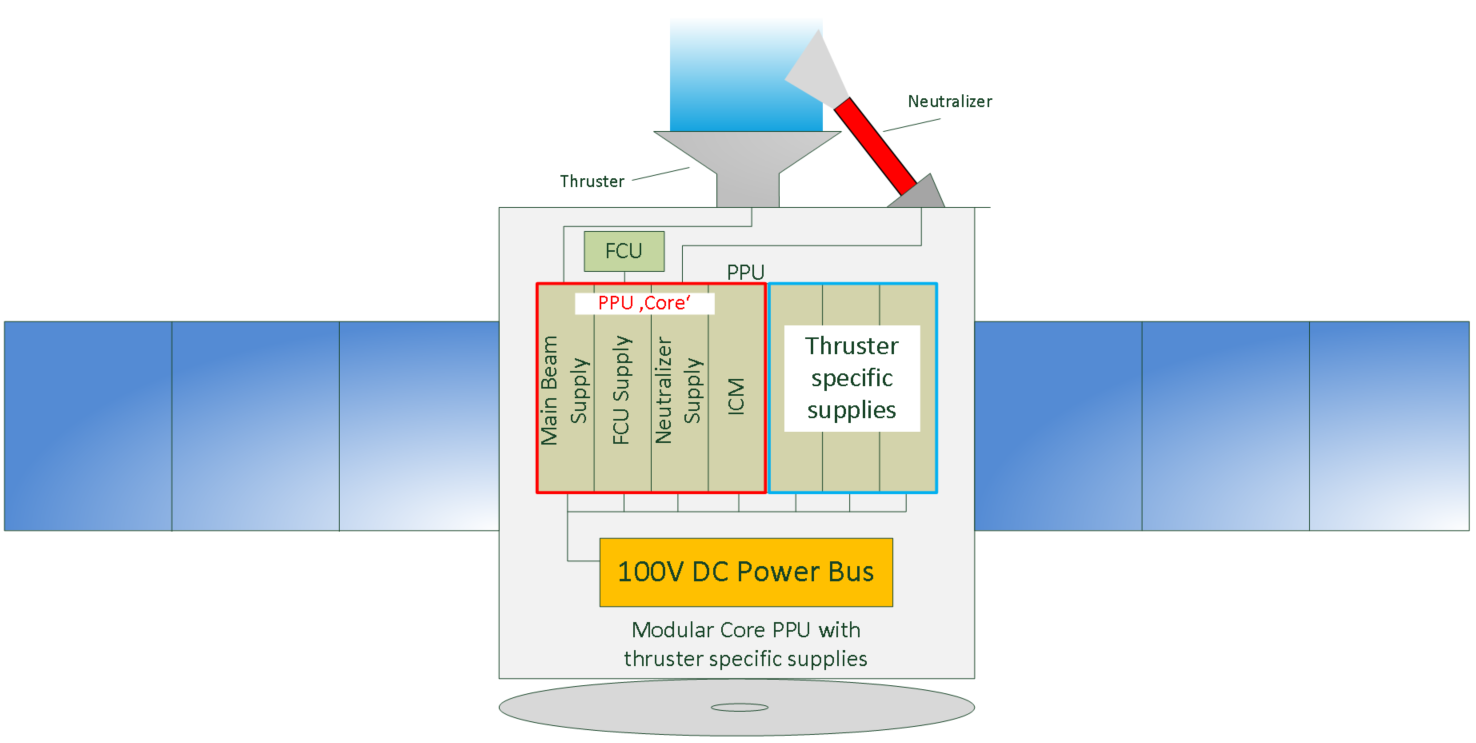
After detailed trade-off, the most suitable PPU architecture — following the modular approach of this study —  a standard core design was determined which is representing a kind of platform that can be customized individually. The idea behind the modular standard core approach is to define a standard core which contains all non-thruster specific power supplies. However, all thruster specific supplies like the RFG supply for the RIT are also added into the same box. The main logic of this concept is to provide a full developed core periphery with the flexibility to customize for the different thrusters and missions. Beside the possibility to add the thruster specific supplies to the box, for the core harmonised electrical and mechanical I/Fs have been defined to allow the easy exchange of the modules if this is required for a dedicated application.

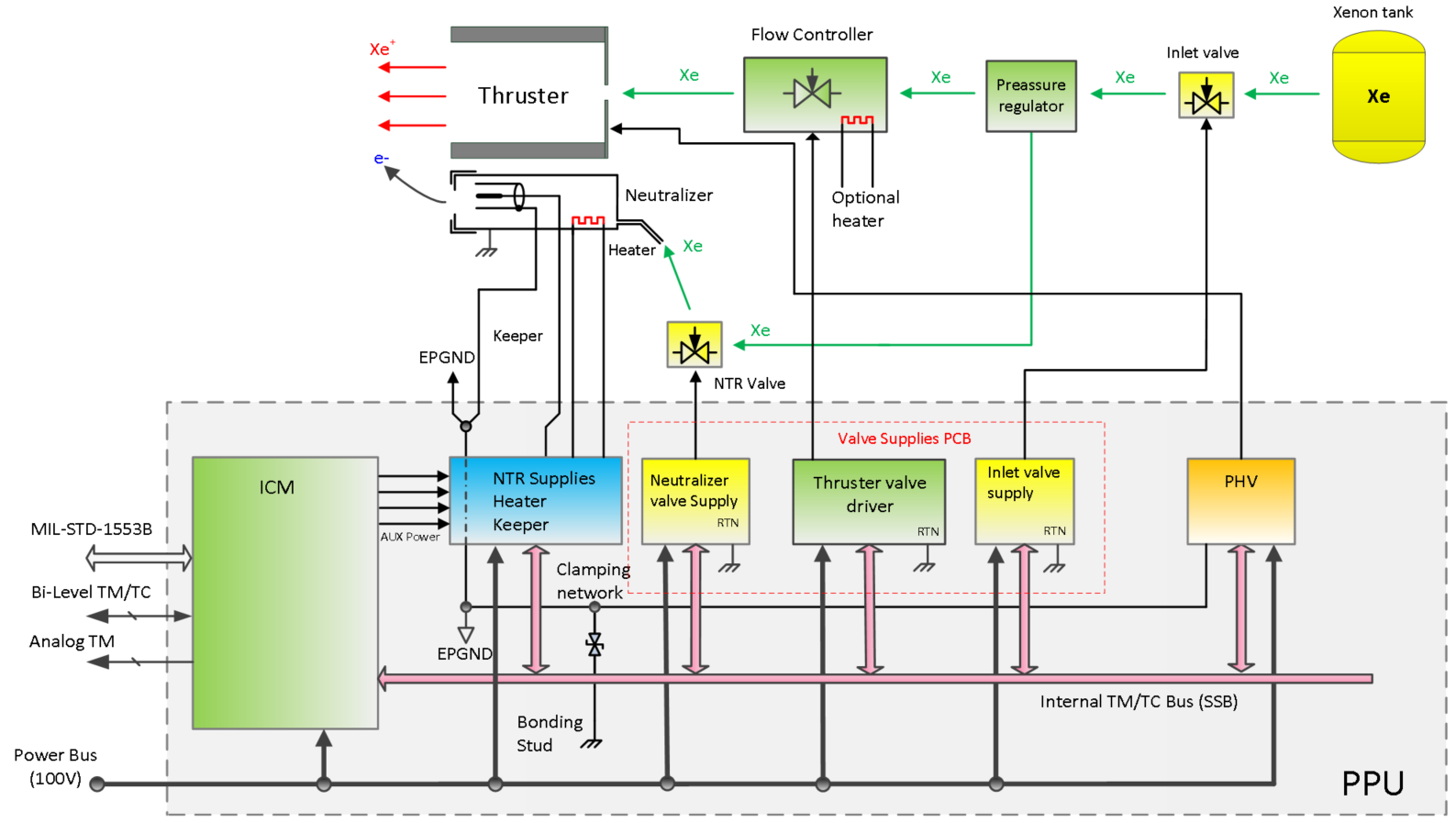
The block diagram of this PPU concepts and the thruster periphery is shown below. 

The PPU follows a modular design concept, which allows an easy tailoring of the unit for different satellite platforms and operation concepts of the propulsion system. Beside the measures to prevent single point failures or failure propagation, no additional redundancy within the PPU is established in alignment with the trade-off results. 

Plan

Baseline Requirements Review (BRR), Architecture Review (AR), Design Review (DR), Test Readiness Review (TRR) and Final Review (FR)

Current Status

Completed 

IFM 350 Nano Thruster – IOD

STATUS | Completed
STATUS DATE | 09/11/2020
ACTIVITY CODE | 4B.132
IFM 350 Nano Thruster – IOD

Objectives


There are two primary objectives for project ICEYE:

  • The use of the FEEP (field emission electric propulsion) ion thruster technology for propulsion. This allows high efficiency in terms of propellant use and superior controllability from the sub-µN range up to the mN range.
  • The PPU for operating the thruster is based on COTS components and was specifically tailored to the needs of a FEEP propulsion system. The in-orbit test is used to verify its functionality.

The following secondary objective for project ICEYE is:

  • The housing for the seven IFM nano modules is made of aluminum with the additive layer manufacturing process combined with CNC machining and surface treatments. This mission will also prove the usability of ALM manufactures for space applications.

Challenges

Apart from the ion emitter itself, the module including housing, reservoir, heater and electrodes needs to be miniaturised. This is particularly challenging since a high voltage of up to -10 kV / +10 kV is being used.

The PPU being able to generate high voltage for emitter and extractor, drive the heater and neutralisers, and measuring the reservoir contactless, has been developed from scratch with COTS components only.

Compared to existing ion sources, the large amount of propellant (up to 250g) presents a challenge in terms of heating, surface tension and spilling.

System Architecture

The cluster for project ICEYE consists of seven individual and individually controllable IFM nano thruster modules embedded into a common housing.

A common power bus is shared between the seven individual modules but mechanical relays can selectively remove modules therefrom. Two RS-485 communication busses are implemented (one branch with three, another with four modules attached to) which allow communication with the OBC.

The RS-485 transceivers are rad-hard and guarantee unblocking the bus once the supply voltage is removed. This allows the OBC to decide which IFM nano thrusters shall be active.

Plan

The project started after the PDR. Before that, prior work was performed to estimate the major risks of the project. All work before kick-off has been reviewed in a PWR. After the design of the housing and the mechanical and thermal simulation, a CDR was successfully completed. Then the thrusters and the housing were manufactured. The performance of the IFM nano thruster modules were determined individually. After integration into the common housing and a successful operation of the entire cluster, the Flight-Readiness Review was completed.  In-orbit commissioning of the thrusters was successful and the thrusters are now operating as intended.

Current Status

The project is now complete and the in-orbit experience has helped to substantially boost further sales of the IFM nano thrusters. This project was supported under an ARTES Competitiveness & Growth – Demonstration Phase – Atlas project.

Electronic Pressure Regulator

- Electronic Pressure Regulator (EPR) for Electrical and Chemical Propulsion

STATUS | Completed
STATUS DATE | 09/10/2020
ACTIVITY CODE | 4B.088
Electronic Pressure Regulator

Objectives

The project aim was to take the previous ‘breadboard’ development of a High Pressure Proportional Valve that started in 2008, further develop all aspects of this design and then build an Electronic Pressure Regulation sub-system and take it through extensive development and Engineering Model testing with a range of commonly used spacecraft propellants.

System Schematic  (shown with redundant branch)


The valves feature Nammo’s heritage hard sealing technology, making the whole system compatible with Xenon, Helium, Nitrogen, Hydrazine, and MON. Note the use of a specifically designed Heater unit in the above schematic to eliminate Joule Thompson issues regarding Xenon phase change through orifices at higher flow rates such as those required for Cold Gas Thrusters. The heater is not required for the other gases and propellants.


Challenges

The key challenges associated with meeting the demanding project objectives were:

  • Coping with a pressure range from 0 to 310bara, a flow range of <3 to 600mg/s Xenon & Helium and accommodating 3 different propellants (Xenon, Nitrogen and Helium) with a single proportionally regulating valve design.
  • Overcoming Xenon Joule Thompson issues
  • Developing hard material sealing technology
  • Thermally compensating design

System Architecture

The Engineering Model EPR can be seen above in ‘as tested’ configuration. The gold plated Xenon heater can be seen on the left. This flows pre-conditioned Xenon into the High Pressure Proportional Valve (HPPV) immediately to its right and thence to the thruster interface at the bottom of the picture.

The HPPV seen at the top is functioning as a high pressure isolation valve as this has been proven at 310bara to perform to requirements. The valve is low mass and compact when compared with mechanical isolation valves, therefore an ideal choice for our system.

Plan

The ARTES project took the Nammo Electronic Pressure Regulator system through from design concept to an all-welded, flight representative, extensively tested Engineering Model. The testing was equivalent to the perceived flight Qualification Testing that represents the next stage of the EPR readiness for flight.

Current Status

As stated above, the EPR is at a development stage where it is ready to undergo a Critical Design Review (CDR). Upon successful completion of the CDR the Electronic Pressure Regulator is ready to undergo full qualification. Full qualification would involve qualification level environmental testing (vibration, shock, thermal cycling, etc.) and qualification level testing including on/off cycles and Tvac testing.

The Nammo thermal vacuum facility used for EM testing is shown below.

HighPEEK

- Conductive Plastics for Satellite Parts

STATUS | Completed
STATUS DATE | 23/01/2023
ACTIVITY CODE | 4A.078
HighPEEK

Objectives

The project objectives are to replace metallic telecom satellite secondary structure parts with conductive thermoplastic ones. Mass saving of at least 50% and lead time reductions are aimed for. The parts need to withstand the GEO space environment, with launch loads and vibrations, outgassing and UV resilience being important requirements.

Two part families are considered in detail: 1. enclosures and 2. support structure and brackets. Real metallic parts used in spacecraft were selected as baselines which to replicate into a thermoplastic versions.

The parts should also have conductive properties. Two approaches are used: material conductance and as well as atomic layer deposition (ALD). The first enables lower-level conductance through the material itself, enabling application such as electrostatic discharge. For this the consortium developed its own conductive PEEK material with optimal properties for the task at hand.

The latter is a method developed by the consortium, wherein nanoscale coatings are very conformally coated over a thermoplastic part. The coating can be very conductive, opening up low – resistance applications, and can be selectively coated with the selective use of thermoplastics.


 Example application 1: Microwave power metallic relay (left) and equivalent re-designed, significantly lighter thermoplastic version (right)


Example application 2: On-Board Computer metallic housing (left) and re-designed equivalent thermoplastic version (right)


Example application 3: conformally coated conductive 3D-printed part (left) and a 3D-printed UV-sensor cirtcuit next to its original (right)

Challenges

Main challenges include verifying that the part can withstand long time periods in a GEO space environment, particularly regarding UV. Additively manufactured parts need to also be checked regarding the isotropy of their mechanical properties.

System Architecture

N/A

Plan

The project has three main phases – secondary structure family review and part selection, first test part and conductive thermoplastic manufacture and test, and then based on the results, optimization and verification tests on the optimized parts.

Current Status

The project selected the part families and parts themselves (almost all are from existing space missions or other ARTES projects) and thermoplastic versions have been manufactured. Two iterations of the selected parts were printed and extensively tested.

The consortium produced its own conductive PEEK compound with improved thermal and outgassing properties.

Selective coating using ALD has been shown to work and selectively coated test pieces have been successfully produced. Two circuit demos were built, of which one operated a reprogrammable microcontroller and a LED while the second a UV-sensor.

100W DEPLOYABLE SOLAR PANELS FOR NANOSATELLITES (ARTES AT 4F.141) (FORMER ON DELEGATION REQUEST)

BATTERY PASSIVATION FOR SMALL TELECOMMUNICATIONS SATELLITES (ARTES AT 4F.137)