Connectivity and Secure Communications programmes receive €2.1 billion at CM25 to continue driving competitive satellite communications

Publication date

10 Dec 2025

ESA Director General, Joseph Aschbacher, and Member States delegates. Image credit: European Space Agency

The European Space Agency’s (ESA) Council meeting at Ministerial level 2025 (CM25) concluded in Bremen, Germany, with Member States placing their continued trust in the Agency to lead their activities in space. In the face of a challenging geopolitical landscape, Member States placed emphasis on strengthening European capabilities to ensure our autonomy and leadership.

Member States voted on a proposal submitted by ESA Director General, Josef Aschbacher, to improve European autonomy, resilience, industrial competitiveness as well as research and development through new and continuing programmes. The proposal presented at CM25 is the first stage of ESA’s Strategy 2040, which outlines five goals that space can deliver in every aspect of citizen’s daily lives.

Read more about Strategy 2040.

Member States at the helm

With CM25, subscriptions to programmes under ESA’s Connectivity and Secure Communications reached €2.1 billion. ESA Connectivity and Secure Communications is responsible for coordinating, shaping, and supporting innovation in satellite communications, working closely with industry to bring the benefits of space technology into daily lives. The directorate is comprised of three major programmes, focused on developing competitive satellite systems and services to ensure real-world impact by securely connecting everyone and everything: the Advanced Research in Telecommunications Systems (ARTES 4.0) programme, the Moonlight programme and the ESA Programme Related to EU Secure Connectivity IRIS2.

ARTES 4.0 programme

ARTES 4.0 is Europe’s largest telecommunications and satellite communications programme, enabling companies to turn ideas and concepts into competitive products, systems and services. As the satellite communications market experiences a profound and rapid transformation, ARTES boosts European competitiveness and innovation to help strengthen our technological and manufacturing readiness levels. This programme advances European leadership in strategic areas that deliver significant economic returns and ensure that the next generation of communications technologies serve and reflect European values.

The outcome of CM25 validated the continuation of ARTES’s three Strategic Programme Lines (Optical and Quantum – ScyLight, Space Systems for Safety and Security (4S), Space for 5G and 6G) and its two General Programme Lines (Future Preparation and Industrial Competitiveness), totalling to a combined €1.5 billion.

This subscription re-affirms ESA’s commitment to bolster European and Canadian leadership in multi-orbital satellite communications, across LEO and GEO markets. In the next three years, the ARTES 4.0 programme will evolve, simplifying its processes to reduce time-to-market and provide industrialisation support to help scale eligible production to capture that market. Furthermore, it will harmonise co-funding schemes across ESA’s research and development programmes, federating technology developments for system, space, ground and user segments. New key partnerships and project developments will also be folded into existing programme lines. This will include direct-to-device (D2D), and projects to advance and validate cutting-edge optical and quantum communication systems to enable high-capacity, secure data transmission and quantum key distribution (QKD).

Read more about ARTES 4.0.

Moonlight Programme

The Moonlight programme aims to give Europe a first-mover advantage in off-planet satellite telecommunications and navigation. By establishing common infrastructure and services, Moonlight will reduce the complexity and mass of future missions for the Moon, creating a cost-effective, sustainable model of space exploration. With hundreds of missions and payloads planned for the moon in the next decade, Europe is in a position to capture this promising new market and ensure strategic autonomy for independent exploration endeavours.

Subscriptions to the Moonlight programme reached €176 million at CM25. The programme will move forward with our endeavour to secure European leadership in the lunar economy.

Moonlight is central to ongoing international cooperation and the development of global standards. Our Member States will benefit from the programme’s economic and industrial impacts – such as an upskilled workforce and revenue generation.

Read more about Moonlight.

ESA Programme Related to EU Secure Connectivity – IRIS2

IRIS2 is the third ESA flagship programme implemented in partnership with the European Commission, designed to develop a multi-orbit secure telecommunications programme critical to sovereign government telecommunications. The current geopolitical context has highlighted the importance of resilient and independent connectivity supported by a competitive, flexible and innovative industrial base to safeguard Europe’s strategic autonomy.

The programme subscriptions for IRIS2 at CM25 amount to €383 million. The next steps for IRIS2 will reinforce secure connectivity, strengthen Europe’s technological supply chain, and enable rapid development of new services and systems. This vision for European resilience, will see IRIS2 evolve into a multi-domain system-of-systems and become the secure telecommunications backbone of ESA’s European Resilience from Space (ERS). It will build upon ESA, European and national satcom initiatives while serving Earth observation and navigation missions for rapid, real-time critical operations.

Read more about IRIS2.

ESA Directors at CM25. Image credit: European Space Agency
A renewed focus on competitivity, technological independence and leadership

“During CM25, key decisions were made that will shape ESA’s activities in response to Europe’s ever-growing need for reliable, resilient, and secure connectivity,” said Laurent Jaffart, Director of Connectivity and Secure Communications. “Our vision is to connect everyone, everything, everywhere and at all times. With a subscription of over €2 billion, I look forward to continuing to work with our Member States, European Commission and partners – as together – we realise our leadership in the satellite communications domain.”

The Council 2025 at Ministerial level validated Connectivity and Secure Communications’ mandate to develop advanced communications technologies and systems, hand-in-hand with industry. The standout success of ARTES 4.0, together with Moonlight and IRIS2, will continue to foster a European industrial ecosystem capable of sustaining flexible manufacturing and innovative technologies responding to pivotal defence, governmental and commercial needs.

ESA-supported Hellenic Assembly, Integration & Testing Facility Clean Room and Infrastructure Implementation Phase begins

Publication date

27 Jun 2025

Visuals representing each project under the Greek National Satellite Space Project (GNTS), funded by the European Commission Recovery and Resilience Facility. The visual for the Hellenic Assembly, Integration & Testing Facility (HAITF) is showcased in the centre. Image credit: ESA

The European Space Agency (ESA), in collaboration with Hellenic Aerospace Industry S.A. (HAI) as prime contractor and BCT Group as main subcontractor, has officially kicked off the contract for the implementation of a cleanroom and supporting infrastructure at the Hellenic Assembly, Integration & Testing Facility (HAITF). The signature to begin the activity commenced on 20 May 2025 with a dedicated meeting held in Athens, Greece. The signatories were Alexandros Diakopoulos, CEO of the Hellenic Aerospace Industry S.A, and Stephane Lascar, former Head of Telecommunications Satellite Programmes Department within ESA’s Connectivity and Secure Communications.

This major milestone follows the successful completion of the design phase and marks the onset of the full construction and implementation phase of the HAITF project. The beginning of the contract represents a decisive step forward for the Greek National Satellite Programme and further strengthen HAI’s position within the European space ecosystem. The project is funded by the European Union through the Recovery and Resilience Facility (RRF), under the National Recovery and Resilience Plan “Greece 2.0, and is implemented by ESA on behalf of the Greek Ministry of Digital Governance.

The HAITF project was launched in November 2023 with the objective to design, build, and operate a fully functional Assembly, Integration and Testing (AIT) infrastructure at HAI’s site in Schimatari. The facility will support the end-to-end process of satellite manufacturing, from subsystem integration to environmental qualification, with capabilities including cleanroom operations, vibration testing, and thermal vacuum testing.

This contract encompasses the execution of the facility’s critical infrastructure, including civil, architectural, mechanical, and electrical elements. A major focus of this phase is the construction and formal acceptance of a state-of-the-art cleanroom environment, essential for conducting high-precision satellite assembly, integration, and testing operations. The final phase of this activity will target the commissioning of all the test equipment within the cleanroom and related infrastructure.

“The HAIT Facility, which will serve as a cornerstone of Greece’s growing space sector,” said Frédéric Rouesnel, Greek Connectivity RRF Project Manager at ESA’s Connectivity and Secure Communications. “Once operational, it will provide the national capacity to assemble, integrate, and qualify small satellites and space systems to foster technological innovation, job creation, and long-term strategic capability in space systems manufacturing and testing.”

“This facility represents a transformative investment for the entire Greek space ecosystem and an important infrastructure for the National Space Strategy,” said Prof. Konstantinos Karantzalos, General Secretary of Telecom and Post and on behalf of the Hellenic Ministry of Digital Governance. “Our expectation is that by enabling the construction, integration, and qualification of satellites and cutting-edge space systems for dual-use applications, the facility will pave the way for new technological capabilities and international collaboration and act as an accelerator for economic growth for the dynamic Greek space sector.”

First ESA-supported Greek In-Orbit Demonstration (IOD) CubeSat ready for launch

Publication date

17 Jun 2025

DUTHSat-2 Flight Model during preparations for the Thermal Vacuum testing campaign. Image credit: ESA

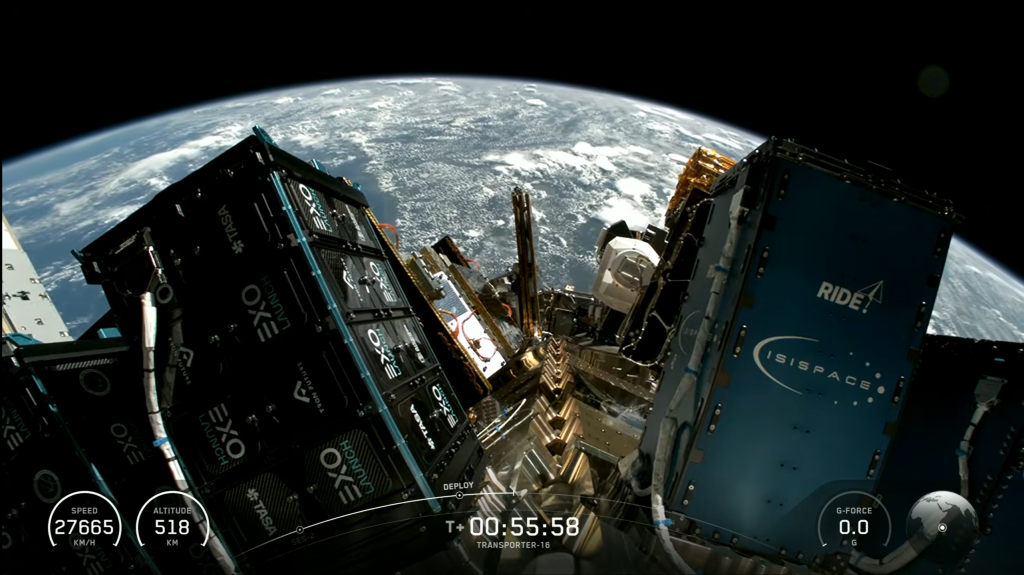
The first of the Greek In-Orbit Demonstration (IOD) CubeSat missions, DUTHSat-2, which is led by the Democritus University of Thrace, has been delivered to the launch provider ExoLaunch, and is ready for launch on the SpaceX Transporter-14 rideshare mission, scheduled for June 2025. Having successfully completed functional and environmental testing in February 2025, the 6U CubeSat mission will capture images in the visible and near infrared spectrum, over both sea and land.

DUTHSat-2 is part of the Greek National Small Satellite Programme (Measure ID 16855), and more specifically under the Greek Cubesats in-orbit Validation Projects that include a total of seven IOV CubeSat missions, managed by the European Space Agency’s (ESA) Greek Connectivity Recovery and Resilience (RRF) Project Team, as part of ESA’s Connectivity and Secure Communications directorate. The programme is executed under  the auspices of the Hellenic Ministry of Digital Governance with the support of the General Secretariat of Telecommunications and Posts and is closely supervised by the Hellenic Space Center. The programme is part of the National Recovery and Resilience Plan ‘Greece 2.0’, which is funded by the Recovery and Resilience Facility (RRF), core programme of the European Union’s NextGenerationEU.

The imagery and measurements will be used to provide yield information on soil moisture, as well as marine contamination. Additionally, the imagery frequency bands and the imager resolution have been selected to be able to detect both oil spills and ship bilge water pollution.

DUTHSat-2 will also perform in-orbit demonstration of an essential telemetry and housekeeping unit. The Essential TeleMetry and housekeeping (ETM) is the spacecraft version of a “black box”, allowing operators to have visibility over the spacecraft’s health in case of failures of the main subsystems. 

DUTHSat-2 rendered in the flight configuration. Image credit: Democritus University of Thrace

The DUTHSat-2 mission brings together Greek academia and industry, being led by the Democritus University of Thrace, and supported by the Athena Research Center and Greek companies Space Asics and Prisma Electronics SA. The spacecraft was assembled on site at the Democritus University of Thrace, with the design, assembly and test process guided and monitored by ESA’s Connectivity and Secure Communications.

“We are proud of this achievement, which was possible by working as one team and by sharing the same motto: Let us make this happen! We are now looking forward to the launch followed by the start of the operations,” said Frédéric Rouesnel, ESA’s Greek Connectivity RRF Project Manager.

“DUTHSat-2 is now at Vandenberg Space Launch Complex 4 with an expected launch date in a couple of weeks onboard a Falcon 9 rocket. We are excited to witness the first satellite of the Greek National Small Satellite programme delivered to the launch provider. Congratulations to both ESA and the Democritus University of Thrace and the respective teams, for managing a technicaly complex project with programmatic challenges. Greece is climbing the steep learning curve of accessing space in order to glean the benefits of the new space economy. We are all proud to be part of the endeavour and wish the best for this as well all upcoming missions,” said Prof. Konstantinos Karatzalos, Secretary General of Telecommunications and Posts.

ESA, Telesat and RAL Space successfully demonstrate Q-Band satellite link over low Earth orbit

Publication date

03 Jun 2025

A group of people posing for a photograph
The Telesat and RAL Space team, with Technical Contributor for ESA Antonio Martellucci (right). Image credit: ESA

ESA, Telesat and the Science and Technology Facilities Council’s (STFC) RAL Space have reported a groundbreaking milestone in telecommunications technology, successfully establishing a Q-Band (38-39 GHz) link over LEO, between the RAL Space Chilbolton Observatory and the Telesat LEO 3 demonstration satellite.

The achievement was performed under a Memorandum of Understanding signed in early 2024 between Telesat and ESA, and showcases the newest milestone in the partnership, building on the world-first 5G NTN demonstration in December 2024.  

This project was funded as an ARTES Advanced Technology activity under the Space for 5G/6G and Sustainable Connectivity programme line, supported by the UK Space Agency. The resulting achievement represents a significant leap forward in satellite communication technologies, validating the performance of millimetre-wave Q-Band communications in LEO. 

The team, brought together experts from the ESA Connectivity and Secure Communications, and Technology, Engineering and Quality directorates, and also marked the first mission for ESA Technology’s mobile laboratory van which will support future campaigns, and leveraged expertise from the Technology directorate’s Wave Interaction and Propagation section. 

A Q-Band receiver developed by RAL Space was mounted on Chilbolton Observatory’s large 25m dish, which is normally used as a LEO satellite tracking radar. The team at the observatory used this radar tracking capability to monitor the state of the satellite and its orbit effectively during each pass. The team established a stable link with a collocated Ka-Band uplink antenna to the Telesat LEO 3 satellite, and maintained connectivity from approximately 15° elevation to a maximum of 80°.  The Telesat LEO 3 satellite also provided frequency up-conversion to Q-Band, amplification and retransmission to ground. The Telesat satellite station transmitted a DVBs signal with fixed QPSK ¼ modulation and fixed power, with the ESA modem locked with a margin of up to 13 dB and Es/N0 of up to 10.66 dB. 

In addition, thanks to a Software Defined Radio (SDR) available at the receiver, the RAL scientists and engineers collected critical wave propagation data for the entire satellite visibility periods. This allows us to evaluate the characteristics of atmospheric Q-Band propagation channel,. including in-excess attenuation, total attenuation and its components, scintillation and Doppler effect. Such propagation experiments are carried out in collaboration with Joanneum Research, Austria, for their experience with LEO measurements gained in the ESA ARTES W-Cube project. 

By studying Q-band and higher frequency communications, ESA is driving a fundamental shift in how satellite communication systems are conceived. This follows on from the legacy of Alphasat TDP5 and the Aldo Paraboni experiment, where ESA and a Thales Alenia Space-led Italian consortium, conducted a similar technological demonstration in geostationary (GEO) orbit. As the satellite communications market moves further into leveraging LEO capabilities, this latest demonstration showcases ESA’s commitment to driving European industry capabilities in an increasingly competitive global market. 

Demonstrations like this support a potential, more intensive use of Q-Band by LEO constellations, which, in turn, brings several critical advantages such as considerably smaller antennas, making it particularly attractive for aerial and land-mobile satellite communications. The Q-Band over LEO is also attractive for aerial (drone/HAPS) relay backhaul using the 5G New Radio (NR) standard, which is a novel approach for 5G networks. Additionally, Q-Band may be an attractive option for downlinking LEO traffic to gateways, freeing up Ku- and Ka-Band spectrum for additional user traffic. 

The most significant implication is the potential for consumers and business to access a much wider frequency spectrum. Satellite and terrestrial networks convergence is unlocking new innovations which will help connect communities, support emergency response systems, and enabling new possibilities for 5G and future 6G communications across the economy and society. 

Fabrizio De Paolis, ESA’s 5G/6G Implementation Manager, said: “We’re proud to be building truly world-leading connectivity capabilities in Europe and Canada, demonstrations like this showcase how ESA is working hand-in-hand with our industry partners. driving our competitiveness on the global scale.” 

Antonio Franchi, ESA’s Head of Space for 5G/6G and Sustainable Connectivity programme line, said: “We are proud to see our collaboration with Telesat – and now RAL Space – continue to grow, unlocking new opportunities through higher frequency communications. This latest demonstration, supported by the dedicated teams from ESA, is a key step toward enabling new 5G and 6G NTN capabilities. It highlights how our Member States are driving innovation to meet both market needs and societal challenges. Congratulations once again to the entire team!” 

Alberto Ginesi, Head of the Telecom Systems and Techniques Section of the Directorate of Technology, Engineering, and Quality, said: “The quest for higher frequency has always been at the centre of ESA R&D investigations over the last half century. This achievement represents yet another important milestone in that direction and reaffirms the role that the Agency wants to play in helping its member/supporting state industry in exploring innovative systems and technologies.” 

Antonio Martellucci, propagation engineer and Nicolas Floury Head of Wave Interaction and Propagation Directorate of Technology, Engineering, and Quality, said, “The experimental assessment of the satellite radio channel and atmospheric propagation effects at high frequencies is an essential step for the design and operation of efficient and reliable satellite services and provides the foundation for radio regulatory studies. This is made possible by the commitment to develop propagation instruments and experimental techniques in ESA programmes.” 

Mario Neri, Telesat’s Director of Spectrum Strategy, Innovation and Space Sustainability said “Telesat applauds this cooperation with ESA and RAL space. Telesat has been continuously innovating to meet the connectivity demands of the future, and the data collected from this demonstration is invaluable as we consider higher frequency bands for future expansion of the Telesat Lightspeed LEO constellation. I’d personally like to recognise and thank Telesat’s engineering professionals who supported this programme.” 

Dr Emal Rumi, Principal Research and Development Engineer at STFC RAL Space said: “We’re witnessing a shift in satellite communications as many operators move from targeting distant geostationary orbits only to increasingly including low earth orbits. This Q-band breakthrough addresses two crucial challenges – the increasing demand for high-speed data, and the rapid growth of LEO telecommunication satellites. Chilbolton Observatory has been driving telecommunication research since the 1980s, and this milestone demonstrates that our expertise in RF design and signal propagation studies is just as relevant today to support partners delivering new research, technologies, and services.”

ESA Supports Austrian Innovation in Multi-Orbit Satellite Communications Technology

Publication date

29 May 2025

The European Space Agency (ESA), together with the Austrian Aerospace Agency (ALR/FFG) and the Federal Ministry of Innovation, Mobility and Infrastructure, is supporting the Multibeam Ka-band Satellite User Terminal (MUKAS) project, funded through ESA’s Core Competitiveness programme, which is part of the Advanced Research in Telecommunications Systems (ARTES 4.0) programme, through its support of an Austrian consortium developing next-generation multi-orbit Satcom user terminal technology.

The project, led by Vienna-based high-tech antenna specialist PIDSO – Propagation Ideas & Solutions GmbH, brings together leading Austrian expertise from Joanneum Research Forschungsgesellschaft mbH (Graz) and S+K Consult. ESA’s support goes beyond funding, providing technical guidance and validation frameworks that help transform innovative concepts into market-ready solutions.

The multi-orbit satcom user terminal being developed addresses a critical need in today’s evolving satellite landscape. As constellations expand across different orbital regimes – geostationary (GEO), medium Earth orbit, and low Earth orbit (LEO) – connectivity solutions must adapt to these complex environments. The innovative terminal will offer seamless operation across all common satellite constellations, delivering maximum transmission performance and reliability.

The user terminal leverages a modular design and compact form factor, making it suitable for both stationary and mobile applications. This versatility opens new possibilities for delivering solutions.

ESA is proud to be supporting Austrian industry, as it strengthens its national expertise in the space sector and enhances the country’s global visibility as a hub for space innovation. With this, PIDSO is an Austrian success story with its extensive know-how in high-performance antennas and wireless communication to the project, leveraging years of experience across aerospace, automotive, and research industries.

“Through collaboration with our partners at the ALR and FFG, we’re proud to support PIDSO in developing innovative multi-orbit satcom technology, and the wider, rapidly growing Austrian space ecosystem,” said Jerome Colinas, Telecommunications System Engineer within ESA’s Connectivity and Secure Communications directorate.

“We are proud to take this next technological leap in satellite communication together with ESA. This partnership is both a great honour and a strong motivation,” says DI Dr. Christoph Kienmayer, Managing Director of PIDSO.

ESA-supported Space INSPIRE product line makes next step to launch

Publication date

28 May 2025

The first Space INSPIRE (INstant SPace In-orbit REconfiguration) propulsion system module, recently completed at Thales Alenia Space’s Belfast facility, has now arrived in Cannes for integration into the ASTRA 1Q satellite, the first of the Space INSPIRE product line which is scheduled for launch in 2026. The product line is supported by ESA’s Advanced Research in Telecommunications Systems (ARTES) programmes (Competitiveness & Growth and Novacom II), as well as French Space Agency (CNES – Centre National d´Etudes Spatiales) and UK Space Agency (UKSA).

Space INSPIRE represents a critical evolution in satellite telecommunications technology, featuring fully software-defined payload architecture that enables complete in-orbit reconfiguration. This technical capability allows satellite operators to dynamically reallocate frequency bands, power, and coverage areas throughout the satellite’s operational lifespan, enabling adaptability to shifting market demands and emerging service requirements, a new capability not found in traditional fixed-configuration satellites.

With 75% of the equipment already delivered for ASTRA 1Q, the project demonstrates how strategic public investment through ARTES can accelerate the commercialisation timeline for advanced space technologies, with the Novacom II programme being supported by ten ESA Member States.

The market validation of the Space INSPIRE platform, which will operate in geostationary orbit, is evident in the commercial adoption by multiple satellite operators including SES, Arabsat, Intelsat, Eutelsat, and SKY Perfect JSAT. Each has entrusted deploying Space INSPIRE platforms to address their individual challenges, markets and customers, from broadcasting to telecommunications and navigation services.

UK teams in Belfast prior to the propulsion module travelling to Cannes. Image credit: Thales Alenia Space

The Space INSPIRE programme exemplifies the European approach to space industry development, combining institutional support through ESA’s ARTES programme, national support through CNES and UKSA, and private sector innovation from Thales Alenia Space and its European supply chain partners. This collaborative model has proven effective in maintaining European technological sovereignty while fostering industrial competitiveness in global satellite communications markets.

“ESA is proud to have supported the technological and commercial development of the Space INSPIRE product line,” explains Etienne Brouillard, Novacom II project manager. “By providing co-funding through both the Competitiveness & Growth and Novacom II programmes, ESA and our national agency partners, have helped support Thales Alenia Space in driving an innovative product line for the benefit of our Member States’ technological and industrial competitiveness.”

“Space INSPIRE will be a game changer in the future telecommunications geostationary landscape,” said Thales Alenia Space CEO Hervé Derrey. “The satellites based on this product lines will be digitalised, extremely agile as they will be reprogrammable in orbit. I want to sincerely thank CNES, ESA and the UK space agency for supporting the development of this promising product line as well as our customers for putting their trust in our company”.

Craig Brown Investment Director at the UK Space Agency said, “The arrival of the first Space INSPIRE propulsion module in Cannes marks a significant milestone for Thales Alenia Space in the UK. The UK Space Agency is pleased to have supported the development of this novel propulsion technology through ESA, enabling a new era of flexible, software-defined satellites. “This achievement showcases the UK’s commitment to advancing commercial space capabilities that benefit both industry and society.”

ESA and RBC Signals UK kick off STORM project for dynamic satellite spectrum management

Publication date

27 May 2025

The European Space Agency (ESA) and RBC Signals UK have signed a contract to develop the Spectrum Trade Orchestration and Resource Management (STORM) platform, an innovative solution designed to transform static spectrum allocations into a dynamic commercial marketplace.

Developed under the ESA Advanced Research in Telecommunications Systems’ (ARTES) Competitiveness & Growth programme, STORM will leverage software-defined radios (SDR) to use spectrum resources more efficiently through a commercial marketplace. The platform aims to make satellite communications more accessible and cost-effective by optimising the management and allocation of radio frequency (RF) resource, benefitting a wide range of users from SMEs to international industry and governments.

The 18-month project will be led by RBC Signals UK, working alongside partners Texuna and Dione Consulting. This collaboration brings together expertise in software development, satellite communications, and regulatory compliance.

STORM will enable spectrum management, trading, efficiency and wider interoperability, between different operators and hardware parts (eg SDR, modulators, UT’s etc); giving organisations a platform to become more agile and responsive in market or business changes. STORM will progress through definition, technology, product, and demonstration phases, with commercial deployment targeted for mid-2026.

This project builds on ESA efforts, recently signing a joint statement with the International Telecommunication Union (ITU) to foster a more sustainable and responsible use of radio spectrum resources for satellite systems, as well as the Clean Spectrum Driving Innovation and Growth conference hosted at ESA HQ in Paris which brought together key stakeholders to drive economic innovation and growth through clean spectrum.

“ESA is proud to be supporting such a project that will help improve spectrum management and trading. STORM presents a step forward in supporting a more accessible, efficient, and competitive satellite communications sector” said Jerome Colinas, Telecommunications System Engineer within ESA’s Connectivity and Secure Communications directorate.

 “We are excited about project STORM and the support we are receiving from ESA & the UK Space Agency. We believe there is a large amount of underutilised spectrum and that this program will provide a market clearing mechanism enabling innovative new solutions such as satellite IoT to come to market.” said Ron Faith, CEO at RBC Signals UK.

“STORM not only opens the space industry for Texuna following 2 years of collaboration with our partners, but more importantly STORM paves the way for many other innovators to get simplified commercial access to satellite spectrum on an ad hoc basis.” said Patrick Lynch, CEO at Texuna.

“STORM is the foundation stone for the global spectrum reuse enhancement. It redefines the spectrum efficiency, unblocking the market and allowing innovative ideas and services to grow,” said Vasileios Tsiafakis, Project Director of STORM.

ESA, GeoVille and Eutelsat OneWeb to deliver connectivity to distribute Earth observation data across Africa

Publication date

26 May 2025

A new collaboration between GeoVille and Eutelsat OneWeb, facilitated through the European Space Agency’s (ESA) Sunrise Partnership Project, is set to transform how Earth observation data reaches the world’s most remote regions. The “OneWeb Copernicus Data Hubs” project, which was recently signed under ESA’s partnership with Eutelsat group and with support from the Austrian Space Agency, will focus on delivering Earth observation data to end users in Africa.

The OneWeb Copernicus Data Hubs specifically target the access to data in connectivity-challenged regions. By integrating Eutelsat OneWeb’s satellite internet constellation with the Copernicus ecosystem, the service ensures high-bandwidth internet access and reliable dissemination of environmental and situational data to previously underserved areas, leveraging OneWeb’s global coverage.

At the heart of this service are the Copernicus OneWeb Data-Bridges – compact hubs equipped with Eutelsat OneWeb User Terminals and specialised processing units that manage data streams and storage in remote locations. These systems are equipped with user-friendly software for configuring and selecting specific data for local archive across all geographic areas, regardless of terrestrial infrastructure limitations.

The partnership leverages GeoVille’s EarthStreamer technology, an innovative high-efficiency streaming and compression solution that enables large volumes of satellite and climate data to be transmitted even in low-bandwidth environments. This technological breakthrough ensures uninterrupted access to critical Earth observation insights around the globe.

Additionally, the service incorporates the European Copernicus Emergency Management Service, directly streaming emergency management data to remote regions and significantly enhancing resilient response capabilities during natural disasters and other critical situations. The project will deliver actionable information for emergency response decision makers and first responders, Copernicus scientists & researchers working in remote areas, governmental organisations working in remote regions and the European Commission’s Directorate-General for International Partnerships.

The Copernicus-Connect feature of this service enables third-party European Copernicus downstream service providers to extend their reach to previously inaccessible locations.

The technical workflow involves compression and conversion of daily Copernicus data into efficient data streams, which are then transmitted via the Eutelsat OneWeb Broadband Service. This expansion creates new market opportunities for Europe’s Earth observation industry while delivering valuable environmental insights to communities worldwide.

This project showcases the growing partnership between ESA’s Connectivity and Secure Communications directorate and GeoVille. In 2024, GeoVille were selected to lead an industrial consortium on a project called Smart-Connect, as part of CSC’s Civil Security from Space programme.

Carsten Tobehn, Sunrise Project Manager in ESA’s Connectivity and Secure Communications, said, “Through our Sunrise Partnership Project, ESA creates a framework where industry leaders like GeoVille and Eutelsat OneWeb can combine their expertise and foster growth in joint Telecommunications and Earth Observation space applications. By de-risking these innovative developments, we enable European companies to deliver solutions that address global challenges while strengthening Europe’s industrial capabilities. This project perfectly demonstrates how our partnership approach enables European space technologies and services to deliver tangible benefits across the globe.”

Guillaume Scottez, Senior Director, Innovation for Eutelsat said, “Eutelsat Group is pleased to work with GeoVille and ESA within the Sunrise Partnership Project to enable the seamless transmission of Copernicus vital environmental data, directly supporting enhanced environmental monitoring and emergency response in remote and rural regions. Through this partnership, we are leveraging the global broadband connectivity provided by our OneWeb constellation to benefit both environmental stewardship and the expansion of Europe’s Earth Observation industry to remote areas.”

Wolfgang Kapferer, Head of Space and Security, GeoVille, states, “We are proud to contribute to the pioneering Sunrise Partnership Project in collaboration with ESA and Eutelsat Group. At the heart of this initiative is the dual-use potential – serving scientific communities, civil security operations and governmental administration. Our Copernicus Data Hubs service is helping to build a new ecosystem for delivering vital insights via satellite communications, ensuring timely and reliable data access. Leveraging our advanced EarthStreamer technology, we enable efficient compression and streaming of high-quality satellite data from the Copernicus programme and the private sector, even over Satcom and in low-bandwidth environments. This transformative capability is making a real difference in how critical information reaches those who need it most, especially in remote and underserved regions.”

JoeySat Celebrates its Second Anniversary

Publication date

21 May 2025

The European Space Agency (ESA) and Eutelsat OneWeb teams celebrated a significant milestone in advancing global connectivity solutions as its innovative JoeySat demonstrator satellite marked its second year in orbit. Developed under the ESA Sunrise Partnership Project in collaboration with Eutelsat OneWeb and with support from the UK Space Agency and industry from five other ESA Member States, JoeySat has successfully completed its comprehensive two-year test campaign at 3 low Earth orbit altitudes.

Launched into low Earth orbit on 20 May 2023 aboard a SpaceX Falcon 9 rocket, JoeySat is named after the hopping baby kangaroo, mirroring its beam-hopping capabilities. Unlike traditional satellite systems which struggle to efficiently allocate their limited spectral resources to meet various business requirements, JoeySat’s innovative approach directly addresses this challenge through its fully digital payload, which enables rapid switching between different locations.

By enabling dynamic allocation of communication resources, JoeySat enhances global connectivity, supporting emergency response efforts, and contributes to bridging the digital divide. Its successful demonstration paves the way for more resilient and adaptable satellite communication systems, benefiting businesses and citizens across the globe.

Its capabilities have been tested with an innovative ground segment, including a Multi-beam Phased Array Gateway Antenna and various user terminals (portable, aeronautical, and maritime). The 5G Pilot Tests have successfully demonstrated applications ranging from video streaming to Internet of Things (IoT) and Augmented/Virtual Reality (AR/VR) solutions, all critical technologies for tomorrow’s business environment. JoeySat’s development using off-the-shelf components and a lean management approach, allowed for rapid development and deployment within just two years of contract signing.

By supporting the development and demonstration of advanced beam-hopping technology, ESA is helping European industry maintain its competitive edge in the rapidly evolving satellite communications market.

“We are proud to be celebrating the second anniversary of JoeySat, the successes it has delivered, and the future innovation we can look forward to. JoeySat showcases how ESA, its Member States and industry can work together to develop and launch in a very short timeframe a satellite enabling organisations and people to access reliable connectivity wherever and whenever they need it”, said Khalil Kably, ESA Telecom Satellite Project Manager.

Guillaume Scottez, Senior Director for Innovation at Eutelsat Group said “JoeySat was a key step in proving new technologies like digital beam hopping and beam-steering-capabilities that underpin our next-generation satellites. We’re grateful to ESA and the UK Space Agency for their support in making this milestone possible.”

“As we mark JoeySat’s second anniversary, we’re proud of how this mission has pushed the boundaries of what’s possible in satellite communications,” said Henny Sands, Head of Telecommunications at the UK Space Agency. “It’s a shining example of UK innovation delivering real-world impact and driving forward connectivity solutions.”

How ESA is enabling AI adoption in telecommunications

Publication date

12 May 2025

Connectivity lines on a globe of Earth over Europe
The research detailed in the document, outlines how governments, telecommunications operators, and technology developers can integrate AI across terrestrial networks and non-terrestrial networks to enhance global connectivity and reduce latency. Image credit: Shutterstock

A strategic vision for the future of telecommunications, where artificial intelligence (AI) serves as the cornerstone of next-generation networks, has been presented in a new white paper released by the European Space Agency’s (ESA) Space for 5G/6G and Sustainable Connectivity programme. The research detailed in the document, outlines how governments, telecommunications operators, and technology developers can integrate AI across terrestrial networks and non-terrestrial networks to enhance global connectivity and reduce latency.

The white paper demonstrates how AI is revolutionising network architecture from radio access networks to core infrastructure. The integration of advanced technologies such as federated learning, generative AI and network data analytics functions are proving instrumental in optimising network performance whilst maintaining robust data privacy standards.

Looking towards the horizon of 6G networks, the white paper positions AI as a fundamental building block rather than a mere enhancement. The research explores cutting-edge hardware developments, including quantum advancements and CubeSats, which will serve as crucial enablers for AI-native 6G networks. The concept of AI for the cyber-physical world introduces revolutionary applications such as digital twins and physics-aware AI, promising to reshape network infrastructure management.

ESA is supporting a competitive connectivity industry with interoperable and adopted standards being crucial for this. The research examines AI standardisation through the lens of 3rd Generational Partnership Project (3GPP) efforts, which enables industry-wide alignment. This standardisation framework proves crucial for ensuring seamless connectivity across diverse network environments, a key consideration for policymakers working to foster technological innovation whilst maintaining system compatibility.

For decision-makers, the white paper emphasises the importance of strategic investment in AI technologies and advocates for collaborative frameworks to ensure secure and efficient transition to 6G systems. The research underscores the necessity for proactive policy development to support this evolution whilst addressing critical considerations around data privacy, security, and ethical AI deployment.

“AI is transforming lives and businesses across the world. It is crucial that ESA enables and encourages responsible industry-wide adoption to ensure the competitiveness on the global market. The early adoption and strategic alignment with AI-driven telecommunications will be crucial for maintaining competitive advantage in the global digital economy. ESA is already driving this AI-driven 6G non-terrestrial networks through its 6G Satellite Precursor initiative, supporting European industry to foster positive change for the lives of citizens and enable new opportunities across the economy,” said Antonio Franchi, Head of ESA’s Space for 5G/6G and Sustainable Connectivity programme.

“AI is redefining how networks are designed, operated and optimised, from Radio Access Networks (RANs) and core automation to edge intelligence and user device adaptability. This white paper outlines how AI’s convergence with terrestrial and non-terrestrial network technologies, guided by evolving 3GPP standards, is laying the groundwork for truly intelligent, self-optimising 6G networks. Explainability and transparency will be critical to building AI-native networks that are trustworthy, resilient, scalable, and ready for 6G,” said Ana Stroescu, Internal Research Fellow at ESA’s Space for 5G/6G and Sustainable Connectivity programme, part of the Connectivity and Secure Communications directorate.

Read the white paper in full.