Connectivity and Secure Communications programmes receive €2.1 billion at CM25 to continue driving competitive satellite communications

Publication date

10 Dec 2025

ESA Director General, Joseph Aschbacher, and Member States delegates. Image credit: European Space Agency

The European Space Agency’s (ESA) Council meeting at Ministerial level 2025 (CM25) concluded in Bremen, Germany, with Member States placing their continued trust in the Agency to lead their activities in space. In the face of a challenging geopolitical landscape, Member States placed emphasis on strengthening European capabilities to ensure our autonomy and leadership.

Member States voted on a proposal submitted by ESA Director General, Josef Aschbacher, to improve European autonomy, resilience, industrial competitiveness as well as research and development through new and continuing programmes. The proposal presented at CM25 is the first stage of ESA’s Strategy 2040, which outlines five goals that space can deliver in every aspect of citizen’s daily lives.

Read more about Strategy 2040.

Member States at the helm

With CM25, subscriptions to programmes under ESA’s Connectivity and Secure Communications reached €2.1 billion. ESA Connectivity and Secure Communications is responsible for coordinating, shaping, and supporting innovation in satellite communications, working closely with industry to bring the benefits of space technology into daily lives. The directorate is comprised of three major programmes, focused on developing competitive satellite systems and services to ensure real-world impact by securely connecting everyone and everything: the Advanced Research in Telecommunications Systems (ARTES 4.0) programme, the Moonlight programme and the ESA Programme Related to EU Secure Connectivity IRIS2.

ARTES 4.0 programme

ARTES 4.0 is Europe’s largest telecommunications and satellite communications programme, enabling companies to turn ideas and concepts into competitive products, systems and services. As the satellite communications market experiences a profound and rapid transformation, ARTES boosts European competitiveness and innovation to help strengthen our technological and manufacturing readiness levels. This programme advances European leadership in strategic areas that deliver significant economic returns and ensure that the next generation of communications technologies serve and reflect European values.

The outcome of CM25 validated the continuation of ARTES’s three Strategic Programme Lines (Optical and Quantum – ScyLight, Space Systems for Safety and Security (4S), Space for 5G and 6G) and its two General Programme Lines (Future Preparation and Industrial Competitiveness), totalling to a combined €1.5 billion.

This subscription re-affirms ESA’s commitment to bolster European and Canadian leadership in multi-orbital satellite communications, across LEO and GEO markets. In the next three years, the ARTES 4.0 programme will evolve, simplifying its processes to reduce time-to-market and provide industrialisation support to help scale eligible production to capture that market. Furthermore, it will harmonise co-funding schemes across ESA’s research and development programmes, federating technology developments for system, space, ground and user segments. New key partnerships and project developments will also be folded into existing programme lines. This will include direct-to-device (D2D), and projects to advance and validate cutting-edge optical and quantum communication systems to enable high-capacity, secure data transmission and quantum key distribution (QKD).

Read more about ARTES 4.0.

Moonlight Programme

The Moonlight programme aims to give Europe a first-mover advantage in off-planet satellite telecommunications and navigation. By establishing common infrastructure and services, Moonlight will reduce the complexity and mass of future missions for the Moon, creating a cost-effective, sustainable model of space exploration. With hundreds of missions and payloads planned for the moon in the next decade, Europe is in a position to capture this promising new market and ensure strategic autonomy for independent exploration endeavours.

Subscriptions to the Moonlight programme reached €176 million at CM25. The programme will move forward with our endeavour to secure European leadership in the lunar economy.

Moonlight is central to ongoing international cooperation and the development of global standards. Our Member States will benefit from the programme’s economic and industrial impacts – such as an upskilled workforce and revenue generation.

Read more about Moonlight.

ESA Programme Related to EU Secure Connectivity – IRIS2

IRIS2 is the third ESA flagship programme implemented in partnership with the European Commission, designed to develop a multi-orbit secure telecommunications programme critical to sovereign government telecommunications. The current geopolitical context has highlighted the importance of resilient and independent connectivity supported by a competitive, flexible and innovative industrial base to safeguard Europe’s strategic autonomy.

The programme subscriptions for IRIS2 at CM25 amount to €383 million. The next steps for IRIS2 will reinforce secure connectivity, strengthen Europe’s technological supply chain, and enable rapid development of new services and systems. This vision for European resilience, will see IRIS2 evolve into a multi-domain system-of-systems and become the secure telecommunications backbone of ESA’s European Resilience from Space (ERS). It will build upon ESA, European and national satcom initiatives while serving Earth observation and navigation missions for rapid, real-time critical operations.

Read more about IRIS2.

ESA Directors at CM25. Image credit: European Space Agency
A renewed focus on competitivity, technological independence and leadership

“During CM25, key decisions were made that will shape ESA’s activities in response to Europe’s ever-growing need for reliable, resilient, and secure connectivity,” said Laurent Jaffart, Director of Connectivity and Secure Communications. “Our vision is to connect everyone, everything, everywhere and at all times. With a subscription of over €2 billion, I look forward to continuing to work with our Member States, European Commission and partners – as together – we realise our leadership in the satellite communications domain.”

The Council 2025 at Ministerial level validated Connectivity and Secure Communications’ mandate to develop advanced communications technologies and systems, hand-in-hand with industry. The standout success of ARTES 4.0, together with Moonlight and IRIS2, will continue to foster a European industrial ecosystem capable of sustaining flexible manufacturing and innovative technologies responding to pivotal defence, governmental and commercial needs.

ESA partners with Polish technology company to develop a satcom security solution using post-quantum algorithms

Publication date

13 Mar 2025

The European Space Agency (ESA) has selected AROBS Polska for the Post-Quantum Cryptography Algorithms for Satellite Telecommunication Applications (PQC ASTrAL) project. AROBS Polska will develop and implement, under ESA’s Advanced Research in Telecommunications Systems (ARTES) Space Systems for Safety & Security programme, an innovative cryptographic system for satellite communications.

Whilst quantum technologies pose significant opportunities, ESA is ensuring that Member States are prepared to protect themselves against associated threats which may compromise traditional cryptographic algorithms. This system will use post-quantum cryptographic algorithms designed to withstand attacks by future quantum computers.

As the prime contractor for PQC ASTrAL, AROBS Polska will develop hardware and firmware, as well as the associated software, which controls the data flow, encryption and authentication procedures using post-quantum cryptography algorithms, key management and the cryptographic IP core. The project will be supported by ResQuant, who will develop the post-quantum cryptography aspects of the system. Leveraging the expertise of these companies, the project will enable satellite systems to authenticate, encrypt and perform digital signatures securely and sustainably through a quantum attack resistant system.

PQC ASTrAL will be developed to meet the international security standards and to be compatible with two high-speed aerospace communication protocols, SpaceWire and SpaceFibre. This will ensure that the project has the potential to benefit international partners, leveraging the standardised post-quantum methods by the U.S. National Institute of Standards and Technology (NIST).

“European National Security Agencies are urging the transition of critical infrastructure to post-quantum cryptography. ESA is proud to partner with AROBS Polska to develop a quantum-safe system that will protect satellite communication infrastructure from emerging threats, ensuring Europe can safely leverage quantum computing advances and defend against related attacks,” said Laurent Jaffart, ESA’s Director of Connectivity and Secure Communications.

“We are delighted that AROBS Polska has been selected for another ESA project. The rapid advancements in quantum computers pose a major challenge to cybersecurity, as traditional encryption systems become vulnerable to the exceptional processing power of future quantum computers. In this context, the solution developed by AROBS Polska within the PQC ASTrAL project is a necessary response to a real threat, contributing to the long-term security of satellite communications,” said Voicu Oprean, Founder and CEO of AROBS.

“By integrating post-quantum algorithms and implementing security mechanisms in hardware, PQC ASTrAL significantly reduces these risks by separating cryptographic processing from core systems and minimising vulnerabilities to cyberattacks and hardware failures. This approach ensures a high level of security for satellite communications, anticipating the industry needs for the years to come,” said Michał Szwajewski, CEO AROBS Polska.

ESA confirms kick-start of IRIS² with European Commission and SpaceRISE

Publication date

16 Dec 2024

ESA confirmed two contracts with the European Commission and industrial consortium, SpaceRISE, today in Brussels, Belgium. The contracts signify the kick-start of the IRIS² (Infrastructure for Resilience, Interconnectivity and Security by Satellite) programme, with the first launch envisioned in 2029.

The signature event marks the beginning of the European Union’s new flagship space programme, building on ESA’s ongoing delivery of constellations for the EU, including Copernicus, the world’s largest Earth-observation programme, and Galileo, the world’s most accurate civilian satellite-navigation system. It will build a multi-orbit satellite constellation which will provide the EU and its Member States with secure connectivity services for government authorities, businesses and citizens, as well as play a role in connecting underserved communities, to help bridge the digital divide.

The earmarked budget for IRIS² is €10.6 billion, with €6.5 billion coming from public funding (including €550 million from ESA’s Partnership Projects programme addressing the most critical elements of the system), and over €4 billion funded by industry. The constellation is to be launched on European rockets, showcasing Europe’s need and commitment to developing increasingly critical space capabilities, with ESA playing a key role in supporting Europe’s independence and autonomy.

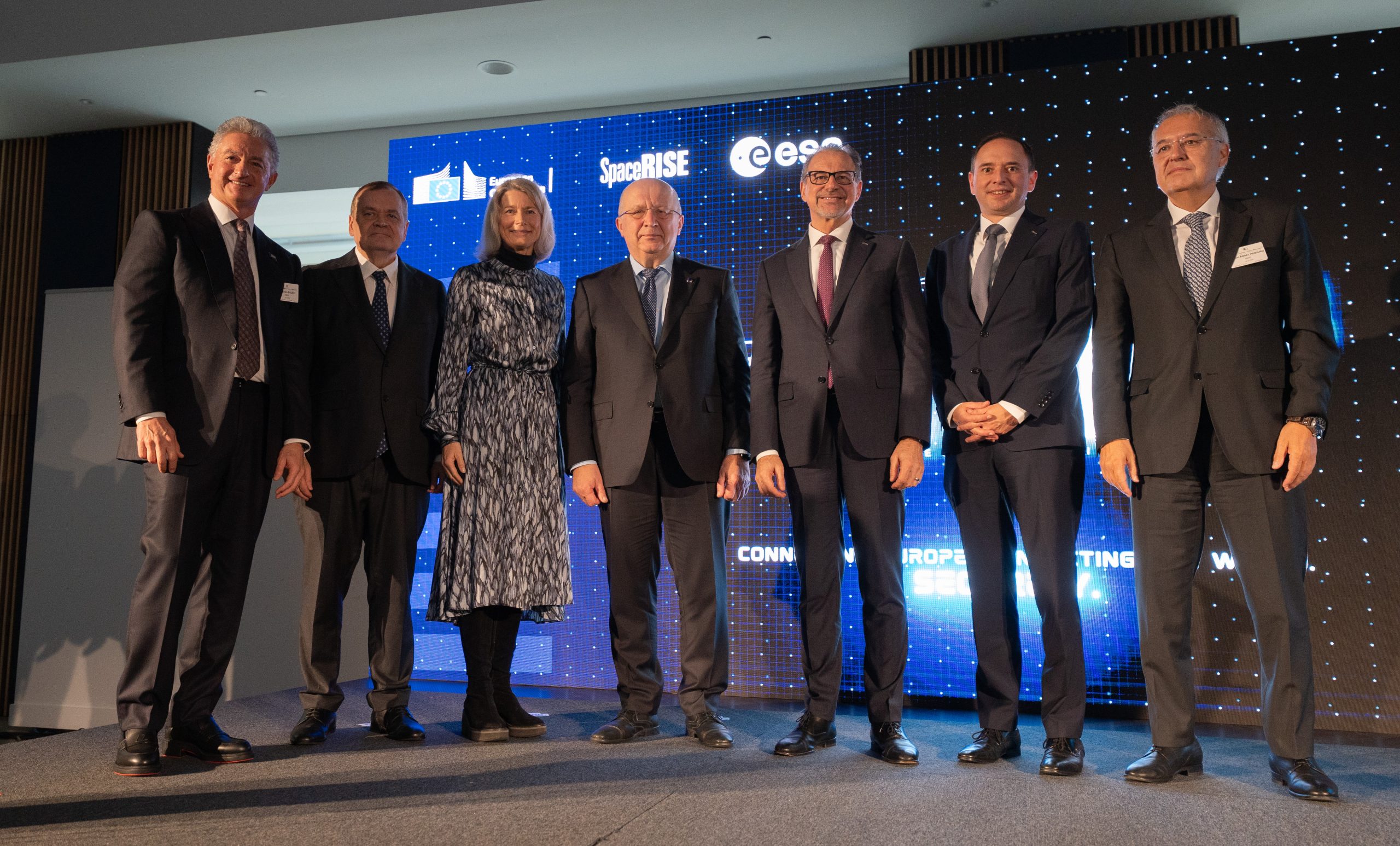
A 12-year concession contract between the European Commission and the industrial consortium called SpaceRISE that is led by European satellite operators SES, Eutelsat and Hispasat, was signed by Timo Pesonen, the European Commission’s Director-General for Defence, Industry and SpaceAdel Al-Saleh as CEO of SES S.A., Eva Berneke as CEO of Eutelsat S.A., and Miguel Ángel Pandura Panadero as CEO of Hispasat S.A..

Laurent Jaffart, ESA Director for Connectivity and Secure Communications, signed the second contract between ESA and the SpaceRISE consortium. The consortium brings together Hispasat and Eutelsat alongside SES as satellite operators. They will contract with manufacturers and other key actors of the supply chain, including SMEs and midcaps.

Through the Contribution Agreement, ESA and the Commission defined a set of entrusted tasks for ESA to implement and the relations between the institutions. This includes developing critical elements of the system with low technology readiness levels and high risk of development, as well as appropriate coordination mechanisms between activities.

As a trusted partner of the Commission, ESA, as the Qualification and Validation Authority, will supervise the development activities in the name and on behalf of the Commission with the SpaceRISE consortium as part of a 12-year contract, with efforts being made to implement 5G standards to enable interoperability between systems.

IRIS² will be a multi-orbit constellation, with approximately 300 satellites spanning across Low Earth Orbit (LEO) and Medium Earth Orbit (MEO). By utilising both orbits, the constellation will benefit from the low latency of LEO and the wider coverage of MEO, providing a superior commercial and sustainable system that is competitive and reduces the need to deploy two constellations to offer the same capabilities. An additional layer in Low LEO providing further services will also be developed and launched.

“In an increasingly complex geopolitical world, ensuring resilient, secure and fast governmental communications is essential. ESA will play a crucial role in the technical implementation of the IRIS² programme. ESA’s excellence will foster innovation in the European space industry, boost European competitiveness, create high-skill jobs and attract talents to Europe. The Commission’s trust in ESA to oversee the development of the constellation and its ground infrastructure speaks volumes of ESA’s successful track record in the delivery of European flagship programmes. ESA is ready to deliver again, for Europe and its citizens,” said Josef Aschbacher, ESA’s Director General.

“Working with our partners at the European Commission and SpaceRISE, we are proud to support the development, qualification and in-orbit validation of the next EU flagship programme for space. Through ESA’s Connectivity and Secure Communications directorate, we will leverage decades of experience in developing and implementing space programmes with Industry. We look forward to carrying forward the implementation of the programme hand-in-hand with the colleagues from the European Commission,” said Laurent Jaffart, ESA’s Director of Connectivity and Secure Communications.

“The Commission has delivered on the Union’s imperative need for an autonomous and secure connectivity capability. IRIS² underpins our strategic autonomy and defence capacity, promotes our competitiveness, and energises public and private sectors’ cooperation,” said Timo Pesonen, European Commission’s Director-General for Defense Industry and Space.

We are honoured to lead the SpaceRISE consortium to work with the European Commission and the European Space Agency on the IRIS² project. IRIS² is integral to Europe’s space strategy and is already fostering enhanced collaboration and innovation between the industry and public sectors. By strategically coming together, we will be able to ensure architecture resiliency and security from Day 1 of the system launch. With the European Commission as an anchor customer of the constellation, our investment into IRIS² will see us augment our MEO capabilities while executing our required rate of return, maintaining investment grade balance sheet metrics, and returning cash to our shareholders,” said Adel Al-Saleh, Chief Executive Officer of SES.

“IRIS² programme is a landmark initiative that embodies Europe’s commitment to digital sovereignty, resilience, and strategic autonomy. At Eutelsat, we are uniquely positioned to bring unparalleled expertise to this mission, leveraging our pioneering capabilities, including our cutting-edge LEO constellation. By combining this advanced infrastructure with the collective strengths of the SpaceRISE consortium, we will deliver a transformative communications backbone that addresses Europe’s most critical connectivity needs of our governments, reinforces its leadership in space innovation, and bridges the digital divide for millions of citizens and businesses across the continent. This project is a testament to Eutelsat’s vision of driving secure and sustainable connectivity for a resilient Europe,” said Eva Berneke, Chief Executive Officer of Eutelsat.

“The signing of IRIS² is a historical milestone for European space. Hispasat was born out of public-private collaboration to provide government and commercial communications in geographical areas of interest to our country. We are therefore convinced that, through SpaceRISE, we will not only guarantee the secure communications of the Member States, but also contribute to generating a more innovative and competitive ecosystem at a time of special relevance for the European space industry,” said Miguel Ángel Panduro, Chief Executive Officer of Hispasat.