

LATEST NEWS
May 4, 2026 • 08:05
April 30, 2026 • 09:01
April 15, 2026 • 01:08
EVENTS
January 25, 2022
04 Mar 2026
The European Space Agency (ESA) has awarded German optical communications company Mynaric with a contract to build a laser communications Demonstration System for its High Throughput Optical Network (HydRON) project. Mynaric will help to develop the technology necessary for in-orbit demonstrations of a European secure laser communications network, a crucial step to enabling further research into high-speed optical links such as the ESA Specifications for Terabit/sec Optical Links (ESTOL).
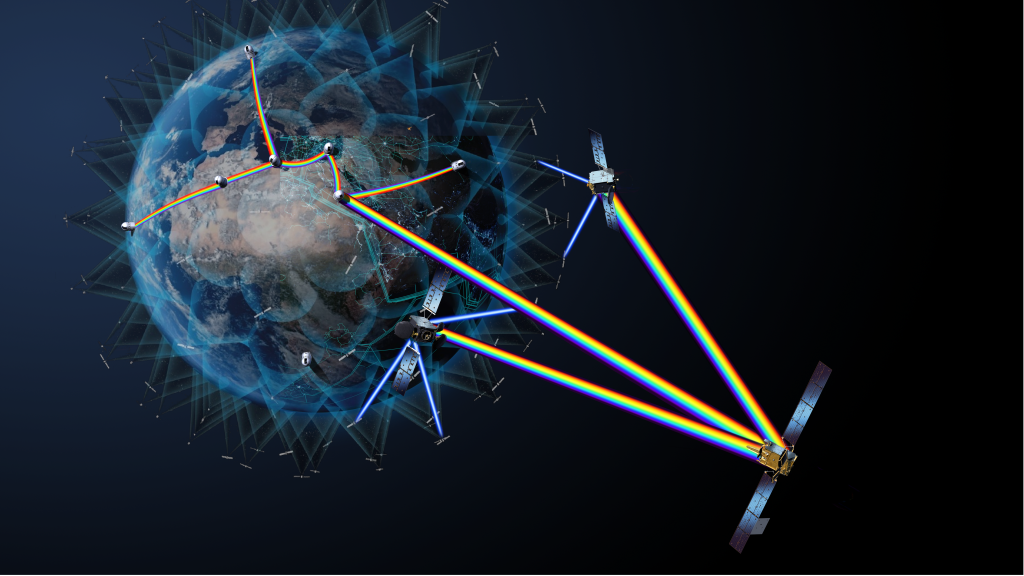
The HydRON project aims to bolster the resilience of European communications infrastructure by deploying a high capacity, secure and interoperable optical data relay network across low and medium Earth orbits. This focus on optical communications falls under the umbrella of the larger Optical & Quantum Communications – ScyLight programme line of ESA’s Advanced Research in Telecommunications Systems (ARTES), alongside projects to develop, demonstrate and implement quantum technologies for satellite communications.
HydRON addresses the long-term need expressed by ESA’s Member States to develop, implement and operate a secure space communications infrastructure capable of meeting the growing demand for larger volumes of space data at speeds edging ever closer to real time. Optical links have the potential to meet all these requirements: by virtue of functioning through direct line of sight, laser communications not only enable consistent gigabit speed data transfers – orders of magnitude faster than traditional RF communications – but are also inherently more difficult to intercept or interfere with.
HydRON’s Element 3 focuses on demonstrating the applications of this technology within the user segment by creating a testing environment in real operating conditions. Within this framework, Mynaric will contribute laser communications terminals to the Element 3 Demonstration System. These terminals will enable in-orbit testing and validation of service concepts and mission architectures for future commercial and institutional use cases aboard maritime and airborne platforms.
What’s more, the Demonstration System will build on the work carried out under HydRON Element 2 to demonstrate interoperability across multiple orbital regimes and potential international partner networks. Indeed, Mynaric was previously awarded a contract to provide laser communications terminals for both ground and space segments of the network comprising Element 2. This element will aim to establish a satellite collector in low Earth orbit, using optical technology to connect space communications networks spread across several layers of orbits.
The Demonstration System is a stepping stone towards the development of technologies crucial to ESA’s roadmap for an interoperable, high-speed space communications infrastructure. In particular, ESTOL will leverage the in-orbit demonstration capabilities of HydRON Element 3 to test high-data-rate optical links – towards a capacity of terabit per second – to support the implementation and deployment of future optical satellite networks.
“With HydRON, we’re aiming for a world-first optical network that allows for fast, terabit-per-second capacity communications with no interference. The project will offer a scalable capacity that will allow for reliable and seamless global connectivity, designed to benefit even the most remote of locations,” said Laurent Jaffart, Director of Resilience, Navigation and Connectivity at ESA. “In the current geopolitical climate, resilient communications are more important than ever, and with Mynaric, we’re taking the next step in delivering an infrastructure that promotes interoperability, reliability and security for a wide range of satellite communication services.”
“The HydRON Demonstration System provides a unique opportunity to test and refine laser communications technologies in an operational network environment,” said Joachim Horwath, Chief Technology Officer at Mynaric. “Through these demonstrations, we can further mature our technology, address interoperability requirements, and continue expanding our product portfolio to meet the evolving needs of multi-orbit and multi-mission space networks.”
“The selection of Mynaric for the HydRON User Segment activities reflects ESA’s confidence in our technological expertise and our ability to execute on complex optical communications programs,” said Andreas Reif, Chief Restructuring Officer of Mynaric. “It represents an important milestone as we continue to strengthen the company, expand our role within Europe’s space infrastructure, and position Mynaric for sustainable growth as a key contributor to future European and global space and defense networks.”
Mynaric’s work on the HydRON Element 3 Demonstration System will contribute to setting the stage for a resilient and interoperable European space communications infrastructure capable of supporting a wide breadth of commercial and institutional mission concepts.
While the implementation of the HydRON Demonstration System proceeds apace, ESA is also preparing the next evolutionary phase of HydRON within the Optical & Quantum Communications – ScyLight programme line. Leveraging the inherent resilience of optical communications, including their low probability of detection and interception (LPD/LPI) characteristics, ESA is exploring the technical opportunities they offer for airborne platforms (HAPS and aircraft), maritime users, as well as deep‑space communications.