PAGE CONTENTS
Objectives
The primary objectives of the project are:
- The development of technology for air-to-GEO laser communications, namely:
- Vibration isolation and active compensation
- Compensation of the dynamics of the aircraft (roll, pitch and yaw movements)
- Accurate open-loop pointing in flight, sufficient to perform spatial link acquisition
- Establishing communication links through a channel disturbed by the atmosphere and airflow around the aircraft
- The integration and alignment of the UltraAir technology demonstrator
- 3. Demonstrating feasibility of the technology during a ground-to- space test campaign and a flight test campaign and collect data on atmospheric conditions over a range of geographic locations. This data is a prerequisite to validate and tune atmospheric and turbulence models used to predict the availability of optical communication links from ground, air and sea to geostationary Earth orbit (GEO) and low Earth orbit (LEO). It is also crucial input to the system design for a later operational service.
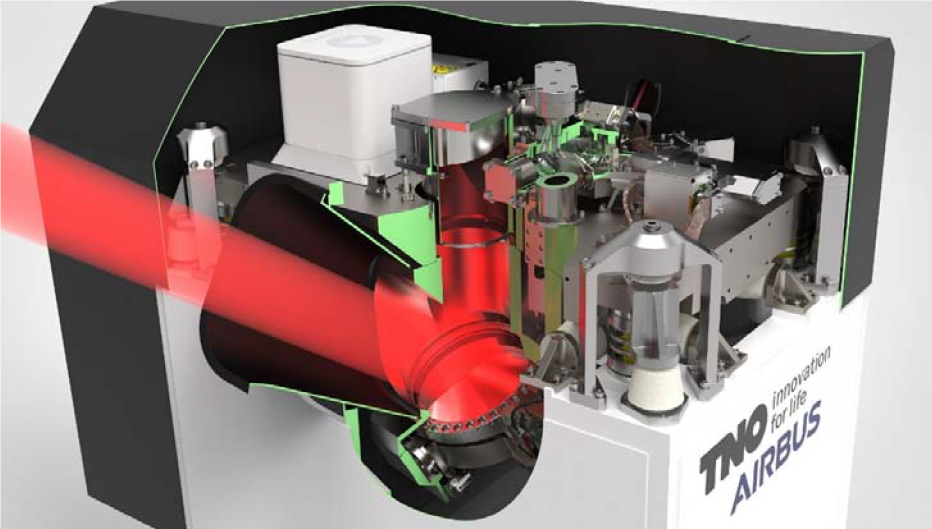
CAD rendering of the UltraAir demonstrator. Image credit: Airbus Defence and Space
Benefits
The UltraAir Airborne Laser Communications Terminal will be able to deliver service with unprecedented capabilities such as:
- High-data-rate communications (>1.8Gbps) and highly resilient laser comms link for regular offload of large sensor suites
- Secure Communications thanks to low beam divergence providing Low probability of detection and interception, and intrinsic anti-jamming characteristics
- No RF radiation, overcoming spectrum congestion
- Enabler for SpaceDataHighway End-to-End services, providing:
- GEO-GEO laser crosslink to backhaul user data
- Security concept useful to governmental users:
- Possibility to transfer laser terminal control to such users
- Use of National-eyes-only user ground stations
Features
The Product features are:
- Uplink data rate of more than 1800 Mbps
- Coarse/fine pointing mechanisms
- Tracking sensors and controller to compensate aircraft dynamics
- Interoperability with onboard Flight Management System (FMS) and Inertial Navigation System (INS)
- Laser subsystem (seed laser, modulator, amplifier)
- Data electronics (coding, forward error correction)
- Operator console (optional)
Challenges
Establishing high data rate free-space laser communications links over large distances (40’000 km) from an aircraft offers unique challenges:
- Harsh dynamic environment, characterised by vibration and roll, pitch and yaw movements
- A combination of atmospheric disturbance and aerodynamic turbulence around the aircraft
- At the same time stringent pointing requirements, due to the narrow laser beam
A later product will in addition require small size, weight and power (SWAP). Furthermore, strict EASA certification requirements are to be met.
System Architecture
The UltraAir terminal demonstrator consists of an optical head and several small electronics racks carrying mainly COTS equipment. The core of the system – the optical head – is a bespoke design consisting of an optical base plate with all the necessary optical hardware. This base plate is mechanically isolated from vibrations and also hosts the inertial navigation system.
The optical hardware features a coarse pointing mirror, a telescope and the core optics, housing the fine pointing mechanisms, tracking sensors, Tx collimator and a calibration unit.
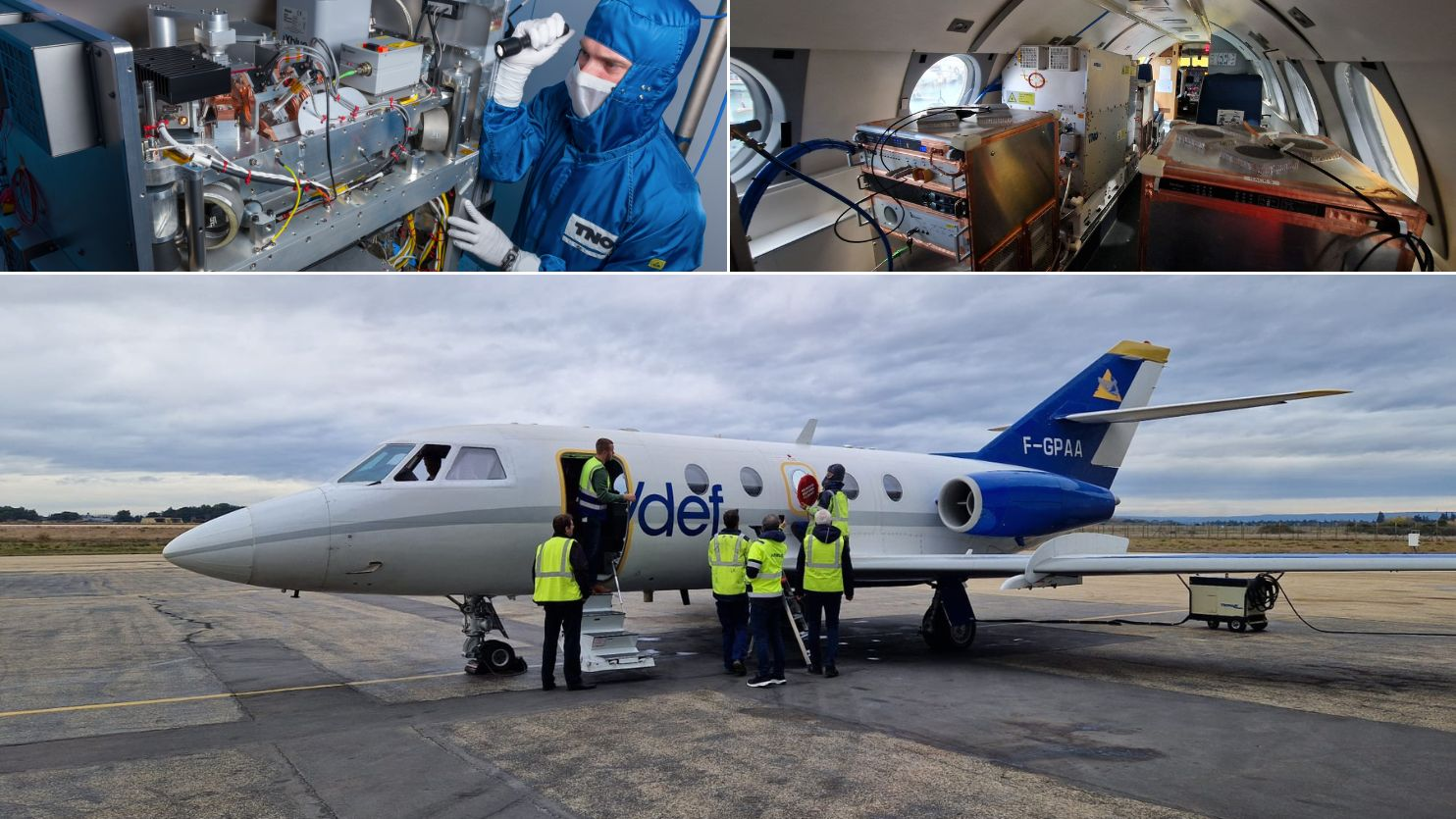
The complete UltraAir terminal is located inside the passenger cabin of a small business jet as a cost-effective approach for the demonstration. One of the passenger windows is replaced with a window of optical quality through which the terminal communicates with TDP-1 on Alphasat.
Plan
The project covers the development of the UltraAir technology flight demonstrator.
Current Status
In December 2025 Airbus Defence and Space and the Netherlands Organisation for Applied Scientific Research (TNO) conducted a series of successful flight tests from the Nimes airport (France), demonstrating laser communication between an aircraft and a geostationary satellite. This project is part of the European Space Agency’s Optical and Quantum Communications – ScyLight programme.
The AVdef Falcon 20 jet aircraft was equipped with Airbus’ UltraAir laser communication terminal, while the secure laser link was established with the AlphaSat TDP-1 terminal in geostationary orbit at 36,000 kilometres above the Earth.
The flight campaign demonstrated robust and reliable acquisition and tracking of optical links. The campaign delivered 31 successful links with closed loop tracking, each 6–14 minutes and generating hours of telemetry. In a world’s first, the performed links showed bit error free coherent communication at a data rate of 2.6 Gbps for several minutes uninterrupted.