SatDisQCo

Feasibility study of distributed quantum computing enabled by satellite communication

STATUS | Ongoing
STATUS DATE | 15/07/2025
ACTIVITY CODE |
SatDisQCo

Objectives

Quantum computing promises to revolutionise a number of fields by solving certain computational tasks faster than what can be achieved with classical computers. To fully achieve this ambitious promise, it is crucial to interconnect Quantum Processing Units (QPUs) in order to run algorithms cooperatively in a distributed fashion, tackling problems beyond the capability of a single QPU and thus enabling a whole new range of applications and use cases. In this context, a paramount problem is how to efficiently distribute entanglement over large distances in order to interconnect faraway QPU. In this project, we are going to study architectures for distributed quantum computing (DQC) enabled by space connectivity. To this aim, we will survey different use cases, quantum algorithms and their suitability for parallelization. We will also address different qubit platforms and other relevant components, such as entangled photon sources, transducers, and quantum memories. We will run extensive simulations collecting all these ingredients together to identify an architecture supporting as many use cases as possible and to formulate a technology roadmap for future developments.

Challenges

  • Identification of use cases where a distributed quantum algorithm outperforms a classical solution.
  • Identification of the quantum algorithms more suitable for parallelisation and investigation of the distributed compiler performance.
  • Identification of the best qubit platform(s) allowing for long-distance interconnection via entanglement distribution.
  • Propose practical architectures to run distributed quantum algorithms. This architecture shall be able to perform non-local two-qubit gate operations that will be required to distribute the computation among different QPU.
  • Identification of the most promising components, whose development will enable the successful realisation of as many use cases as possible.

Plan

  • Use cases, and reference scenario definition
  • Technical Specification
  • Optimal Technical Baseline Identification
  • Technology Assessment and Development Plan

Current Status

We have initiated the survey part of the project. In particular, on the software side, we are reviewing the currently available use cases, with the algorithms more suitable for parallelisation and the distributed quantum compiler. On the hardware side, we are investigating the qubit platform, the transducers, and the quantum memory.

We are also kick-starting the simulation activities for the distribution of entangled photons from satellites, evaluating rates and fidelities.

Companies

Integrated Photon Sources for Space-Based Quantum Telecommunications

STATUS | Ongoing
STATUS DATE | 14/07/2025
ACTIVITY CODE |
Integrated Photon Sources for Space-Based Quantum Telecommunications

Objectives

The project aims to design, specify, and validate compact optical modules critical for spaceborne quantum key distribution (QKD) systems. Key objectives include setting the preliminary design, finalizing technical specifications, confirming the detailed design, and defining relevant environmental conditions for prototype validation and functional testing. The focus lies on developing space-compatible Entangled Photon Sources (EPS) and Faint Pulse Sources (FPS), optimizing for Size, Weight, Power, and Cost (SWaP-C). Particular attention is given to balancing EPS unit size and photon pair brightness by adjusting the length and form of the periodically poled potassium titanyl phosphate (ppKTP) crystal. This approach enables the possibility of using multiple compact EPS units on a single satellite to improve performance and redundancy.

Challenges

A key challenge of the project lies in ultimate miniaturisation of single photon sources in order to showcase them in practical QKD applications.

System Architecture

The EPS employs a high-power (>100 mW) SLM pump laser at 405 nm and uses periodically poled nonlinear crystals, for efficient spontaneous parametric down-conversion. Robotic manipulators are used to position and bond small optical components (≤3 mm), ensuring precise alignment. Critical to performance are stable thermoelectric cooling (±0.001 K), high-fidelity entanglement generation, and reliable polarization-maintaining fibre coupling with high polarization extinction ratio and angular stability. The FPS utilises compact, switched gain-chips and a common seed to emit pulses at up to 1 GHz with stable amplitude and precise timing. A two-channel switching driver controls emission. Similar robotic optical assembly techniques are applied to align and bond small optical components, ensuring consistent PM fibre coupling. Both modules use commercial off-the-shelf components and robust assembly methods, supporting potential space qualification. The overall architecture reflects a high degree of integration and precision, enabling stable and scalable photon generation for quantum key distribution applications.

Plan

The project follows a structured plan divided into key phases: initial requirements analysis, preliminary and detailed design, component procurement and assembly, and functional testing. Major milestones include a meeting to define the characterization strategy, a Preliminary Design Review, a Test Readiness Review, and a Critical Design Review. The project concludes with a final presentation to ESA.

Current Status

The project has progressed from concept development toward prototype definition. Detailed technical specifications for key components have been initiated based on system requirements. A market survey identified suitable EU-based suppliers, and initial orders have been placed. A literature review of electrical and fluid power systems is ongoing to support design decisions. Risk identification and mitigation planning have also begun.

ONEST

Optical Ground Station Network Testbed

STATUS | Ongoing
STATUS DATE | 26/06/2025
ACTIVITY CODE | 6B.128
ONEST

Objectives

The objective of the ONEST project is to design and implement a flexible, modular testbed for optical and quantum communication networks, enabling the integration and testing of real and simulated Optical Ground Stations (OGSs). ONEST supports automated pass handling, satellite link scheduling, and Delay-Tolerant Networking (DTN) for reliable end-to-end data delivery. The system allows external parties to register OGSs and roaming networks, manage interfaces, and conduct performance validation through realistic or emulated satellite scenarios. By combining link planning, satellite emulation, and network orchestration within a unified architecture, ONEST aims to advance European capabilities in secure, high-throughput space communications and provide a scalable environment for technology prototyping, validation, and inter-network cooperation.

Challenges

Key challenges of the ONEST project include the integration of existing and simulated Optical Ground Stations within a unified, delay-tolerant communication environment.

Managing handovers across heterogeneous OGS networks, ensuring interface interoperability, and automating satellite link scheduling under variable orbital and weather conditions add complexity.

The system must also support precise link budget calculations and robust external data interfacing for operational accuracy.

System Architecture

The ONEST system architecture is designed as a layered framework supporting both operational and simulated Optical Ground Stations (OGSs) for optical communication. It is structured into three primary planes: the management plane, the data plane, and the simulation plane.

The management plane handles control logic, scheduling, configuration, and monitoring. Central components include the OGS Resource Planner, which coordinates availability and resource allocation; the OGS Scheduler, which manages satellite pass windows; and the Link Availability Calculator, which uses weather data to determine optimal communication conditions. The user interface component provides centralised user access for system configuration and status monitoring.

The data plane focuses on reliable data delivery. The DTN Network Manager ensures end-to-end communication across intermittent or delayed links using Delay-Tolerant Networking protocols. The User Data interface enables data exchange with external consumers.

The simulation plane includes the OGS Simulator and Satellite Simulator, which allow testing of network behaviour without real hardware. These components operate independently of the live network, enabling flexible scenario modelling.

All components are connected through well-defined interfaces and support both real-time operations and emulated workflows, ensuring the ONEST system is adaptable, scalable, and ready for future optical ground segment requirements.

Plan

The project was kicked off on 22 May 2025. The project plan comprises of the following milestones:

  • Technical Baseline Review (TBR)
  • Critical Design Review (CDR)
  • Test Readiness Review (TRR)
  • Final Review and Demonstration Kick-off with Testbed Workshop (FR)
  • End of Project Final Presentation (FP)

Current Status

Currently the initial deliverables for the Technical Baseline Review (TBR) are in progress, including the State of the Art and Technical Specification documentation.

AutoMAIT

AutoMAIT

STATUS | Ongoing
STATUS DATE |
ACTIVITY CODE | 5F.035
AutoMAIT

Objectives

The AutoMAIT project focuses on creating automated processes for attaching micro-optic to photonic integrated circuits (PICs) aimed at satellite applications. Objectives include enhancing assembly reliability and repeatability, improving optical coupling efficiency, reducing manual degrees of freedom, and developing processes that withstand harsh environmental conditions like thermal cycling and vibration. The project advances these packaging processes to a technology readiness level (TRL5), enabling high-volume manufacturing for the price-sensitive Non-Geostationary Orbit (NGSO) market and supporting MBRYONICS’ STARCOM and TeraBIX product lines.

Challenges

The AutoMAIT project encompasses challenges in developing automated micro-optic attachment processes for photonic integrated circuits. Key issues include achieving reliable and repeatable assembly, reducing the degrees of freedom in current processes, and improving optical coupling efficiency. Ensuring the processes and components could withstand harsh environmental conditions, like thermal cycling and vibration, was also a significant hurdle. The report also discusses the need for future production automation to meet market demands.

System Architecture

The AutoMAIT system focuses on automating the micro-optic attachment process for photonic integrated circuits (PICs) used in satellite applications. The core of the system revolves around a Finetech Lambda 2 flip-chip bonder, which provides precise placement and alignment capabilities. This bonder is enhanced with custom-designed fixtures for thermal bonding and environmental testing.

The architecture includes automated epoxy dispensing for controlled application of adhesive. Optical feedback mechanisms are integrated for real-time monitoring and optimization of optical coupling during the alignment process. Specifically designed PICs, lensed fibre arrays, and various epoxy types are key components. The system undergoes rigorous post-process testing, including die shear, mechanical shock and vibration, thermal cycling, and TVAC (thermal vacuum) testing to ensure reliability in harsh space environments.

Plan

The AutoMAIT project phases include developing flip-chip based micro-lens and fibre array attachment processes for photonic integrated circuits. Key milestones involve design considerations for reduced degrees of freedom in optical alignment, automated epoxy deposition, and curing processes. Post-process testing was conducted, including die shear, mechanical shock and vibration, thermal cycling, and TVAC testing to evaluate the processes’ effectiveness and environmental resilience for satellite applications. Additionally, the project included roadmapping and business development strategies for future automation and market engagement.

Current Status

The AutoMAIT project has developed and tested automated photonic packaging processes for satellite communications, focusing on improving optical coupling efficiency and reliability for high-volume manufacturing. Testing, including die shear, mechanical shock, vibration, thermal cycling, and TVAC, has been completed. The report also outlines future roadmapping and business development strategies, including plans for production automation, market analysis, and customer engagement, with a focus on supporting MBRYONICS’ STARCOM and TeraBIX product lines.

OPTIMUS

Optical Communication Multi User System (OPTIMUS)

STATUS | Ongoing
STATUS DATE |
ACTIVITY CODE | 6B.128
OPTIMUS

Objectives

The OPTIMUS test bench establishes a foundation for next-generation optical communication services by demonstrating robust, user-driven capabilities in scheduling, data delivery, and network monitoring. It enables seamless registration of OGS, Network Operations Centers (NOCs), and satellite operators via a lightweight, harmonised process that ensures interoperability across diverse optical systems. By implementing a “NOC of NOCs” architecture, OPTIMUS centralises planning and resource management to maximise pass reliability and data throughput. The platform integrates Human-Machine Interface, planning algorithms, real-time monitoring, and networking modules into a cohesive framework, supporting both single- and multi-OGS scenarios under realistic operational conditions.

OPTIMUS also serves as a reference for standardisation and can host advanced use cases such as quantum key distribution and quantum communication experiments. Through rigorous requirement refinement, design finalisation, and targeted validation tests, the project raises the solution’s Technology Readiness Level and prepares it for seamless integration into operational environments – laying the groundwork for scalable, cost-effective Optical Communications as a Service.


Challenges

The project navigates three key challenges: integrating a still-maturing Disruption Tolerant Networking (DTN) protocol end-to-end – requiring protocol conversion and satellite-simulator support; coordinating diverse subsystems (planning, HMI, DTN, HCC, monitoring) developed by multiple teams using agile methods and clear workflows; and balancing cost-driven design constraints by leveraging open-source software, consortium expertise, and careful trade-offs to contain development, licensing, and integration expenses.

System Architecture

The Testbed adopts a modular, service-oriented architecture comprising five key components interconnected by secure, standardised interfaces:

  • Human-Machine Interface (HMI) serves as the entry point for operators and customers, providing registration, scheduling, simulation control, and data retrieval.
  • Scheduler & Optimisation Engine processes pass requests, applies link-budget and cost-based ranking, and handles dynamic rescheduling. It exposes REST endpoints and publishes scheduling events to an internal message bus.
  • Holistic Control Centre (HCC) serves as a middleware as it provides within OPTIMUS the ability to dynamically connect OGS or OGS-networks. OGSs can connect to the entire system as new services and HCC provides the needed infrastructure to provide coherent configurations, security and so on.
  • Emulator consumes scheduling events to drive spacecraft-to-ground interaction scenarios under configurable impairments (latency, packet loss, handover), streaming telemetry results to the monitoring layer.
  • Central Monitoring System (CMS) subscribes to health and performance topics on the message bus, aggregates metrics in a time-series database, and pushes alerts and trend data to the HMI.

A DTN integration layer underlies data transfers, segmenting and forwarding bundles over intermittent links. The architecture enables independent development, easy scalability to multiple operators, and robust validation of optical communication workflows.

Plan

The project unfolds in five phases, each ending with a formal milestone review:

  1. Preparation – Project Kick-Off (KO) and State-of-the-Art/Trade-Off studies, concluding with the Preliminary Design Review (PDR).
  2. Design – Architecture and ICD alignment, ending at the Critical Design Review (CDR).
  3. Build – Module implementation and system integration, culminating in the Factory Test Readiness Review (FTRR).
  4. Test – System and interface validations (including remote OGS), fixes applied, ready for the Test Readiness Review (TRR).
  5. Operate – Operational demonstrations and final handover at the Final Review (FR).

Current Status

The project is in the Preparation phase, having completed the Kick-Off and initiated State-of-the-Art studies and technology trade-off analyses. Core activities include defining detailed user scenarios, refining high-level requirements, and setting up development environments. Upcoming tasks focus on finalising the Preliminary Design Review inputs, solidifying the ICD framework, and aligning stakeholder workflows to ensure a smooth transition into the Design phase.

Feasibility Study of Space to Underwater Optical Communications

ScyLight - Optical Communication Technologies

STATUS | Ongoing
STATUS DATE | 22/04/2025
ACTIVITY CODE | 7C.096

Objectives

The aim of this programme is to investigate the feasibility of high data rate communications from satellite to autonomous underwater vehicles (AUVs) via laser communication. This requirement is in response to the increasing number of AUV and underwater devices being deployed and the requirement for greater capacity information transfer underwater.

Currently available underwater communications via acoustic and RF technologies are suited to long range, low data rate and short-range, high data rate respectively. Additionally, both acoustic and RF technologies do not offer communication channels through the air-water interface. By exploring the opportunities offered by optical communications technology there is potential for long range, high data rate communications through the air-water interface, exploiting to the relatively low attenuation of blue-green light through both the atmosphere and water.

Challenges

The key challenge of the project is overcoming the technical challenges posed by the environment through which the optical link must pass. Water is a highly scattering medium that cannot be avoided in this scenario, a significant amount of signal loss and dispersion will occur through water and must be overcome.

Challenges are also posed by the size, weight and power constraints that will be imposed on a system due to the constraints of both AUVs and satellites.
 

System Architecture

The project outcome is a technology readiness level 2 (TRL2) baseline technical solution for achieving space to underwater communications using laser communications. This solution will include the following:

  • Combined impact of the underwater and atmospheric channel behaviours,

  • Technologies including lasers and detectors,

  • Link budget, aperture sizes and power levels,

  • System scenarios and,

  • Waveform and modulation formats.

Recommendations for future development of the solution will be generated based on the identified limitations with the aim to process the technology to higher TRL in the future.

Plan

The feasibility study runs between March 2025 and November 2025, during which four main technical areas will be explored:

  1. Identification AUV use cases and review of current communication methods,

  2. Generation of technical requirements for space to underwater communications

  3. Feasibility study and trade off analysis of potential technical solutions

  4. Evaluation of identified technical solutions

Two key milestones will occur during the feasibility study, the first is scheduled for June 2025 and will occur when technical areas 1 and 2 of the feasibility study are complete. The second milestone will occur upon the completion of the entire study.

Current Status

The project is progressing well with the team finalising the first of the four main technical areas. Four uses cases for space to underwater communications on AUVs and the scenarios within which they would operate have been identified, these are:

  • Long Range Oceanographic Surveys,

  • Subsea Infrastructure Monitoring,

  • Mine Counter Measures and,

  • Maritime Search and Rescue Operations.

Additionally, a review of current communication methods employed by AUVs, and state of the art communication technologies has been conducted. Next steps include establishing a set of technical requirements and exploring their feasibility.

AO-LIMA

Avalanche Photodiodes for Low-noise Applications in Optical/Quantum Communications at 1550nm

STATUS | Ongoing
STATUS DATE | 12/03/2025
ACTIVITY CODE | 6C.037
AO-LIMA

Objectives

The primary objective of this project is to design, fabricate, and characterize a 2.5 Gbps APD receiver, aiming for a fivefold improvement in sensitivity compared to commercially avaliable InGaAs APDs. Additionally, the project includes the development of APD chips with bandwidths of 200 MHz, 500 MHz, and 1 GHz. These APD chips are designed for operation at a 1550 nm wavelength, featuring low noise, high responsivity, and minimal dark current.

The receiver integrates APD chips developed by Albis, along with commercially available off-the-shelf (COTS) passive components and a radiation-hard transimpedance amplifier (TIA). Furthermore, the project includes the development of an evaluation board to facilitate straightforward testing of the receiver’s functionality in a laboratory setting.

Challenges

To achieve the targeted 5-fold sensitivity improvement in the AO-LIMA project, the main APD design requirements include:

  • High unity gain responsivity to enable high signal amplitude at all multiplication gains.
  • Low k-ratio (i.e. low excess noise factor) to reduce APD and receiver NEP, and improves receiver sensitivity.
  • Operation at high multiplication gain to achieve the improved sensitivity with low k-material.
  • Large gain-bandwidth product to allow for high data rate transmission at high multiplication gain.
  • Low APD dark current to reduce APD NEP.

The key challenge is to find an optimum balance between the APD noise and the operational gain.

System Architecture

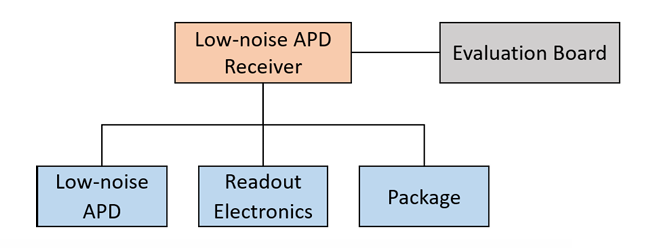
The following product tree is a hierarchical breakdown of the product into the hardware and software elements:

The key products or elements are described below:

APD Chip

The avalanche photodiode (APD) chip serves as the optical signal detector, converting incoming optical signals into electrical output. Leveraging a low-noise avalanche multiplication process, the APD chip provides significant internal gain with minimal excess noise, achieving at least a fivefold improvement in detection sensitivity compared to existing InGaAs APDs at 2.5 Gbps. The chip features a large active region with an anti-reflective coating on the front side to enable efficient optical coupling to a 50 µm multimode fiber at a 1550 nm wavelength.
 

Readout Electronics

The readout circuit amplifies the RF electrical signal generated by the APD and delivers a differential data output pair. Additionally, if required, it can provide a discretized digital signal, enabling a hard decision output (“0” or “1”).
 

Evaluation Board

The evaluation board is designed to facilitate performance assessment of the receiver. It includes all necessary connections for biasing and signal readout, ensuring ease of use in laboratory testing environments.


Plan

The project consists of two development phases: a “Technology-preparation” and a “Technology – development” phase. In the preparation part we conduct literature study to review the state-of-the-art, propose preliminary device design and run simulations. The development phase includes two rounds of APD manufacturing and testing. The first round is to design development test structures to validate the models, verify the compliance with the SoW requirements, and to define the final design. The second round manufactures the final APDs and the receivers, and performs thorough compliance verification testing including radiation testing. Finally, a global analysis of the results is performed.

Current Status

The project started with a Kick-Off-Meeting in March 2025. The project is currently in the “Technology – preparation” phase.

Albis team concludes an assessment of the current state-of-the-art InGaAs APD and is diving deeply into the simulation models. Albis team is actively engaged in brainstorming sessions to create an innovative and optimal device design that can accommodate the demanding technical requirements of AO-LIMA project.

OTA80

Optical Tube Assembly 80cm

STATUS | Ongoing
STATUS DATE | 30/01/2025
ACTIVITY CODE | 6C.061

Objectives

The objective of the project is to design a cost-effective Optical Tube Assembly (OTA) with Nasmyth output for an 80cm telescope dedicated for optical communications.

While most solutions deploy today are based on a classical telescope design, AMOS is developing an optical tube designed specifically for optical communications. It allows for larger throughput at a lower cost and lead time.

With this project, AMOS is designing the OTA and the possible tools required for the manufacturing, integration and test of the 80cm tube. The goal is to work on a cost-effective design and to reduce the time of delivery. 

Challenges

The following challenges are identified for the project:

  • Development of an optical antenna with higher performances compared to classical telescopes 

  • To have a cost- effective design 

  • To reduce the time from order to delivery by selecting components with lower lead time and simpler assemblies.

System Architecture

The optical tube is composed of following sub systems and components:

  • Optical Tube Assembly

  • M1 unit

  • M2 unit, including focuser

  • M3 unit 

  • Tube structure

  • M1 cover

  • Interfaces for auxiliary telescopes

Plan

The project phases are:

  1. Definition Phase;

    Requirements & interfaces are developed resulting in a optical antenna baseline concept.

  2. Technology Phase

    Preliminary and detailed design of an optical antenna is performed with a PDR and CDR.

    Manufacturing and validation of the OTA80 system.

Current Status

PDR achieved, CDR in progress.

LEO FLOPs

OPTICAL FEEDER LINK SITE-DIVERSITY PROTOCOLS FOR SATELLITE CONSTELLATION NETWORKS

STATUS | Ongoing
STATUS DATE | 17/01/2025
ACTIVITY CODE | 3A.170
LEO FLOPs

Objectives

The design and demonstration of link protection and restoration protocols, suitable for enhancing the reliability of optical feeder link systems. The solution shall be commercially competitive compared to radio frequency (RF) feeder systems for low Earth orbit satellite constellations, and result in similar or better performance with respect to key system parameters like latency, jitter or throughput.

Challenges

Reliable connectivity to a LEO constellation using optical feeders faces major challenges: 

  • Short contact times require a large, spatially dispersed network to ensure availability.
  • Cloud cover and atmospheric turbulence induced outages decrease the planning reliability of these links. 
  • The solution needs to commercially competitive at very high data rates (>=100Gbit/s), otherwise RF solutions prevail.

System Architecture

The system architecture will become available after the conclusion of system trades.

Plan

The project is split into two stages:

  • Analysis and evaluation of existing methods, along with the assessment of feasibility for implementation into the emulator.
  • Implementation, performance benchmarking, and result analysis.

Current Status

The project has started and completed reviewing literature and assessing state-of-the-art.

O3KHPE

- IP Core Development for CCSDS based Optical Payload Data Transmitter

STATUS | Completed
STATUS DATE | 22/12/2024
ACTIVITY CODE | 3C.021

Objectives

The main objective of the project is to develop the VHDL IP Cores implementing coding and synchronization layer for optical telemetry described in the CCSDS 142.0-P-1.1 standard. More in details, the standard describes High Photon Efficiency (HPE) and Optical On-Off Keying (O3K) optical telemetry links. The IP Cores are written in technology independent VHDL and for each configuration (HPE, O3K-RS and O3K-LDPC) a characterization on AMD KU060 was performed. Finally, validation on target FPGA technology was carried out.

Challenges

The main challenge of this project is to develop a re-usable product that has to be configurable, technology independent and fully verified in accordance with the ECSS standard and validated on a relevant HW platform.

System Architecture

The IP Core implements three different architectures supporting the three telemetry waveforms described in CCSDS 142.0-P-1.1: HPE, O3K-RS, O3K-LDPC.

These three IP Cores implement the coding and synchronization layer, in particular HPE uses a Serially Concatenated convolutionally coded Pulse Position Modulation (SCPPM) encoder, whereas O3K can support either Reed-Solomon (RS) or Low Density Parity Check (LDPC) encoders.

Plan

The project plan consists of the following phases:

  • Requirements definition.

  • Architecture definition.

  • VHDL design and verification.

  • Characterization on target technology.

  • Validation on COTS development board.

Current Status

The Project is successfully closed. The IP Core VHDL database has been delivered to ESA as well as all expected deliverable documents.

The IP Core database will be part of the ESA IP Core portfolio.