Collaborative and Dynamic Approaches to Increasing Spectrum Utilisation

STATUS | Completed
STATUS DATE | 14/06/2024
ACTIVITY CODE | 1D.018

Objectives

The main objectives of the study are to :

  • Investigate the benefits of new, forward looking dynamic spectrum access techniques, over currently existing methods to share spectrum among services
  • Study the feasibility, performances and benefits of those promising techniques over relevant SATCOM scenarios
  • Formulate a strategy to enable the use of dynamic spectrum access techniques, also taking into account the necessary evolutions of the current regulatory framework

The major outcomes are to :

  • Establish a roadmap of the key technologies needed to be developed to make such techniques viable,
  • Identify the actions at regulatory or standardization level that shall be followed by the Agency to enable such framework

System Architecture

Several System architecture are addressed in order to study the different scenarios.

Plan

The overall work logic is presented in the following figure:

During the WP100, 5 scenarios of dynamic spectrum sharing involving SATCOM are described and the spectrum sharing techniques are analysed. A number of Key Performance Indicators is established to evaluate all the use cases and select 2 among them. A detailed design of the selected spectrum sharing techniques is realized in the WP200. The performances of the designed spectrum sharing techniques are assessed in the WP300. The recommendations for future developments are carried out in the WP400.

Current Status

The first progress meeting took place in May. The TN 1 was released. It contains the description of 5 scenarios of dynamic spectrum sharing. 2 scenarios are selected. Work on WP 200 and 300 is in progress.  

BACKHAULED HAPS

- INTEGRATION OF SATELLITE BACKHAULED HAPS IN FUTURE SATCOM NETWORKS

STATUS | Completed
STATUS DATE | 14/06/2024
ACTIVITY CODE | 1B.114
BACKHAULED HAPS

Objectives

Current terrestrial mobile technology is not able to cover demand in some use cases. This is why operators and industry are making analysis and trials for these services using HAPS.

The candidate communication protocols to be used (DVB, 4G/5G, CCSDS) suffer from some drawbacks and cannot be directly deployed. DVB was designed for a use case where both base station and the satellite are at fixed locations (no mobility). 4G/5G will suffer from latency and channel impairments which have not been tested until now. Furthermore, there are regulatory issues which are new in this situation (a HAPS cell may be much larger than a conventional 4G cell), due to the distance of the remote antenna, and which will need to be addressed in the future.

5G is a standard which still needs consolidation. Testing will also be required to assess if it works under the proposed conditions. So, an analysis seems as the optimal choice, before economic resources are committed to trials with physical equipment.

The work is focused on analysing the use cases and possible architecture solutions, selecting those most promising. Then to determine which concrete analysis and simulations are performed taking into account the maturity level of the 5G standard definition. At the end of the project, a diagnostic is provided indicating what are the necessary modifications, for the selected use cases.

Challenges

Main challenge is placed in determining the suitability of 5G standard considering HAPS platform and the related interface with satellite.

From an 5G user terminal perspective, HAPS platform is as an antenna but far away compared with terrestrial. From satellite point of view, HAPS platform is as a user terminal.

Channel model, waveform analysis, hardware impairments, synchronization, handover management are some topics to be analysed.

System Architecture

Architecture system definition is analysed in this project. As starting point have been defined several scenarios 

  • Satellite as simple backhaul of 5G base station

  • Satellite as support of aggregated non-3GPP access 

  • Satellite interconnecting 5GC located on board HAPS

Additionally, other variants could be proposed, by implementing some technology enablers previously described within the Satellite Backhauled HAPS architecture. Firstly, a transparent satellite payload is assumed, New Radio is used over the satellite backhaul link.

Then the most advanced technology is assumed, with regenerative payloads (more suitable for implementation with LEO constellation). A complete 5G integration level is achieved.

Plan

The project is developed in one phase with the following milestones:

  • MS1: System Requirements Review (SRR)

  • MS2: System Analysis Review (SAR)

  • MS3: Final Review (FR) including conclusions, roadmap and recommendations.

Current Status

The project has been completed and all activities achieved: 

  • WP1000: Case Selection & Scenario Definition, including the selected scenarios, the justification of the selection and relevance of the selected scenarios for the satcom sector.

  • WP2000: Suitability Analysis, Adaptations and Development Plan assesses the suitability of the current technology required for each scenario at least at physical, link and network layers, and identify necessary adaptations accordingly.

  • WP3000: Implementation and adaptation includes the simulations and emulations carried out to evaluate the performance of the proposed system and to verify the previously identified issues.

  • WP4000: Contributions to 3GPP summarizes the findings of the activity and presents a development roadmap leading to the realization of each of the scenarios studied in the activity.

EdgeSAT

- Edge Network Computing Capabilities For Satellite Remote Terminals

STATUS | Completed
STATUS DATE | 14/06/2024
ACTIVITY CODE | 1C.044
EdgeSAT

Objectives

EdgeSAT objectives are as follows:

  • Identify and review SatCom connectivity scenarios benefiting from edge networking capabilities;
  • Define Reference Architecture(s), identify critical functionalities, issues and potential solutions, building upon Multi-access Edge Computing, MAMS and/or 3GPP IAB, xRAN/ORAN specifications;
  • Detail the satellite enabled edge node architectures and requirements, including embedded computing/processing capabilities, and dimension and assess such capabilities according to the deployment use cases;
  • Specify Application Programming Interfaces (API) in order to ease services development on top of satellite enabled edge node architectures;
  • Investigate the impact to the overall service value chain and identify the business models needed to monetize the proposed infrastructure developments;
  • Demonstrate how an existing SatCom system could evolve in order to satisfy some of the identified use cases, with special attention to the coexistence and integration with terrestrial access networks and backhaul links, the management of the edge node resources and the scalability performance with large number of edge nodes;
  • Formulate a set of recommendations and strategic actions necessary for the European & Canadian industry to be able to address identified opportunities.
  • Formulate contributions to standardization bodies as and where applicable.

Challenges

EdgeSAT is addressing edge network computing from the satellite perspective. Edge network computing is a widely adopted concept among the terrestrial communication actors. From the perspective of EdgeSAT the challenge is the global alignment of edge computing capabilities for satellite remote terminals in a global uniform network currently being developed in 5G.

System Architecture

In the core of EdgeSAT is the establishment of a SatCom enabled edge node reference architecture.

The simplified system architecture is as follows:

The above architecture considers the following additional functionalities:

  1. End-to-end resource management;

  2. End-to-end backhaul management;

  3. End-to-end network management; 

  4. End-to-end resource orchestration.

Plan

EdgeSAT has a straightforward development plan of consecutive technical tasks focusing on:

  1. Connectivity scenarios and edge networking requirements;

  2. SatCom enabled edge node reference architecture;

  3. SatCom enabled edge node specification and design;

  4. SatCom enabled edge node implementation and performance validation;

  5. Recommendations and roadmap;

Business aspects and value chains form an integral part of the technical tasks.

Current Status

The EdgeSAT study has completed successfully in 2020, after which its testbed was made available to the Agency for 12 months.

The main results of EdgeSAT were presented at the Space2Connect conference in October 2021.

EdgeSAT identified SatCom connectivity scenarios benefiting from edge networking capabilities. It defined a reference architecture for implementing edge networking capabilities in those SatCom connectivity scenarios. Throughout EdgeSAT the 5G multi-access edge computing approach was considered as a cornerstone element. The EdegSAT activity reviewed and investigated critical enabling technologies and solutions. In particular, it analysed the satellite enabled edge node architectures and the requirements for them in terms of embedded computing/processing capabilities, and assessed and dimensioned such capabilities according to the deployment use cases. Furthermore, EdgeSAT specified an Application Programming Interface (API) in order to ease services development on top of satellite enabled edge node architectures.

EdgeSAT also investigated the impact of the merging edge networking capabilities in remote satellite terminals to the overall service value chain and identified business models needed to monetize the proposed infrastructure developments.

Finally, EdgeSAT demonstrated how an existing SatCom system could evolve in order to satisfy selected use cases, including coexistence and integration with terrestrial access networks and backhaul links, the management of the edge node resources and the scalability performance with large number of edge nodes. 
EdgeSAT concluded by formulating a set of recommendations and strategic actions necessary for the European & Canadian industry to be able to successfully address the identified opportunities.

METAMORPHOSIS

- TOPOLOGIES, ARCHITECTURES, BUSINESS MODELS, AND OPERATIONAL CONCEPTS FOR FUTURE VIRTUAL NETWORK OPERATIONS

STATUS | Completed
STATUS DATE | 14/06/2024
ACTIVITY CODE | 1C.043
METAMORPHOSIS

Objectives

METAMORPHOSIS objetives were to

  • Define Reference scenarios and use cases and associated requirements for 5G services for the targeted verticals,
  • Define Business models, value chain configuration evolutions, and the roles of different actors involved per targeted vertical and across verticals,
  • Define integrated satellite terrestrial reference architecture(s) to provision a perceived integrated infrastructure that accommodates the requirements defined by the verticals.
  • Define the integrated satellite terrestrial reference functional architecture, with the associated interfaces (APIs) and the overall management and orchestration (MANO), including those towards OSS/BSS


Challenges

METAMORPHOSIS will consolidate its analysis, present its results defend corresponding contributions in vertical associations meetings, relevant 5G events and / or standardisation bodies.

System Architecture

The following generic architecture has been addressed in this study with a focus on the control and management planes:

Plan

This project started on September 2018 and was finalised on January 2020.

Current Status

For the 3 categories of verticals addressed during the project, namely Transport (Maritime and Railways), Media & Entertainment and Public Safety, corresponding value chain configurations have been identified and mapped onto the 5G generic business model taking into account the specifics of each verticals.

The corresponding connectivity requirements have been derived (broadband, IoT, session and communication continuity for Public Safety, etc.) have been derived allowing to generate 3 classes of generic reference architectures;

  1. A 5G Satellite PLMN providing Direct access to User Equipment through a satellite connection, with or without 3GPP Radio Access Network and roaming capability with terrestrial 3GPP networks;
  2. A 5G PLMN, with Direct access between a UE and 3GPP Satellite and terrestrial Radio Access Technologies;
  3. 5G PLMN, with satellite networks providing transport connectivity between the corresponding 5G Core Network and Radio Access Network functions.

On the basis of this analysis, recommendations have been provided for activities to be pursued in support to ARTES participating states industry for what concerns the development of technologies and products associated with 5G systems supporting the delivery of services associated with verticals. These recommendations have been categorised as follows:

  • Standardisation and communication actions, for engaged NR and IoT radio protocols, for the identified verticals, as well as for other verticals such as Utilities
  • Technology development, in particular for what concerns virtualisation aspects with respect to satellite components and slicing
  • Large scale trials, for the corresponding verticals. 

TOPOLOGIES, ARCHITECTURES, BUSINESS MODELS, AND OPERATIONAL CONCEPTS FOR FUTURE VIRTUAL NETWORK OPERATIONS. ( ARTES FPE 1C.043)

MENDHOSA

Media & ENtertainment Delivery over Hetnet with Optimized Satellite Architecture

STATUS | Completed
STATUS DATE | 14/06/2024
ACTIVITY CODE | 1C.042
MENDHOSA

Objectives

The study’s objectives were to answer to some overarching questions :

– Is there a need for Satcom solutions from the terrestrial community, under which conditions, and what needs to be defined to do that?

– Will the first disruption of the Satcom sector be sufficient?

– What will be the necessary technologies, products and architectures [On the satellite side] to address the evolving needs of the terrestrial community?

– How to ensure a vertical integration with terrestrial players covering business solution and technological aspects?

– How to evolve the business model to address efficiently the issues currently faced by terrestrial actors and to show that satellites can be a credible alternative [or complement] to the terrestrial only approach.

Challenges

Identify the requirements for Future satellite solutions to augment terrestrial solutions (mainly 5G), up to the point where terrestrial actors may get a competitive advantage on their market, in term of deployment CAPEX/OPEX, service attractiveness or user QoE.

Plan

The Mendhosa study has developed its recommendations to the ESA from February to September 2016.

Phase 1 to April 2016 examined the requirements and needs of the IT & Media sectors in 2020-25 before developing and down-selecting suitable integration satcom scenarios. Reference scenarios have been finalised with the agency at Milestone 1.

Phase 2 to September 2016 identified and assessed the benefits of innovative features on a reference SatCom architecture. These are used to prepare the roadmap and recommendations for the Agency.

Current Status

Completed.

OCEAN

Objective Cost-Effectiveness Analysis of broadband Network deployments

STATUS | Completed
STATUS DATE | 16/05/2017
ACTIVITY CODE | 1A.095
OCEAN

Objectives

  • Analyse and characterise broadband solutions relying on solutions involving satellite systems vs. terrestrial-only architecture
  • For each solution:
    • Assess its topology
    • Estimate its cost, and
    • Assess its benefits in terms of:
      • The quality of broadband delivered
      • The uptake to be expected
  • Do this for three geo-economic regions
  • Look at access network, as well as interconnection network
  • Do this for short-term (2015-2019) and long-term solutions (2020-2025)
  • Develop a numerical and visualisation tool which allows to elaborate sample test cases for communication purposes
  • Carry out a pilot measurement campaign to assess the broadband quality delivered by the satellite solution

Challenges

No key challenges identified for this project

Plan

The study logic is articulated around 3 phases:

  1. A first phase to set up the landscape with the objective to refine the characteristics of the chosen geo-economics regions and justify and define the associated scenarios (M1), and to define and cost the architectures chosen for each scenario (M2), in the meantime to initiate defining and developing the Numerical and Visualization tool
  2. A second phase focusing on the service uptake analysis (M3) with the continuation of defining and developing the Numerical and Visualization tool
  3. The last phase devoted to finalize the Numerical and Visualization tool and produce the sample test cases (M4, M5)

Current Status

OCEAN has ended successfully. Through OCEAN we concluded that satellite has a true role to play for rural/remote areas. In particular, we observe that:

  • Terrestrial and satellite services compete where the population density is medium, even if concentrated over a quite limited territory;
  • Satellite services are more cost effective where the population density is medium to low and the premises are spread over large territories.

Three tools in the form of standalone Excel workbooks based on the models and calculations for costing broadband networks and broadband service take-up projections were developed in OCEAN. Key parameter sensitivity demos are also available in the developed tool for costing terrestrial networks architectures, e.g., cost sensitivity of the degree of duct sharing to the overall network deployment cost.

SPECSI

Strategic Positioning of the European and Canadian Satcom Industry

STATUS | Completed
STATUS DATE | 14/06/2024
ACTIVITY CODE | 1C.042
SPECSI

Objectives

The SPECSI project examined the role of satellites in future communication networks and applications in 2020-25.

It studied emerging Information Communication Technology (ICT) trends to identify future opportunities for satcom and their associated system propositions. The outputs of the study are designed to help ESA understand how the European and Canadian satellite industry can be best supported through its ARTES programme. 

These goals were met by addressing the following specific objectives: 

  • Develop a detailed understanding of the evolution IT & Media sector architectures and requirements influencing satellite communication networks;
  • Identify at least two reference scenarios and system designs, for which the impact of the satcom industry can be demonstrated to be most significant;
  • Formulate a strategy (roadmap, associated conditions, necessary resources) for the satcom sector in addressing future opportunities in general and these reference scenarios in particular;
  • Implement a strong interaction between terrestrial ICT, media and satellite stakeholders to develop joint value propositions;
  • Prepare the results of the study to support the Agency in the preparation of its future programmes and strategy for telecommunications. 

The scope of the study included geostationary and non-geostationary (MEO, LEO, HEO) systems, high altitude platforms (HAPS), user and ground segments and any combination of these.

Challenges

Today, communication satellites provide a complex mix of services ranging from long distance trunking, telephony, video and audio broadcasting, mobile communication, on-demand narrowband data, broadband multimedia and Internet access. However, the continuing digital revolution is driving both a step-change in user expectations and increasing competition for satellite capabilities from terrestrial communication and distribution technologies. 

In order to grow, the satellite industry must understand the demands of the evolving market and potentially re-define itself in light of the increased infrastructure capabilities and service performance demands being offered by new infrastructures such as 5G. 

The ubiquity, quality of experience and service personalisation required by a diverse set of demanding future applications (including pervasive high definition video, cloud and augmented reality services and the Internet of Things) will result in a need for innovative telecommunication technologies. 

Moreover, future systems must be flexible to meet evolving or unknown requirements, must respond to increasing pressure on service prices, accommodate evolving business models driven by the need to deliver holistic service experience for end users, and deliver to geographies and socio-economic groups previously left out. 

At the same time overseas competitors are making substantial investments in satellite communications infrastructures in order to capture growth. European and Canadian industry must be strategically positioned to exploit opportunities and respond to competition on price and performance.

Plan

The SPECSI study developed its recommendations to the ESA over the six months to July 2016. 

Phase 1 to April 2016 examined the requirements and needs of the IT & Media sectors in 2020-25 in collaboration with a broad range of stakeholders before developing and down-selecting  2 satcom value propositions (reference scenarios and system concepts) for further study. 

Phase 2 to July 2016 developed end-to-end system designs for the selected concepts and undertook a technological, industrial, operational and regulatory gap analysis for the satcom sector. These were used to prepare the roadmap and recommendations for the Agency 

Current Status

The study successfully completed in October 2016 and will be presented at the ESA ARTES 1 Day in January 2017. 

The SPECSI study reached conclusions on

  • the future network and 5G use-cases for which satellite systems offer substantial value propositions and market opportunity;
  • performance and cost targets required for next generation satellite systems to remain competitive with or complementary to terrestrial systems;
  • how the satellite ecosystem must adapt itself for fit to the future network and 5G context;
  • proposed evolutions, detailed designs and development roadmaps for next generation systems for future broadband markets;
  • the feasibility of such satellite systems in the 2020-25 timeframe.

The two selected reference scenarios assessed in detail were an evolved flexible Ultra-High Throughput Geostationary satellite system and an optimised High Throughput Low Earth Orbit satellite system; each servicing ubiquitous broadband use cases in the 5G environment. 

The study team would like to thank ESA, and the terrestrial and satellite telecommunication industry stakeholders who provided inputs to this study.

1C.042 – STRATEGIC POSITIONING OF THE EUROPEAN/CANADIAN SATCOM INDUSTRY FOR MEGACONSTELLATIONS – EXPRO PLUS

INSTINCT

Scenarios for integration of satellite components in future networks

STATUS | Completed
STATUS DATE | 31/01/2017
ACTIVITY CODE | 1C.018
INSTINCT

Objectives

In order to identify the best potential opportunities for European satellite service providers through this study the project plans to answer the following general questions:

  • What are the technical and economic conditions that will make satellite networks attractive to be integrated with terrestrial IP cloud-networks?
  • How do these conditions and requirements impact on satellite networks – their service delivery and assurance operations as well as on their technical and business effectiveness and efficiency?
  • What are the requirements on the interfaces that will provide for interoperability at the orchestration (service and business), management (control and monitoring) and user-data layers?
  • What developments need to take place to support interoperability between satellite and terrestrial cloud-networks?

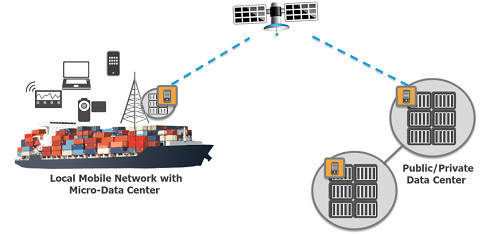
The basic deployment assumption is the existence of local mobile networks that are able to connect through satellite networks a set of wireless devices to a set of services which are deployed in public or private data centres using specific state of the art cloud technologies. In addition a local micro-data centre may be deployed together with the local mobile networks to support local connectivity as well as the aggregation and distribution of remote communication services according to the specific characteristics of the satellite network. The micro-data centres are represented by medium- to small- scale deployments of server clusters across a wide geographic area, for instance covering a remote rural area or a cargo ship.


Challenges

  • Forecast the evolution of existing services over the next ten years.
  • Identify and study future uses and services that could emerge in the service-verticals of content management, data distribution and of information collection and data dissemination in view of current trends, notably including the availability (always on, everywhere), the development of mobile terminal equipment and services, of ‘cloud computing’, the Internet of Things and Machine Type Communications, the delivery of new types of content such as HD / 3D videos, the data and traffic tsunami, as well as the rising societal and environmental concerns and the quest for the improvement of energy efficiency, and describe typical architectures including operational models.
  • Identify, analyse and characterise the state of the art in cloud-networking techniques and technologies for terrestrial networks (wired and wireless) in Europe, US and world-wide covering the solutions, their standardisation, validation (standard conformance and testbeds), deployments and alignment (consensus/ divergence) and propose classification schemes based on detailed performance, deployment, orchestration / re-configurability, management (control / monitoring), scalability / elasticity, security / privacy, service delivery modality / protocols and charging, pricing and regulations dimensions.
  • Assess the new constraints and requirements (including co-operation, economic, technical and trust / security / privacy) that will be imposed on the terrestrial telecommunications cloud -network and -service infrastructures in order to provide assured QoE / QoS in multi-domain provisioning environments.
  • Define integrated satcom – terrestrial cloud-networks service delivery architectures, validate and benchmark (via real testbeds and simulations) and suggest guidelines for evolutionary implementations answering questions such as:

–        What are the possible value-added scenarios for terrestrial and satellite cloud-networks integration in the content management or distribution and information collection and dissemination verticals?

–        What are the associated markets and business incentives for each?

–        What is the mix of services that would be offered over each and which is their expected introduction priority? What are the advantages and disadvantages of GEO and non GEO (LEO/MEO) network topologies in each case?

–         What are the service delivery architectures (covering all business, operational and technical dimensions) most relevant to these and what are the expected deployments in the short, mid and long-term?

–         What terrestrial cloud-networking technologies can be re-used and what are the necessary adaptations and enhancements for the satcom networks?

–        What are the measures and KPIs that enable the evaluation and benchmarking of the validation use cases and how do these map to the physical layer and network performance metrics?

–        What are the impacts on the CAPEX and OPEX for the satellite component per system use-case?

Make recommendations for future work based on the definition of a multi-layered roadmap of ranked actions (technology, standardisation, dissemination) and identify future experimentation/demonstrations over the air that could be implemented to further validate the concepts the air that could be implemented to further validate the concepts

Plan

The project started in October 2014, and is planned to run for 15 months.

It is basically structured in four main consecutive actions. The initial activity Task 1 focuses on the analysis of cloud networking techniques and technologies for terrestrial wired and wireless networks, which is followed by an activity (Task 2) concerned with the assessment of dimensions of suitability for integration with satellite networks and integration scenarios.

The first phase of the project that includes the above two activities will conclude by the “Cloud Networking and Techniques and Technology Review”.

The CNTTR is followed by Task 3, Integrated cloud networking architecture(s) definition and validation. This activity concludes with a checkpoint, the Integrated Architecture(s) Review, before the final activity called Future work recommendations, technology development roadmaps and standards evolution can kick-in. The study is expected to conclude with a FR after month 15.

The project has been extended, both timewise and scopewise to produce a white paper assessing satellite-terrestrial integration opportunities in the 5G environment.

Current Status

The project has completed successfully. INSTINCT demonstrated the feasibility of satellite networks integration with terrestrial clouds to dynamically and optimally offer services, and validated and benchmarked selected options in real testbeds and via simulations.

INSTINCT also produced a white paper assessing satellite-terrestrial integration opportunities in the 5G environment.