LATEST NEWS
June 25, 2026 • 12:06
June 18, 2026 • 10:38
May 26, 2026 • 09:45
May 20, 2026 • 15:04
EVENTS
January 25, 2022
10 Dec 2025

The European Space Agency’s (ESA) Council meeting at Ministerial level 2025 (CM25) concluded in Bremen, Germany, with Member States placing their continued trust in the Agency to lead their activities in space. In the face of a challenging geopolitical landscape, Member States placed emphasis on strengthening European capabilities to ensure our autonomy and leadership.
Member States voted on a proposal submitted by ESA Director General, Josef Aschbacher, to improve European autonomy, resilience, industrial competitiveness as well as research and development through new and continuing programmes. The proposal presented at CM25 is the first stage of ESA’s Strategy 2040, which outlines five goals that space can deliver in every aspect of citizen’s daily lives.
Read more about Strategy 2040.
Member States at the helm
With CM25, subscriptions to programmes under ESA’s Connectivity and Secure Communications reached €2.1 billion. ESA Connectivity and Secure Communications is responsible for coordinating, shaping, and supporting innovation in satellite communications, working closely with industry to bring the benefits of space technology into daily lives. The directorate is comprised of three major programmes, focused on developing competitive satellite systems and services to ensure real-world impact by securely connecting everyone and everything: the Advanced Research in Telecommunications Systems (ARTES 4.0) programme, the Moonlight programme and the ESA Programme Related to EU Secure Connectivity IRIS2.
ARTES 4.0 programme
ARTES 4.0 is Europe’s largest telecommunications and satellite communications programme, enabling companies to turn ideas and concepts into competitive products, systems and services. As the satellite communications market experiences a profound and rapid transformation, ARTES boosts European competitiveness and innovation to help strengthen our technological and manufacturing readiness levels. This programme advances European leadership in strategic areas that deliver significant economic returns and ensure that the next generation of communications technologies serve and reflect European values.
The outcome of CM25 validated the continuation of ARTES’s three Strategic Programme Lines (Optical and Quantum – ScyLight, Space Systems for Safety and Security (4S), Space for 5G and 6G) and its two General Programme Lines (Future Preparation and Industrial Competitiveness), totalling to a combined €1.5 billion.
This subscription re-affirms ESA’s commitment to bolster European and Canadian leadership in multi-orbital satellite communications, across LEO and GEO markets. In the next three years, the ARTES 4.0 programme will evolve, simplifying its processes to reduce time-to-market and provide industrialisation support to help scale eligible production to capture that market. Furthermore, it will harmonise co-funding schemes across ESA’s research and development programmes, federating technology developments for system, space, ground and user segments. New key partnerships and project developments will also be folded into existing programme lines. This will include direct-to-device (D2D), and projects to advance and validate cutting-edge optical and quantum communication systems to enable high-capacity, secure data transmission and quantum key distribution (QKD).
Read more about ARTES 4.0.
Moonlight Programme
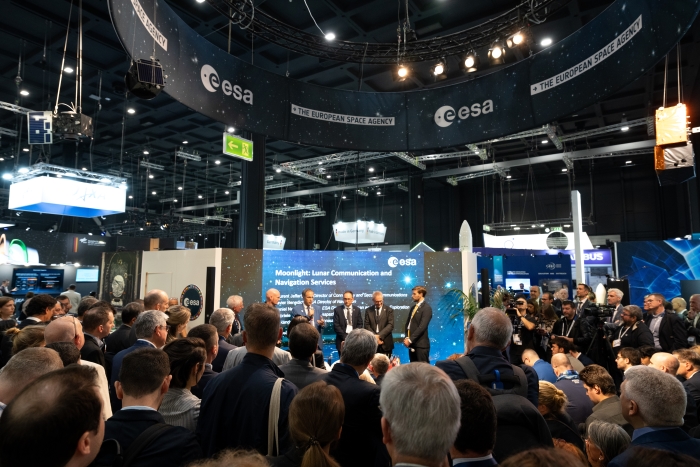
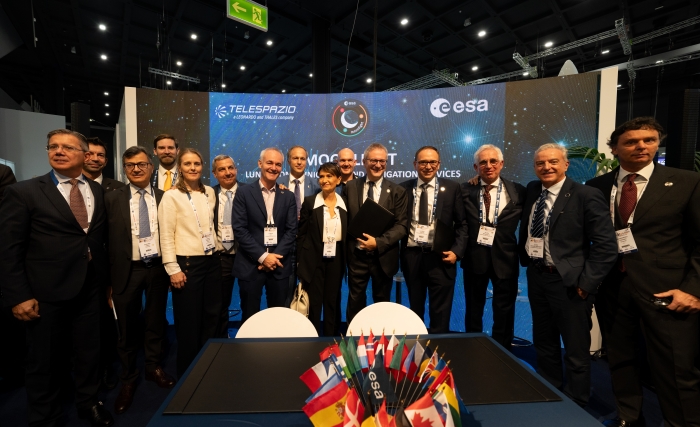
The Moonlight programme aims to give Europe a first-mover advantage in off-planet satellite telecommunications and navigation. By establishing common infrastructure and services, Moonlight will reduce the complexity and mass of future missions for the Moon, creating a cost-effective, sustainable model of space exploration. With hundreds of missions and payloads planned for the moon in the next decade, Europe is in a position to capture this promising new market and ensure strategic autonomy for independent exploration endeavours.
Subscriptions to the Moonlight programme reached €176 million at CM25. The programme will move forward with our endeavour to secure European leadership in the lunar economy.
Moonlight is central to ongoing international cooperation and the development of global standards. Our Member States will benefit from the programme’s economic and industrial impacts – such as an upskilled workforce and revenue generation.
Read more about Moonlight.
ESA Programme Related to EU Secure Connectivity – IRIS2
IRIS2 is the third ESA flagship programme implemented in partnership with the European Commission, designed to develop a multi-orbit secure telecommunications programme critical to sovereign government telecommunications. The current geopolitical context has highlighted the importance of resilient and independent connectivity supported by a competitive, flexible and innovative industrial base to safeguard Europe’s strategic autonomy.
The programme subscriptions for IRIS2 at CM25 amount to €383 million. The next steps for IRIS2 will reinforce secure connectivity, strengthen Europe’s technological supply chain, and enable rapid development of new services and systems. This vision for European resilience, will see IRIS2 evolve into a multi-domain system-of-systems and become the secure telecommunications backbone of ESA’s European Resilience from Space (ERS). It will build upon ESA, European and national satcom initiatives while serving Earth observation and navigation missions for rapid, real-time critical operations.
Read more about IRIS2.

A renewed focus on competitivity, technological independence and leadership
“During CM25, key decisions were made that will shape ESA’s activities in response to Europe’s ever-growing need for reliable, resilient, and secure connectivity,” said Laurent Jaffart, Director of Connectivity and Secure Communications. “Our vision is to connect everyone, everything, everywhere and at all times. With a subscription of over €2 billion, I look forward to continuing to work with our Member States, European Commission and partners – as together – we realise our leadership in the satellite communications domain.”
The Council 2025 at Ministerial level validated Connectivity and Secure Communications’ mandate to develop advanced communications technologies and systems, hand-in-hand with industry. The standout success of ARTES 4.0, together with Moonlight and IRIS2, will continue to foster a European industrial ecosystem capable of sustaining flexible manufacturing and innovative technologies responding to pivotal defence, governmental and commercial needs.