ESA chooses Kepler to build satellite for in-orbit interoperability demonstration of three ‘made-in-Europe’ optical communications terminals and space situational awareness camera

Publication date

15 Apr 2026

The European Space Agency (ESA) has selected the Canada-based Kepler Communications Inc. as prime contractor to build its demonstration satellite for multi-orbit, secure, real-time optical communications under the Agency’s High-thRoughput Optical Network (HydRON) project.

The HydRON Element 3 signature took place at the 41st Space Symposium in Colorado Springs. From right to left: ESA Director General, Josef Aschbacher; ESA Director of Resilience, Navigation and Connectivity, Laurent Jaffart; President of the Canadian Space Agency, Lisa Campbell; Kepler Communications’ CEO and Co-Founder Mina Mitry; Director General of the German Space Agency, DLR, Walther Pelzer; and Head of the Optical and Quantum Communication Office, Harald Hauschildt. Image credit: Kepler Communications

The contract agreement was signed by Laurent Jaffart, Director of Resilience, Navigation and Connectivity at ESA, and by Mina Mitry, Co-founder and CEO of Kepler, on 14 April 2026 at the 41st Space Symposium in Colorado Springs. The signature was witnessed by ESA Director General, Josef Aschbacher, and Canadian Space Agency President, Lisa Campbell, the German Aerospace Center (DLR), and executive representatives from Astrolight, TESAT, Vyoma and MBRYONICS, who form Kepler’s industrial consortium.

This agreement will see Kepler provide one of its standard satellite platforms – already deployed within the company’s own network – as well as launch preparations and in-orbit operations for the mission. Kepler’s platform will host a space situational awareness payload and optical communication terminal hardware, provided by additional partners from ESA Member States: Vyoma and TESAT from Germany, MBRYONICS from Ireland and Astrolight from Lithuania, illustrating the advanced capabilities of the European ecosystem.

Under ESA’s Optical & Quantum Communications – ScyLight programme, HydRON responds to the long-term need of ESA Member States to develop, implement and operate a secure space communications infrastructure capable of handling the growing demand for fast and secure transmission of space data. Optical links meet these requirements by functioning through direct line-of-sight between two terminals. This characteristic enables gigabit-speed data transfers that are inherently more difficult to intercept and disrupt than traditional satellite communications using radio frequency.

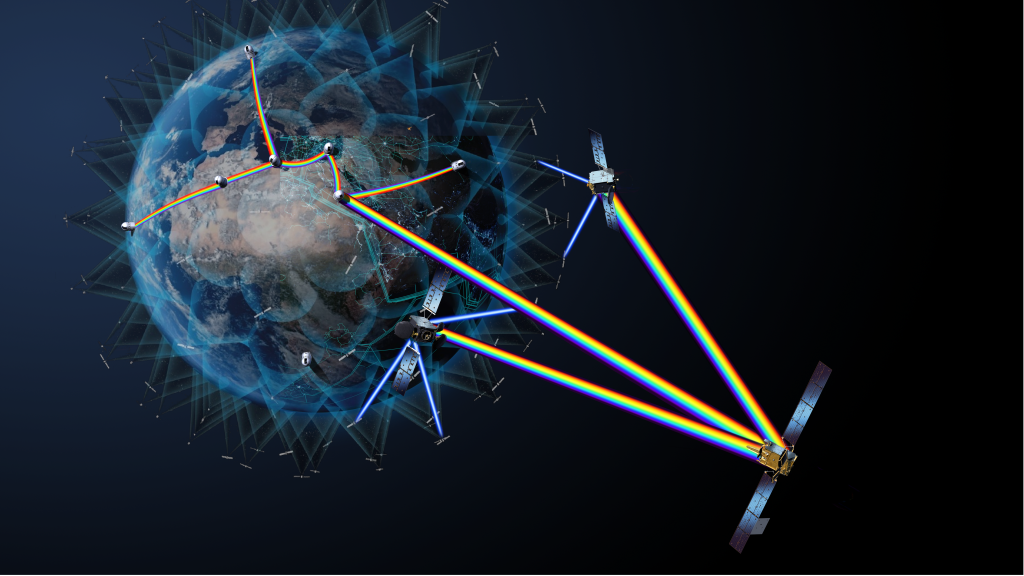
The HydRON project is being implemented as a Demonstration System comprising three elements: Element 1 consists of a low Earth orbit constellation of ten satellites, which can link optically with one another and to several optical ground stations; Element 2 extends the network across multiple orbits, including geostationary orbit; and Element 3 focuses on validating data-transmission uses cases with commercial users through the HydRON network.

ESA Director of Resilience, Navigation and Connectivity, Laurent Jaffart (right), signed the contract to kick-start HydRON’s Element 3 with Kepler Communications’ Co-Founder and CEO Mina Mitry (left). Image credit: Kepler Communications

Within the framework of Element 3, Kepler’s mission will aim to demonstrate interoperability between various commercial optical terminal systems and across multiple orbits. These capabilities are crucial to boosting the resilience of European communications infrastructure with a high-capacity optical data relay network across low and medium Earth orbits.

Alongside other projects in the ScyLight strategic programme line of ESA’s Advanced Research in Telecommunications Systems (ARTES), HydRON contributes to anticipating and implementing the future communication needs of ESA Member States.

“HydRON will serve as the world’s first multi-orbital optical communications network with a terabit-per-second capacity, offering resilient and efficient data transfer to address the challenges of bringing connectivity to multiple users securely, quickly and reliably,” said Laurent Jaffart, Director of Resilience, Navigation and Connectivity. “Today’s signature with Kepler Communications continues our collaboration on the project, as they contribute their expertise in concert with their consortium to deliver within Element 3; the component of HydRON that’s key to building new industrial capabilities, demonstrating new service concepts, fostering system extensions, and promoting international cooperation and interoperability.”

“HydRON is a key initiative in advancing sovereign optical communications and enabling high-capacity data transport,” said Mina Mitry, CEO and Co-Founder of Kepler. “Element 3 represents a critical step in broad interoperability testing and delivering real-time access to data for various applications.”

“With HydRON Element 3 and further HydRON evolutions, ESA will respond to the needs of its Member States for high speed and secure communications across air, High-Altitude Pseudo-Satellites (HAPS), maritime and – in the longer term – deep space communications,” said Harald Hauschildt, Head of the Optical and Quantum Communication Office in charge of ESA’s Optical and Quantum Communications – ScyLight programme line.

This contract builds on Kepler’s previous contribution to HydRON Element 1 and comes on the heels of earlier announcement within the framework of Element 3, highlighting the strategic importance of HydRON for ESA and its Member States. This mission will help build on-orbit heritage and operational experience for several payload providers – accelerating the integration of optical communication technologies into future HydRON capabilities.

Next-generation optical ground station for fast and secure connectivity ready to begin operations in Chile, with ESA support

Publication date

10 Mar 2026

A new optical ground station established by SSC Space under the NODES contract with the European Space Agency (ESA), and with support from the Swedish National Space Agency has passed site acceptance testing and is ready for operations in Santiago, Chile. The new optical ground station further aligns with ESA’s goal to develop fast and secure satellite communications.

Top view of the SSC Space Optical ground station in Santiago, Chile. Imaged credit: SSC Space

This achievement is the result of close collaboration between Sweden’s SSC Space, France’s Safran Space and ESA under the Agency’s Optical and Quantum Communications – ScyLight programme. Manufactured by Safran Space, this new optical ground station will be part of SSC Space’s optical ground network service, offering free-space laser communications with bi-directional capabilities that will enable two-way links between satellites and the ground for a variety of in-orbit missions. The optical ground station will also support Consultative Committee for Space Data Systems (CCSDS) and Space Domain Awareness (SDA) standards through integrated modems for additional compatibility.

The optical link capabilities of this new station are faster and more secure than traditional radio frequency (RF) satellite communication systems. Instead of being broadcast, satellite data can be transmitted through a laser beam at exponentially faster speeds with nearly no loss in quality; SSC Space’s ground station is capable of data rates of up to 10 gigabit per second – or a tenfold increase over the average speed for RF transmissions. This is particularly important for time-sensitive applications, such as disaster response, which require complete and actionable data sets quickly after they area collected in orbit.

Because the transmission of data through narrow, direct optical links is inherently more difficult to intercept and interfere with than traditional RF links. In addition, by bypassing the RF spectrum entirely, this optical communications system does not require licensing, allowing operators to avoid lengthy regulatory bottlenecks.

SSC Space Optical ground station in Santiago, Chile. Image credit: SSC Space

SSC Space’s optical ground station is housed in a 100-hectare site protected by the Andes foothills. It runs on locally generated solar power provided by a 624-panel solar array capable of 350-kilowatt hour, reducing its carbon emissions by eight percent. The station joins another installation that started testing in 2025 in Western Australia, inaugurating a network of optical ground stations supporting direct-to-Earth laser links. The development of SSC Space’s network is underpinned by ESA’s Optical and Quantum Communications – ScyLight programme, which focuses on the development of optical ground station networks to complement traditional RF capabilities.

SSC Space Optical ground station in Santiago, Chile. Image credit: SSC Space

“At ESA, we’re working with our partners to showcase the ‘Made in Europe’ innovations that will provide connectivity to our Member States that’s faster, more secure and more resilient than ever before,” said Laurent Jaffart, Director of ESA Resilience, Navigation and Connectivity. “Our Optical and Quantum Communications – ScyLight programme is an essential tool to keeping our partners at the leading edge of the global satellite communications market, and this partnership with SSC Space shows just how we’re delivering connectivity solutions beyond Europe and Canada.”

“The station in Santiago is not just another node – it’s a leap forward. We’re moving satellite communications into a new era of speed, security, and resilience. As part of the NODES network, this station brings us closer to fulfilling tomorrow’s mission needs, with interference-resistant transmission capable of meeting heavy data demand,” says Hanna Sundberg, Optical Programme Manager at SSC Space.

ESA’s flagship optical communications project awards Mynaric with contract to develop technology for its Demonstration System

Publication date

04 Mar 2026

The European Space Agency (ESA) has awarded German optical communications company Mynaric with a contract to build a laser communications Demonstration System for its High Throughput Optical Network (HydRON) project. Mynaric will help to develop the technology necessary for in-orbit demonstrations of a European secure laser communications network, a crucial step to enabling further research into high-speed optical links such as the ESA Specifications for Terabit/sec Optical Links (ESTOL).

HydRON optical communication for broadband in space. Image credit: European Space Agency

The HydRON project aims to bolster the resilience of European communications infrastructure by deploying a high capacity, secure and interoperable optical data relay network across low and medium Earth orbits. This focus on optical communications falls under the umbrella of the larger Optical & Quantum Communications – ScyLight programme line of ESA’s Advanced Research in Telecommunications Systems (ARTES), alongside projects to develop, demonstrate and implement quantum technologies for satellite communications.

HydRON addresses the long-term need expressed by ESA’s Member States to develop, implement and operate a secure space communications infrastructure capable of meeting the growing demand for larger volumes of space data at speeds edging ever closer to real time. Optical links have the potential to meet all these requirements: by virtue of functioning through direct line of sight, laser communications not only enable consistent gigabit speed data transfers – orders of magnitude faster than traditional RF communications – but are also inherently more difficult to intercept or interfere with.

HydRON’s Element 3 focuses on demonstrating the applications of this technology within the user segment by creating a testing environment in real operating conditions. Within this framework, Mynaric will contribute laser communications terminals to the Element 3 Demonstration System. These terminals will enable in-orbit testing and validation of service concepts and mission architectures for future commercial and institutional use cases aboard maritime and airborne platforms.

What’s more, the Demonstration System will build on the work carried out under HydRON Element 2 to demonstrate interoperability across multiple orbital regimes and potential international partner networks. Indeed, Mynaric was previously awarded a contract to provide laser communications terminals for both ground and space segments of the network comprising Element 2. This element will aim to establish a satellite collector in low Earth orbit, using optical technology to connect space communications networks spread across several layers of orbits.

The Demonstration System is a stepping stone towards the development of technologies crucial to ESA’s roadmap for an interoperable, high-speed space communications infrastructure. In particular, ESTOL will leverage the in-orbit demonstration capabilities of HydRON Element 3 to test high-data-rate optical links – towards a capacity of terabit per second – to support the implementation and deployment of future optical satellite networks.

“With HydRON, we’re aiming for a world-first optical network that allows for fast, terabit-per-second capacity communications with no interference. The project will offer a scalable capacity that will allow for reliable and seamless global connectivity, designed to benefit even the most remote of locations,” said Laurent Jaffart, Director of Resilience, Navigation and Connectivity at ESA. “In the current geopolitical climate, resilient communications are more important than ever, and with Mynaric, we’re taking the next step in delivering an infrastructure that promotes interoperability, reliability and security for a wide range of satellite communication services.”  

“The HydRON Demonstration System provides a unique opportunity to test and refine laser communications technologies in an operational network environment,” said Joachim Horwath, Chief Technology Officer at Mynaric. “Through these demonstrations, we can further mature our technology, address interoperability requirements, and continue expanding our product portfolio to meet the evolving needs of multi-orbit and multi-mission space networks.”

“The selection of Mynaric for the HydRON User Segment activities reflects ESA’s confidence in our technological expertise and our ability to execute on complex optical communications programs,” said Andreas Reif, Chief Restructuring Officer of Mynaric. “It represents an important milestone as we continue to strengthen the company, expand our role within Europe’s space infrastructure, and position Mynaric for sustainable growth as a key contributor to future European and global space and defense networks.”

Mynaric’s work on the HydRON Element 3 Demonstration System will contribute to setting the stage for a resilient and interoperable European space communications infrastructure capable of supporting a wide breadth of commercial and institutional mission concepts.

While the implementation of the HydRON Demonstration System proceeds apace, ESA is also preparing the next evolutionary phase of HydRON within the Optical & Quantum Communications – ScyLight programme line. Leveraging the inherent resilience of optical communications, including their low probability of detection and interception (LPD/LPI) characteristics, ESA is exploring the technical opportunities they offer for airborne platforms (HAPS and aircraft), maritime users, as well as deep‑space communications.

ESA, Airbus, TESAT and TNO set new record for fast and secure optical communications from geostationary orbit

Publication date

26 Feb 2026

The European Space Agency (ESA), alongside Europe’s Airbus Defence and Space, the Netherlands Organisation for Applied Scientific Research (TNO), and TESAT, have successful demonstrated laser communications between an aircraft and a geostationary satellite over 36,000 kilometres away.

Test aircraft fitted with UltraAir terminal on the runway. Image credit: Airbus Defence and Space

The development is supported by ESA’s Optical and Quantum Communications – ScyLight programme, within the Advanced Research in Telecommunications Systems (ARTES) programme. ScyLight addresses the development, demonstration and utilisation of innovative optical and quantum technologies for satellite communications through system studies and market analyses in partnership with Industry. Fulfilling this mandate, UltraAir’s technology paves the way for secure, gigabit per second–speed communications with low probability of interference or interception.

In a series of flight tests from the Nîmes Airport in France, the jet aircraft equipped with Airbus’ UltraAir laser communication terminal established and maintained a secure laser link with its counterpart in geostationary orbit. On the aircraft, the UltraAir terminal’s mechanical and optical control technology – needed to achieve a stable laser link – was developed by TNO, while its free-space optical link was provided by Airbus subsidiary, TESAT.

Together, these advancements allowed UltraAir to connect with a TDP–1, a testbed for the implementation of optical data links equipped onboard the Alphasat satellite. The TDP-1 Laser Communication Terminal is owned by the German Aerospace Center (DLR) and is operated by TESAT, in collaboration with ESA.

The Alphasat telecom satellite. Image credit: European Space Agency. Image credit: ESA-S. Corvaja

Optical data links have the potential to enable satellites to rapidly and securely transmit complete data sets in a single burst, a significant improvement over legacy Radio frequency (RF) systems. The UltraAir demonstration flights tested acquisition and tracking abilities for optical links from a moving platform – rather than a static ground station – and established a seamless performance: a bit error free, coherent data rate of 2.6 gigabit per second that remained uninterrupted for several minutes.

This advancement has both civilian and defence applications, providing a secure alternative to RF satellite communications. RF has historically been the backbone of satellite communications, but it can be intercepted, jammed and disrupted by user proliferation and adverse weather – decreasing the integrity and security of data transmissions. In defence, laser communications could help overcome the challenge posed by clouds in multidomain operations and make it harder to intercept communications. In civilian applications, it could enable high–speed data connections with mobile platforms such as passenger airliners, cars and ships to keep passengers connected.

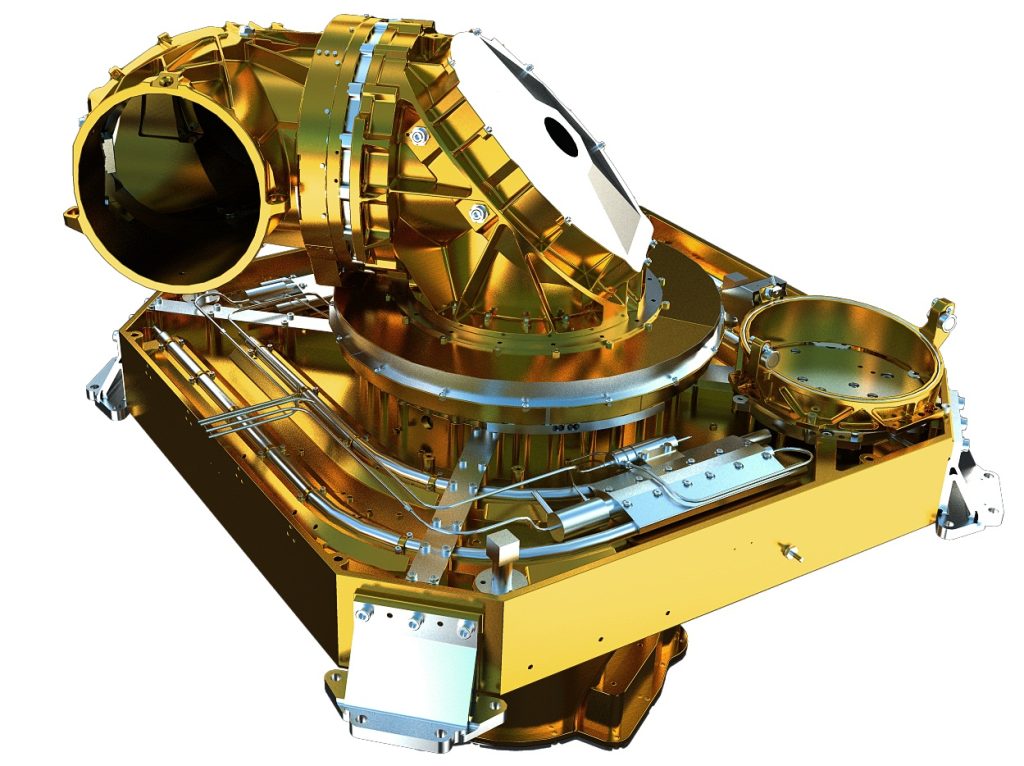
Alphasat TDP-1 Optical Communication Terminal
Alphasat TDP1 Optical Communication Terminal. Image credit: TESAT, DLR

“This achievement demonstrates how optical communications can transform secure connectivity for our Member States. Particularly by working to resolve the technical challenges that come with establishing fast laser communications, capable of evading interference and detection in demanding conditions,” said Laurent Jaffart, Director of Resilience, Navigation and Connectivity at ESA. “Collaboration drives innovation, and this milestone will strategically deliver benefits to future missions, where speed and security of data transmission is paramount. For Europe and beyond.”

“Establishing laser links between moving targets at this distance is technically very challenging. Continuous movements, platform vibrations and atmospheric disturbances require extreme precision,” said François Lombard, Head of Connected Intelligence at Airbus Defence and Space. “This milestone is a further development of our long successful laser communication history; it opens the door to a new era of laser satellite communications to meet defence and commercial needs in the next decades.”

“This breakthrough proves that our industry strengthens Europe’s security and its autonomy by leading strategic technology in the field of secure laser communications,” said Kees Buijsrogge, Director of Space at TNO.

“Optical communications between airborne users and satellite networks, like ESA’s High-thRoughput Optical Network (HydRON), are high on ESA’s agenda,” said Harald Hauschildt, Head of ESA’s Optical and Quantum Communication Office. “High-data rate, low-latency links that connect High-Altitude Pseudo Satellites (HAPS) and aircraft are equally demanded for commercial and resilience driven applications.”

The project was co-funded by Airbus and TNO, with support from the Netherlands Space Office (NSO) and the German Aerospace Center (DLR) as part of ESA’s Optical and Quantum Communications – ScyLight programme.

ESA and Japan’s Space Compass Corporation partner to pioneer next-generation optical communication network

Publication date

25 Mar 2025

Concept image of connectivity across the globe. Image credit: Shutterstock

ESA, in partnership with Japanese company, Space Compass Corporation, has signed a Memorandum of Intent (MoI) to jointly conduct the feasibility study for Japan’s LAIDEN project and ESA’s High-thRoughput Optical Network (HydRON) demonstration system.

ESA’s innovative HydRON project sits under the Advanced Research in Telecommunications Systems (ARTES) Strategic Programme Line Optical and Quantum Communications – ScyLight Strategic Programme Line, and aims to deliver terabit-per-second capacity by integrating space-based optical communications with terrestrial networks.

Led by Space Compass, the LAIDEN project is a national project overseen by Japan’s New Energy and Industrial Technology Development Organization (NEDO). LAIDEN will work to develop and demonstrate an Inter-satellite low Earth orbit (LEO) Optical Communication Network System. As part of the project, Space Compass has established a project formation with the National Institute of Information and Communications Technology (NICT), AXELSPACE Corporation and NEC Corporation.

Bringing together two pioneering optical communication initiatives in ESA’s HydRON and Japan’s LAIDEN project, it demonstrates the growing importance and strategic nature of optical technologies, with international cooperation, such as this one, crucial to ensure the role of ESA Member States in the developing market.

Space Compass plans to launch the first commercial geostationary orbit (GEO) satellite and offer optical data relay services with GEO as a part of its in-orbit demonstration. The MoI will focus on creating seamless interoperability between multiple orbital layers, including GEO, Medium Earth Orbit (MEO), and LEO satellites, as well as ground stations. This multi-layer approach promises to enhance global connectivity and create more resilient communication networks for both space and terrestrial applications.

The partnership will advance through three crucial phases: beginning with a technical feasibility assessment for interoperability testing, followed by the development of comprehensive joint test protocols, and culminating in the execution of integrated system validation.

“This partnership exemplifies ESA’s commitment to fostering international collaboration in developing and demonstrating optical communications,” said Laurent Jaffart, ESA Director of Connectivity and Secure Communications. “The showcases how ESA Member States are driving, developing and demonstrating world-class and recognised optical communications technologies to the benefit of our industry and international partners.”

“This MoI with ESA represents a crucial step towards realising a truly global optical communication network,” said Koichiro Matsufuji, Co-CEO at Space Compass. “By integrating Japan’s LAIDEN project with ESA’s HydRON system, we are advancing the technical feasibility of high-speed, high-capacity data relay between multiple orbital layers. This partnership also aligns with our vision of a ‘Space Integrated Computing Network,’ where innovative communication and computing technologies converge to create a more connected and efficient space infrastructure.”

ESA and Austria host world-leading quantum minds to drive space-based quantum information networks

Publication date

24 Mar 2025

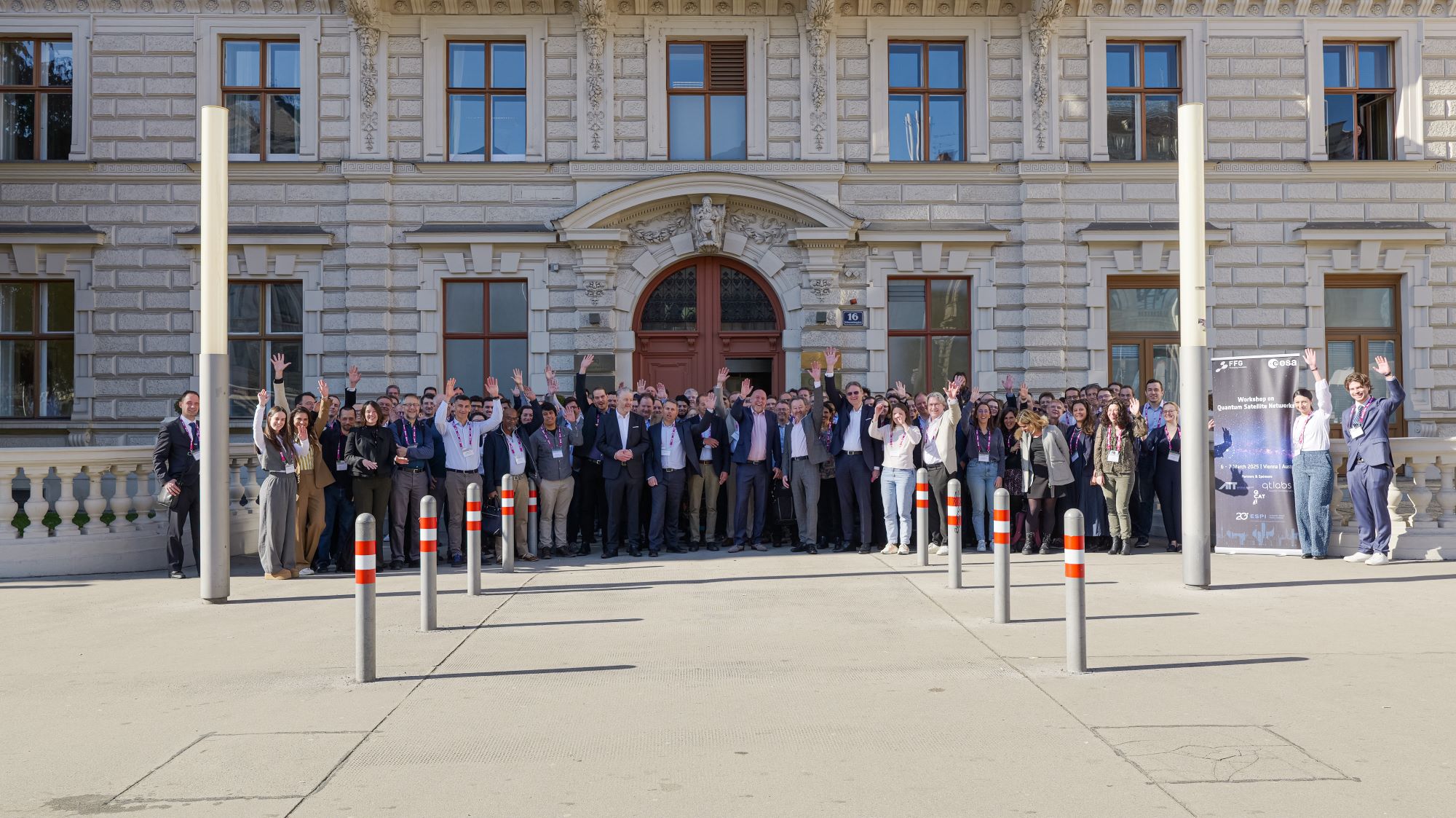
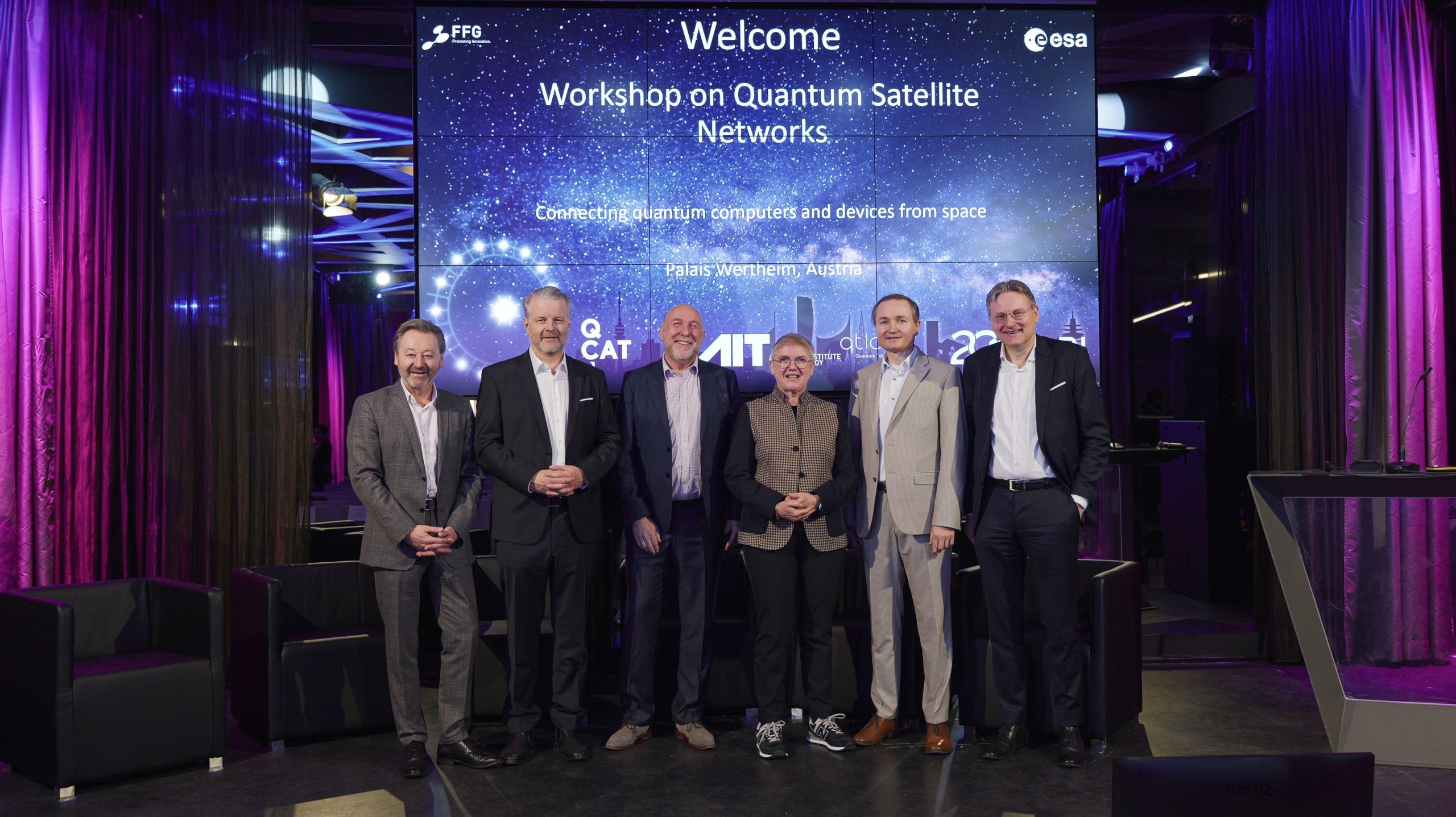
The European Space Agency (ESA) and the Austrian Research Promotion Agency (FFG) jointly hosted a workshop to address the challenges and opportunities in the interconnection of quantum networks, for example, through future scalable quantum computers and devices over large distances. The event on Quantum Satellite Networks, took place in Vienna, Austria, over two days and showcased how the country and ESA are driving ESA Member State quantum capabilities.

The key focus of the workshop included the discussion of future quantum information network architectures and technologies, the role of space and satellites in such architectures, and how to leverage long distance connectivity between quantum devices and processing units. A day prior to the workshop, the Austrian Research Promotion Agency co-organised a Quantum Austria networking event that brought together multi-disciplinary professionals, from technical engineers to policymakers, fostering new partnerships and identifying promising approaches for advancing the Austrian Research Promotion Agency’s vision of satellite quantum information networks.

Austria’s growing influence in the quantum technology sector was highlighted through several domestic organisations presenting innovative solutions for space-based quantum networks. The workshop enabled ideas to be shared from across the quantum ecosystem, with keynotes from Erste Bank, Centre National de la Recherche Scientifique (CNRS) at Sorbonne University, European Space Policy Institute (ESPI), Simon Fraser University, Xanadu, and Alpine Quantum Technologies (AQT).

The event provided the widespread context of space technology and developments for an audience from a variety of business, academic and institutional backgrounds, with some partially new to the sector. Through this, the workshop aimed to evaluate the role of space technologies for quantum network architectures with ESA’s Strategic Programme line Optical and Quantum Communications – ScyLight. One of the objectives of the workshop was to lower barriers and build mutual understanding between these communities. The space context was provided together with the European Commission and industry partners, who jointly develop such technologies through the Security And cryptoGrAphic mission (SAGA) and the European Quantum Communication Infrastructure (EuroQCI) projects.

The workshop also worked to address the challenges faced in the advanced development in multiple critical domains, with pioneering use cases of satellite-enabled quantum networks and the solutions and interfaces that will enable long-distance quantum computing, being shared. Concluding with clear directives for advancing quantum network technologies, the workshop has established a roadmap for future developments in space-based quantum communications.

“This workshop has demonstrated how ESA, our Member States and the Austrian Research Promotion Agency are collectively taking the lead in space-enabled quantum communications. By bringing together key stakeholders in the field to Austria, we also recognise the instrumental role the country has in spearheading this area of the space sector,” said Laurent Jaffart, ESA Director of Connectivity and Secure Communications. “The cross-pollination of ideas between quantum computing and satellite communications represent the growing pace at which our technologies and expertise are accelerating, presenting the opportunity to make a global impact.”

“Austria has established itself as a global leader in quantum research and is now leveraging this expertise to expand its influence in the quantum technology sector. The Austrian Research Promotion Agency plays a pivotal role by fostering a robust ecosystem for quantum innovation and supporting ventures that transform advanced quantum research into practical applications, such as satellite communication,” said Karin Tausz, Managing Director of the Austrian Research Promotion Agency (FFG).

Scientific Director Andreas Kugi from AIT: “We are proud that AIT’s Quantum Communication group has established itself as a strong partner for the European Satellite Technology Industry, particularly through its involvement in the EuroQCI missions EAGLE-1 and SAGA. We are also delighted that our team contributed to organising this fantastic event in Vienna.

ESPI Director, H. Ludwig Moeller said: “Quantum and optical communications are a key innovation, enabling future secure communications, a critical component of European sovereignty, needed more than ever. It is therefore critical for Europe to accelerate the required technology development, including scaling-up as anchor customer of resulting systems and services. Speed and scale matter!”

Rupert Ursin, founder and CEO of qtlabs – a pioneer in long-distance and satellite quantum communication – emphasises the significance of Austria’s position in this cutting-edge field said: “The quality of the programme and the strong participation in this workshop clearly demonstrate Austria’s importance in the development of satellite quantum networks. I am proud that qtlabs is at the forefront of this field, successfully transforming scientific excellence into stable jobs and revenue within an emerging industry here in Austria.”

With its leadership in quantum innovation, qtlabs continues to drive advancements that bridge fundamental research with real-world applications, strengthening Austria’s role in the global quantum technology landscape.

Event partners included the AIT Austrian Institute of Technology, Austria’s largest Research and Technology Organisation, which specialises in quantum cryptography, among other fields; Quantum Technology Laboratories (qtlabs), a European leader in satellite-based quantum communication; and the European Space Policy Institute (ESPI), an independent policy think tank for promoting European space policy on an international and global level.