

PAGE CONTENTS
Objectives
The objectives of this study are:
- On one hand, to take benefit on the telecommunications satellites from the availability of recently developed sensors and actuators to determine at system level how the AOCS could handle new functions or decrease its cost.
- On the other hand, to analyse the new requirements of the operators induced by the increased number of collocated spacecraft or the recent issue of the French law about space activity.
Challenges
With this study, Thales Alenia Space has continued to improve the common Spacebus/Alphabus AOCS with very challenging cost competitiveness objectives while improving the functionality offered to the operators.
The decrease of the AOCS cost has been made possible thanks to the introduction of low cost sensors like the Sun sensor on a chip or the micro-gyro. For this new low cost coarse gyro, the challenge has been to adapt of the existing AOCS to the loss of performance of this sensor.
The compliance of the common Spacebus/Alphabus AOCS to the new requirements of the operators have been also challenging.
It has required the design of a Gyro-less AOCS which permit without any over cost to operate and deorbited a spacecraft even with two gyros failed.
The optimisation of the electrical propulsion with a new three axis deployable and pointing mechanism has also been required to offer larger platforms while improving the competitiveness of the common Spacebus/Alphabus avionics.
Plan
This study started from the existing SPACEBUS/ALPHABUS common AOCS in 2012, and end up with the development, software prototyping and validation tests of the selected new functions in 2014.
Current Status
All activities are now fully completed.
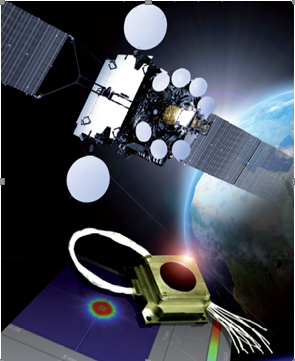
The Sun sensor on a chip (SSoC) which could ease the sun sensor accommodation and improve the sun detection, has been accommodated on a Spacebus 4000 and several benefits have been analysed.
The Spacebus 4000 AOCS has been modified to be compliant to The Micro-electromechanical systems (MEMS) Gyro-meters recently developed that could decrease the cost of the Attitude and orbit control sub-system. Software modifications have been validated with a prototype on board software on a Hi-Fi simulator.
The development of a Gyro-less AOCS, to offer the capability of the common Spacebus/Alphabus avionics to operate and re-orbit the S/C in case of failure of both gyros, has been validated with a prototype on board software on a Hi-Fi simulator
The optimization of the electrical propulsion with a three axis deployable and pointing mechanism to reduce the chemical pulse number in order to offer larger platforms with the electrical propulsion has been performed. A combined Station keeping and angular momentum control strategy has been design and the three axis arm control law has been validated on a Hi-Fi simulator.