


PAGE CONTENTS
Objectives
The primary goal of the programme has been to design, develop and qualify differentiating technologies, equipments and payload architectures which enabled a new generation of high capacity flexible payload. Differentiation would be provided in two forms which are inherent in the title of the programme;
- Genericity is an industrial benefit gained through standardising the design and construction of both the payload and the equipments leading to faster delivery schedules and (if the flexibility level is correct) lower costs.
- Flexibility is an operational benefit designed to increase the value proposition of the payload (or equipments) to the operator whereby higher through life revenue can be generated by the spacecraft due to its ability to be re-configured in orbit as operational demands require.
Benefits
The main benefits for programme are summarised below:
- Phase 1.2a
o The design development, and qualification of a highly advanced and flexible payload input section placing ASTRIUM in a leading market position for this emerging customer requirement. Much of this technology is now being proposed for emerging flexible processed multi-beam payloads.
o The development and qualification of advanced equipment level components and technologies which when implemented in conventional products (beacons, LNAs, receivers) provide a state of the art differentiating capability.
- Phase 1.2b
o This provided Astrium with an analytical parametric model for understanding the impact of flexible payload technology on key payload parameters (cost, mass, DC power) thereby allowing Astrium the ability to successfully discuss this trade-off with key stakeholders and effectively target the product developments for the phase 1.2c programme.
- Phase 1.2c
o This developed a set of input section equipments taking benefit from the advanced technologies developed under phase 1.2a. These equipments are now being used in many standard payloads on both Astrium and external platforms.
Features
Astrium has chosen to base its Generic Flexible Payload on a distributed analogue processor architecture. This has the benefits that;
It offers similar transponder characteristics to conventional payloads
It has the same “look and feel” as a conventional payload leading operators to feel more secure in its day to day operation.
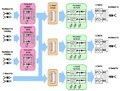
The equipments developed to support the payload architecture are:
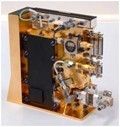
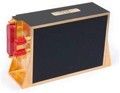
- Agile Integrated Downconverter Assembly (AIDA); this converts a block of 1GHz of uplink spectrum down to a common C band intermediate frequency where beam to beam connectivity is performed. The ADIA equipment is shown below.
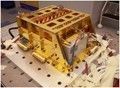
- Routing and Switching Equipment (RASE); the equipment has up to 16 beam inputs. Each of these 16 beam inputs is split 16 ways and connects to a 16:1 switch matrix. This allows each uplink beam to be split 16 ways and then switched to any of up to 16 downlink beams. The RASE can also operate in a broadcast mode allowing a single uplink beam to be connected to all 16 downlink beams. The RASE equipment is shown below
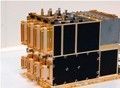
- Single Channel Agile Converter Equipment (SCACE); this equipment provides the channel translation frequency and the variable bandwidth IMUX function, along with the channel amplifier function. The equipment uses a novel patented technique to position a fully variable bandwidth channel filter anywhere in the up or downlink frequency bands. The SCACE can produce IMUX channels having a bandwidth in the ranges 18 to 120MHz and 54 to 250MHz. The channel amplifier included within the SCACE provides all the features of a conventional payload channel amplifier, including FGM, ALC and variable threshold setting modes. The channel amplifier has been designed to drive standard linearised Traveling Wave Tube Amplifiers. The SCACE equipment is shown below
- Master Reference Oscillator (MRO); this equipment provides the common reference source for the local oscillators in the SCACE and AIDA. The resonator within the equipment is based on Astrium’s in house grown radiation hard quartz. The MRO equipment is shown below
Challenges
To support the demanding specification of those novel equipments, a number of new parts, technologies and processes had to be introduced. This involved the development of new MMIC, high density microwave ceramic packages, new mounting techniques. This led to a large volume of parts, materials and processes qualifications.
Plan
The programme was implemented in three phases.
- Phase 1.2a – Development, build and qualification of an Agile Integrated Downconverter Assembly (AIDA), a Routing and Switching Equipment (RASE), a Single Channel Agile Converter Equipment (SCACE) and a Master Reference Oscillator (MRO) to support the newly developed concept of Generic Flexible Payload. All those equipments were qualified to EQM level.
- Phase 1.2b – Study programme to evaluate the achievements of phase 1.2a and make recommendations as to the enhancement of these developments in the following phase 1.2c programme.
- Phase 1.2c – Development, build and qualification of a FSS fixed receiver and a FSS Agile Converter. Those equipments were qualified to EQM level. This phase also included the development of a 24/17GHz downconverter hybrid to Engineering Model level.
Current Status
The Generic Flexible Payload programme is now complete. All equipments designed, developed and build under the programme have completed qualification, with a first application successfully achieved on flight programmes.
The next steps for Astrium’s payload and equipment team in the area of flexible payloads include;
- Further development of flexible output section technologies including flexible MPM, phase combined tubes, multi-port amplifiers, frequency tuneable OMUX and flexible antennas
- Further development and support to the equipment team to optimise the flexible input section equipment’s including extension of the AGILE converter capability to include non-integer N frequency generation, and the development of a second generation SCACE V2. Considerable work will be completed to understand the design drivers for these equipment’s in both channelized and multi-beam applications.
- Managing the ramp-up of the standard equipment product line based upon the new generation receiver, beacons and agile converters.
- Consideration of the road map and development steps for processed payloads with a particular view on how toimplement a truly generic and flexible pre and post processor taking benefit from the achievements of the GFP programme.
Companies

Airbus Defence and Space
United Kingdom