
-
StatusOngoing
-
Status date2025-11-26
-
Activity Code7B.072
The development of the activities will culminate in the design and validation of a baseband receiver user terminal, specifically tailored to address beam squinting by leveraging compensation/equalisation techniques. The main technical objectives are as follows:
- To identify the optimal carrier frequency and bandwidth, as well as the appropriate antenna array configuration, in order to support bandwidths from a minimum of 400 MHz up to 2 GHz within the Ka band. This must be accomplished using phase-only beamforming and aiming at a spectral efficiency of up to 4 bits per second per Hertz.
- To research and implement compensation/equalisation algorithms capable of mitigating beam squinting, considering typical impairments in satellite-to-ground communication, such as Doppler shift and Doppler rate.
- To pursue innovation and performance improvements in systems that can benefit from these technologies.
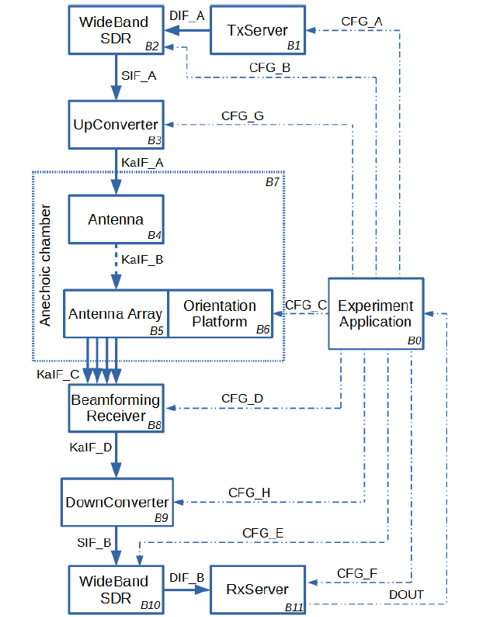
In the following picture the Testbed is represented.
The principal challenge of this project lies in identifying an effective compensation technique, translating it into a form that is both comprehensible and practical for software engineering and testbed integration, and subsequently implementing and validating it. This process demands advanced technical expertise but also the ability to bridge the gap between theoretical development and practical application.
Based on the publicly available state-of-the-art information gathered by the consortium, it appears that no existing commercial platforms currently offer receiver-side beam squint compensation that can be seamlessly integrated into user terminals. This represents a significant gap in current technologies. The development of this Activity is aimed to bridge this gap by solutions specifically tailored for receiver-side compensation, enhancing signal reliability.
This innovation aims at empowering user terminals with enhanced performance, making them more resilient and improving overall end-user experience.
The product’s key benefit can be connected to its architectural features.
The flexible signal processing methodology based on SDR, Rx server and the experiment application is central: it will be exploited to manage compensation and equalisation algorithms, and to handle impairments such as Doppler shift and rate.
The goal is that the receiver maintains optimal performance under dynamic conditions, enhancing reliability and resilience for end users. This capability is aimed at supporting signal quality, even as environmental factors change.
Although in this Activity the goal is to demonstrate the feasibility of the solution in a laboratory environment, the concept is compatible with user terminal platforms. This paves the way for future engineering and optimisation, which final goal is the integration of the solution without extensive upgrades.
The system diagram, which is depicted earlier, illustrates the system architecture. The core is the RX section, made up of an antenna array, which is controlled by a beamformer. The incoming signal from the antenna array is then down converted, to allow compatibility with the SDR operative RF frequency bands. This enable subsequent signal processing within the supported operational bandwidth. The SDR interfaces directly with a dedicated reception-side server, which acts as a bridge to the experimental application layer, ensuring seamless data flow and system integration. On the transmission side, which primarily functions as a testbed component, the setup includes a separate SDR, an upconverter, and a representative antenna, integrated to emulate the characteristics of the transmission chain for experimental validation and system testing purposes.
The project is structured into six technical Work Packages (WP1-6) and one dedicated to project management (WP0).
- WP1 – Requirements Review and Consolidation of System Scenarios
- WP2 – State-of-the-Art Analysis and Technical Specification
- WP3 – Verification System Design
- WP4 – Implementation and Verification Plan
- WP5 – Testbed Implementation and Test Results
- WP6 – Final Review and Development Plan
The project’s progress is tracked by three key Milestones (MS1–MS3), which correspond to the delivery and assessment of major outputs, and structured in 18 months.
The Project Kicked-off in September 2025.