
-
StatusOngoing
-
Status date2025-11-10
-
Activity Code5B.244
The project is the continuation of the previous Advanced Technology activity in which a breadboard model has been made and successfully designed and tested.
The project aims to develop in Europe the capability of providing the small satellite market (e.g. 3u to 27u CubeSat) with high-gain antennas enabling satellite-to-satellite or satellite-to-ground data link specifically oriented to low Earth orbit (LEO) constellations, LEO to geostationary Earth orbit (GEO) or LEO to Earth communications.
The antenna is conceived to be capable of operating in Ka-band.
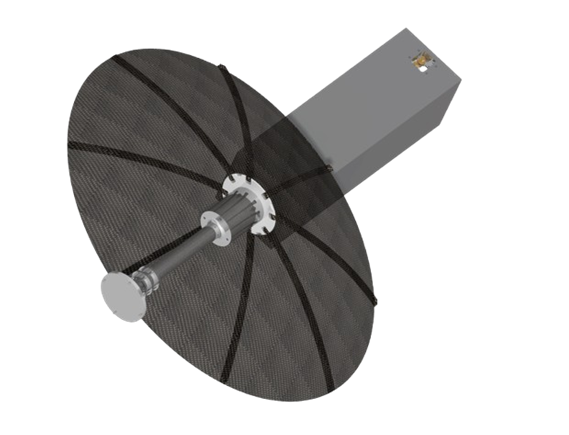
To compensate for the limited power available from small satellites, the gain of the deployed antenna is maximised. Additionally, the overall antenna system has to be compact, light and reliable, in particular the unfolding must allow the proper positioning of primary and secondary reflectors such that the intended performance is reached.
The antenna is intended to be simple to reduce possible criticalities during unfolding; this is intended for reducing costs (which is always a driver in particular for small satellites) with no reduction in performance.
The antenna system in launch configuration (folded) will fit into a 3u equivalent volume interfacing the satellite only through four bolts placed at the top (in the unfolding size). The electrical and data connections are placed at the bottom of the antenna‘s container.
The overall system architecture relies on a parabolic primary reflector actuated by four linear stepper motor actuators.
The overall duration of the programme is 24 months, reaching a target TRL of 6.
Initially, the activity involves a market survey to confirm the potential mission applications and requirements for such an antenna. Subsequently, detailed specifications are defined to ensure that the antenna meets market needs and is compatible with the target small satellite platforms. The activity then proceeds with the study and selection of the most suitable material for the realization of the primary Ka-band reflector. This is followed by a new detailed design phase and the testing of an engineering model.
The programme started on 3 March 2025. The following activities are currently presented:
- A market survey on deployable antennas;
- The definition of the system requirements;
- A survey on material used for deployable antenna.
the reflective surface material requirements definition for the Ka-band material that will be used to manufacture the reflective surface.